When Valentino Bompiani founded his publishing house in Milan in 1929—the year of the Wall Street crash—he launched an audacious campaign for literary cosmopolitanism that outwitted totalitarian censorship.

The autumn of 1929 was an unforgiving moment to launch a cultural business. On 29 October, the stock market in New York crashed, plunging the western world into the Great Depression. In Italy, the fascist regime was consolidating its monopoly over the press and culture, establishing strict censorship boards and promoting autarkic, nationalistic literature. Capital was timid, printing paper was expensive, and the reading public was notoriously small.
Yet in November 1929, in a small office in central Milan, thirty-one-year-old Count Valentino Bompiani (1898–1992) walked away from a secure executive post at Arnoldo Mondadori Editore. With ten thousand lire of personal savings and a staff of two, he incorporated Casa Editrice Valentino Bompiani & C.. While others retreated into safe classics, Bompiani took the opposite path: he set out to build a publishing house that was unabashedly modern, cosmopolitan, and intellectually uncompromising.
The smuggling of modern literature
Bompiani understood that books were not instruments of propaganda, but doors onto human consciousness. Surrounding himself with brilliant young translators and writers—most notably Elio Vittorini, Cesare Zavattini, and Corrado Alvaro—he began acquiring the Italian translation rights to Europe and America’s most daring voices.
His supreme gamble came in 1941 with Americana, a monumental anthology of contemporary American writers curated and translated by Vittorini. Featuring Ernest Hemingway, William Faulkner, John Steinbeck, and Erskine Caldwell, the volume was seized by the fascist Ministry of Popular Culture on the eve of distribution. Bompiani did not give up: using his aristocratic charm and political subtlety, he negotiated with the censors, agreed to add an ideological introduction by fascist critic Emilio Cecchi, and released the book. It sold out immediately, passing secretly from hand to hand among students and anti-fascist resistance fighters as a revelation of freedom and realism.
The visual page: Munari and the design of the book
Bompiani also transformed the physical aesthetics of the Italian book. Rejecting the solemn, grey typographical formats of nineteenth-century academic presses, he enlisted the avant-garde Futurist and designer Bruno Munari. Together, they invented dynamic covers featuring photo-montages, bold sans-serif lettering, and provocative full-bleed imagery. In series like Letteraria, Idee Nuove, and the monumental multi-volume Dizionario Letterario Bompiani, the book became an object of modern industrial design.
What remains today
Valentino Bompiani directed his imprint until 1972, leaving an indelible imprint on Italian cultural history. Today, the core memory of his venture is preserved at APICE (Archivi della Parola, dell’Immagine e della Comunicazione Editoriale) at the Università degli Studi di Milano: the Fondo Storico Valentino Bompiani holds thousands of typed letters with Albert Camus, Jean-Paul Sartre, T.S. Eliot, and Umberto Eco (who spent decades as senior editor at Bompiani, publishing *The Name of the Rose* here in 1980). Walking through Milan from Via Santa Sofia to the Galleria Vittorio Emanuele II, the imprint continues to symbolize the moment when Milanese publishing refused to look inward and opened its doors to the world.
Historic Views & Archives
From the Archives: Historical Newsreels
Milano anni Trenta: la vita culturale, Galleria e strade dell’editoria
Interwar documentary footage of central Milan, traversing Piazza Duomo, the bustling arcades of Galleria Vittorio Emanuele II, and the commercial boulevards where Valentino Bompiani opened his publishing firm in November 1929.
Visiting the Site: Street View & Modern Geography
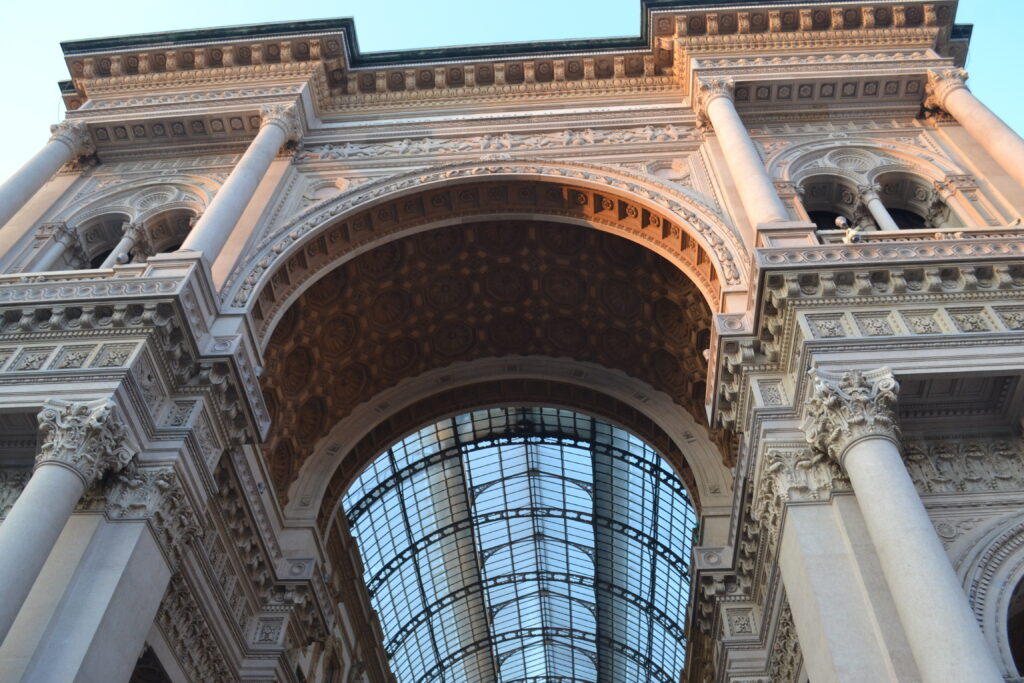
The intellectual and editorial heart of Valentino Bompiani was forged in the literary cafes of Galleria Vittorio Emanuele II and his publishing offices in central Milan. Here, writers and translators gathered beneath the iron-and-glass vaults to plan groundbreaking series and translate modern world literature.
Historic Address: Galleria Vittorio Emanuele II & Via Santa Sofia 8, 20121 Milano, Italy
Sources
- APICE – Università degli Studi di Milano, Fondo Storico Valentino Bompiani, Milan
- Valentino Bompiani, Via privata: Come si diventa editori, Milan, Mondadori, 1973
- Dizionario Biografico degli Italiani (Treccani), entry on Valentino Bompiani (Vol. 34)
- Gian Carlo Ferretti, Storia dell’editoria letteraria in Italia: 1945–2003, Turin, Einaudi, 2004