
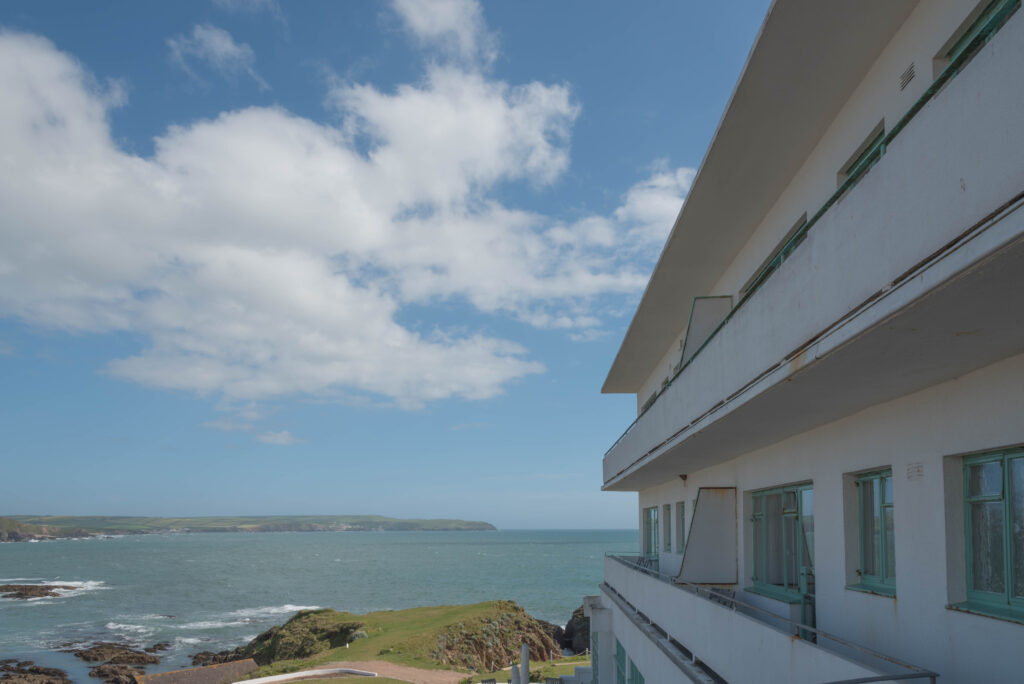

Agatha Christie wrote two novels in a beach house built for her under the cliff, and set both of them on the island she could see from its window.
At a glance
Burgh Island is a tidal island off the south Devon coast at Bigbury-on-Sea, reachable on foot at low water and by sea tractor when the causeway floods. Archibald Nettlefold, of Nettlefold Studios, bought the island in 1927 and built a substantial Art Deco hotel there, which opened in 1929 and became a fashionable destination through the 1930s. Additions followed, including a room made from the captain’s cabin of the warship HMS Ganges. During the Second World War it served as a recovery centre for wounded RAF personnel. It is Grade II listed and still a hotel.
Key facts
- Island bought: 1927, by Archibald Nettlefold of Nettlefold Studios
- Hotel built: opened 1929, in the Art Deco manner
- Additions: through the 1930s, including a room made from the captain’s cabin of HMS Ganges
- Guests: Agatha Christie, Noël Coward, Edward VIII with Mrs Simpson, Winston Churchill
- The Beach House: built for Agatha Christie, below the hotel in the rock face
- Written there: Evil Under the Sun and And Then There Were None, both set on islands
- Second World War: a recovery centre for wounded RAF personnel
- GPS: 50.279846, -3.898143 — View on Google Maps
History
Nettlefold made his money in film production and bought the island in 1927, at the moment when the English seaside was being reimagined for a wealthy, modern, car-owning clientele. An Art Deco hotel on a tidal island is a precise expression of that idea: exclusive by geography rather than by price alone, and cut off twice a day by the sea.
Christie’s association began through Nettlefold, who had backed several London stage productions of her work. The Beach House, set into the rock below the hotel, was built for her, and both island novels — Evil Under the Sun and And Then There Were None — were written there. The second is one of the best-selling novels ever published, and its premise depends entirely on a place you cannot leave.
The war ended the first era. The hotel became a recovery centre for wounded RAF personnel, and the island took bomb damage. It went through decline and restoration in the later twentieth century and now trades on its 1930s character, which is at least honestly earned.
What you see
A white, horizontal block with curved corners and metal-framed windows, sitting above the beach on a rock: the international seaside modern of the late 1920s, which reached England from the Continent and stayed near the water. The flat planes and the absence of pitched roofs are the point, and on a Devon headland they are still startling.
Go at a changing tide. The causeway floods, the sea tractor comes out on its high wheels, and the building detaches itself from the mainland. That is not a marketing device; it is the condition the hotel was designed around, and it explains the architecture better than any elevation drawing.
Practical information
- A working hotel; access to the island and the building is generally for guests and booked diners
- The sea tractor runs when the causeway is under water; at low tide you can walk across from Bigbury-on-Sea
- Check tide times before setting out — this is the one place where that advice is not decorative
Getting there
Bigbury-on-Sea is on the south Devon coast, about half an hour by road from Plymouth and an hour from Exeter. There is no railway station nearby; Plymouth is the nearest mainline stop, with buses and taxis onward.
Nearby
- The Kinema in the Woods — the other English survival of the interwar leisure boom
- Tyneside Cinema — 1937, and listed for the same reasons
Sources
- Wikipedia, « Burgh Island Hotel » and « Burgh Island » — the 1927 purchase by Archibald Nettlefold, the Art Deco hotel, the HMS Ganges cabin, the guests, the wartime recovery centre and the Grade II listing
- Burgh Island Hotel, own history pages — the Beach House built for Agatha Christie, the two island novels written there, and the Nettlefold connection through her stage productions
- OpenStreetMap Nominatim — coordinates verified against the hotel
Find it on the map
See this place and what’s around it →📷 Become a Cultural Heritage Online photographer
Share your photos of places: they stay published under your name as the author. The more they're seen, the more you get noticed — and soon a contest will reward the most appreciated photos.
Log in or sign up free to add a photoIs this page about you?
This page is read by travellers and heritage enthusiasts who find it on Google. Tell us how you are connected to this place and we will take it from there.