

Vytautas the Great made this island the capital of Lithuania in 1409 and died in it twenty-one years later. No army ever took it; a Russian one burned the town instead.
At a glance
Trakai Island Castle stands on the largest of three islands in Lake Galvė, west of Vilnius. Grand Duke Kęstutis began the stone castle in the second half of the fourteenth century, and his son Vytautas the Great completed the major works around 1409 — the year he made Trakai the capital of the Grand Duchy and moved the treasury and the state records there. Vytautas died in the castle in 1430. It was never taken in war. The town was plundered and burned by a Russian army in 1655 and the castles fell into ruin; restoration to the fifteenth-century form began in 1953 and was completed in 1987. The Trakai History Museum has held it since 1962.
Key facts
- Begun: second half of the fourteenth century, by Grand Duke Kęstutis
- Major works completed: around 1409, under Vytautas the Great
- Capital of Lithuania: from 1409, when the treasury and the Lithuanian Metrica were moved here
- Vytautas died here: 1430
- Never conquered: the castle was not taken by an enemy
- Destroyed: after 1655, when a Russian army burned the town
- Restored: from 1953; central palace rebuilt 1962; restoration completed 1987
- GPS: 54.652730, 24.933919 — View on Google Maps
History
Trakai was one of the principal centres of the Grand Duchy of Lithuania, the largest state in fifteenth-century Europe and the last in it to accept Christianity. An island site on a lake is a defensive proposition of a particular kind: it does not need high ground, it needs water and a bridge you can remove. The arrangement worked. Trakai was never taken.
Vytautas the Great, who made the castle his and the town the capital in 1409, is the central figure of Lithuanian statehood, and the fact that he died here in 1430 gives the building a symbolic weight it has never lost. The treasury and the Metrica — the chancery records of the Grand Duchy — were kept here, which is the practical measure of a capital.
The end came sideways. In 1655, during the wars with Muscovy, a Russian army plundered and burned the town of Trakai; the castles were wrecked and not rebuilt, and for three centuries the island held a ruin. The Soviet-era restoration, from 1953 to 1987, returned it to its fifteenth-century form — a reconstruction, and openly so, which is part of what a visitor should know before judging what they are looking at.
What you see
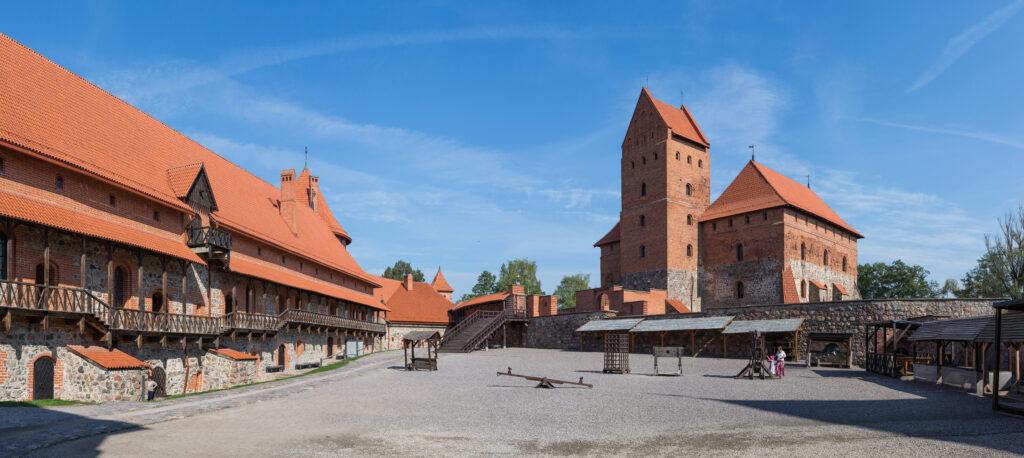
Red brick rising straight from the water, a ducal palace with a keep set behind a walled forecourt, and a wooden bridge as the only way in. The courtyard is the best place to read the building: galleries running round it in timber, the palace block on one side, the lake shut out entirely. Gothic brickwork of this kind is a Baltic language, shared with Malbork and the Hanseatic towns, and Trakai speaks it plainly.
Remember that most of what stands is reconstruction of 1953–1987. That does not make it worthless; it makes it a document of two moments at once, the fifteenth century it depicts and the twentieth that rebuilt it. The chapel and the museum halls inside hold medieval arms, chainmail and religious art.
Practical information
- Museum with regular opening hours; entry by ticket, and busy in high summer
- Reached on foot across the wooden bridges — allow time, the walk from the town is part of the visit
- Boats on Lake Galvė give the view of the castle that the photographs use
Getting there
Trakai lies about twenty-eight kilometres west of Vilnius. Trains and buses run from the capital in roughly half an hour, and the castle is a twenty-minute walk from Trakai station along the lake shore.
Nearby
- Zamek Biskupi, Janów Podlaski — a bishops’ seat on the old Polish-Lithuanian frontier
- Pałac Wojanów — the neo-Gothic house in Silesia
Sources
- Wikipedia, « Trakai Island Castle » — the construction under Kęstutis and Vytautas, the move of the capital in 1409, Vytautas’s death in 1430, the destruction after 1655, the restoration from 1953 to 1987 and the museum since 1962
- Trakų istorijos muziejus (Trakai History Museum), own pages on the island castle — the building and the collections
- Trakai tourism board — access and visiting
- OpenStreetMap Nominatim — coordinates verified against the island castle
Find it on the map
See this place and what’s around it →📷 Become a Cultural Heritage Online photographer
Share your photos of places: they stay published under your name as the author. The more they're seen, the more you get noticed — and soon a contest will reward the most appreciated photos.
Log in or sign up free to add a photoIs this page about you?
This page is read by travellers and heritage enthusiasts who find it on Google. Tell us how you are connected to this place and we will take it from there.