

A Prussian king gave this estate to his daughter in 1839. Whether the man who shaped it was Schinkel himself is a question Silesian scholars have been arguing over for a century.
At a glance
Wojanów sits in the Jelenia Góra basin, at the foot of the Karkonosze mountains, in the cluster of country houses now marketed as the Valley of Palaces and Gardens. Karl Albrecht Ike modernised the house and laid out a landscape park in 1832–33, in a neo-Gothic version of classicism drawn by an architect of Karl Friedrich Schinkel’s circle. In 1839 Princess Louise, daughter of King Frederick William III of Prussia and by marriage a princess of the Netherlands, received the estate from her father, and the house was adapted again for royal use. The park was reworked to plans by Peter Joseph Lenné. It is a hotel today.
Key facts
- Estate taken over: 1817, by Karl Sigismund von Rothkirch
- Modernised: 1832–1833, for Karl Albrecht Ike, with a new landscape park
- Style: a neo-Gothic variant of classicism, by an architect of Schinkel’s circle — the attribution to Schinkel himself is disputed
- Royal owner: Princess Louise, from 1839, a gift from her father Frederick William III of Prussia
- Later rebuilding: attributed to a scheme by either Friedrich August Stüler or Hermann Wentzel
- Park: reworked in the 1830s–40s to plans by Peter Joseph Lenné
- GPS: 50.875483, 15.814946 — View on Google Maps
- Today: hotel and conference venue
History
The Jelenia Góra valley became fashionable with the Prussian court in the early nineteenth century, and a run of estates there were rebuilt within a generation of each other. Wojanów belongs to that wave. Rothkirch took it over in 1817; Ike modernised the house and made the park in 1832–33, in the pale, castellated manner that Berlin had made respectable.
Who drew it is the interesting part. Günter Grundmann, the leading pre-war authority on Silesian architecture, gave the rebuilding to Karl Friedrich Schinkel. Later scholars have pulled back: Schinkel may have influenced the appearance in part, but the house is not his work. What is agreed is that the designer came from his circle, which in Prussia in the 1830s was a large and well-trained group. We record the disagreement rather than settle it.
In 1839 the estate passed to Princess Louise, and the house was adapted for a royal household; the sources name Friedrich August Stüler and Hermann Wentzel as the authors of the two competing schemes, without agreeing which was built. Peter Joseph Lenné, the most important Prussian landscape designer of the century, reworked the grounds. After 1945 the estate declined, as most Silesian houses did, and it was restored and converted to a hotel in the 2000s.
What you see
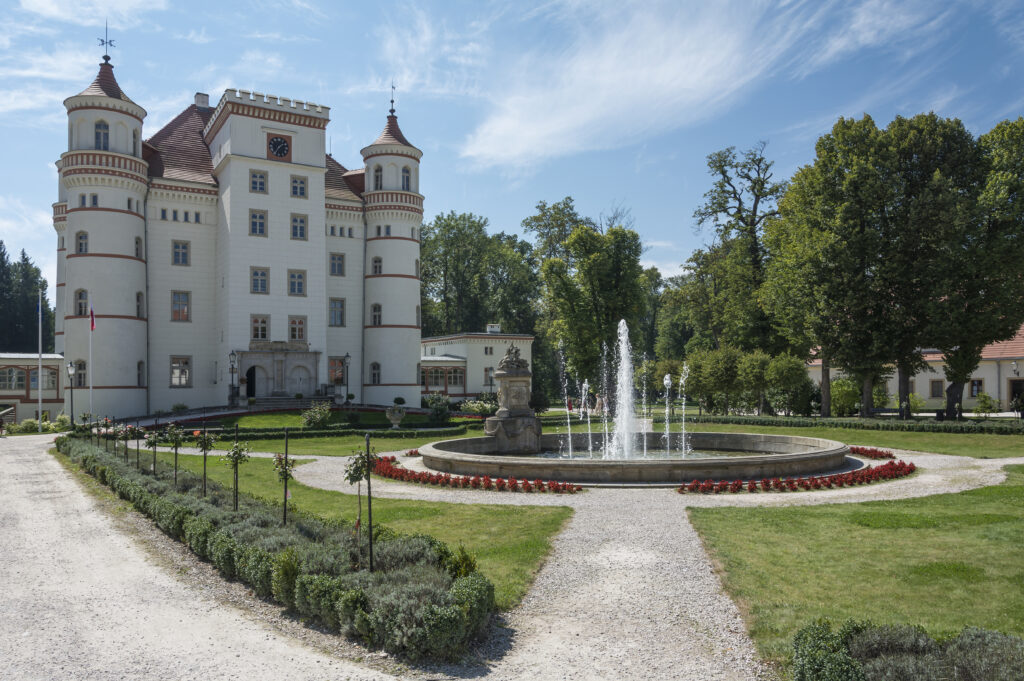
A pale, broad, two-storey block with corner towers and battlemented parapets: neo-Gothic in its details, classical in its symmetry and its calm. This is the Prussian compromise of the 1830s, romantic silhouette on a rational plan, and Wojanów is one of the clearest examples of it left standing.
Read the house from the park rather than the drive. Lenné’s planting was designed to give the building to you in stages, through openings in the tree cover, with the Karkonosze behind. The towers are there to be seen at that distance, against those mountains; close up they do very little.
Practical information
- A working hotel — the grounds and the exterior are the public part of the experience
- Part of the Valley of Palaces and Gardens, a signposted route through the Jelenia Góra basin; several neighbouring houses can be seen in a day
- Best in late spring or autumn, when the park is legible and the mountains are clear
Getting there
Wojanów lies in the commune of Mysłakowice, about ten kilometres east of Jelenia Góra in south-western Poland. Jelenia Góra has rail connections to Wrocław, roughly two hours away; the valley is easiest with a car.
Nearby
- Książ Castle — the largest castle in Silesia, an hour west
- Kamieniec Ząbkowicki Palace — the great neo-Gothic palace built for the same Prussian royal circle
Sources
- Wikipedia (Polish), « Pałac w Wojanowie » — the 1817 and 1832–33 phases, the Schinkel attribution and the scholarly disagreement over it, Princess Louise’s acquisition in 1839, the Stüler and Wentzel schemes, Lenné’s park
- Pałac Wojanów, own history pages — ownership and the modern restoration
- Europejski Szlak Zamków i Pałaców — the house within the Valley of Palaces and Gardens
- OpenStreetMap Nominatim — coordinates verified against the palace
Note for the record: the design has been attributed to Karl Friedrich Schinkel and that attribution is contested. We have not asserted it.
Find it on the map
See this place and what’s around it →📷 Become a Cultural Heritage Online photographer
Share your photos of places: they stay published under your name as the author. The more they're seen, the more you get noticed — and soon a contest will reward the most appreciated photos.
Log in or sign up free to add a photoIs this page about you?
This page is read by travellers and heritage enthusiasts who find it on Google. Tell us how you are connected to this place and we will take it from there.