
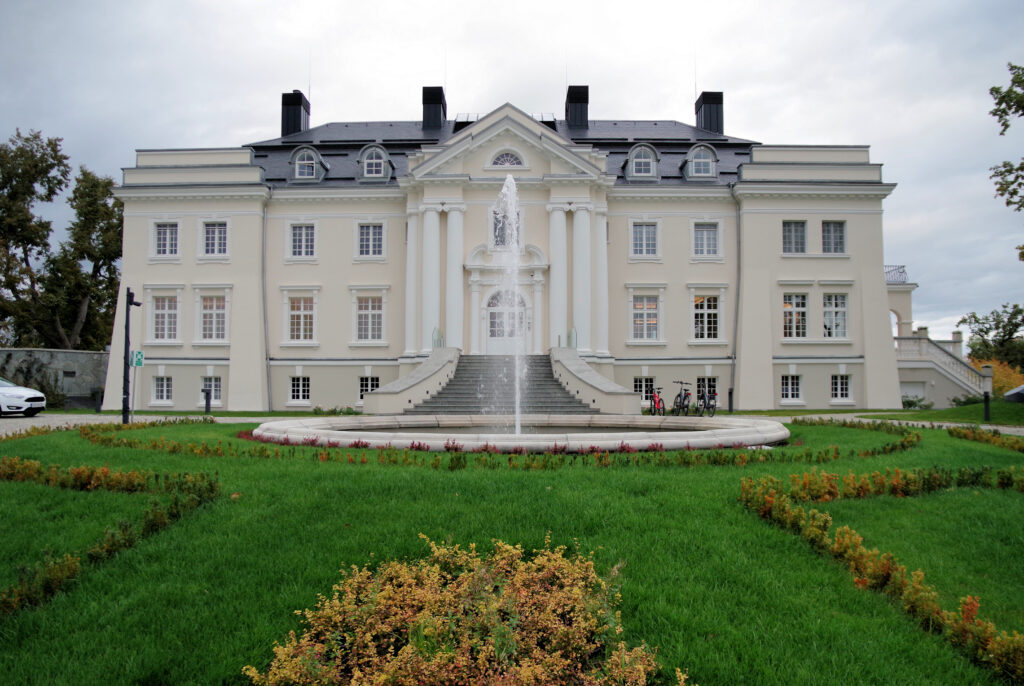

Three rebuildings, three styles, and the same family holding the deeds each time. The Komierowskis trace their claim to this ground back a thousand years.
At a glance
Komierowo lies in the Krajna country of northern Poland, in Kuyavia-Pomerania. The estate has been held by the Komierowski family, of the Pomian arms, for centuries; the family takes its name from the village. Piotr Komierowski built a single-storey Baroque manor here in 1680. At the turn of the nineteenth and twentieth centuries Roman Komierowski had it rebuilt as a palace in a pseudo-Gothic manner to a design by Wiktor Stabrowski, and between 1924 and 1929 Tomasz Komierowski extended it again to designs by the architect Stanisław Cybichowski, which gave the house its present neo-Baroque and classicising character. The palace complex is a protected monument and stands in a large park.
Key facts
- 1680: single-storey Baroque manor, built by Piotr Komierowski
- Around 1900: rebuilt as a pseudo-Gothic palace for Roman Komierowski, designed by Wiktor Stabrowski
- 1924–1929: extended for Tomasz Komierowski to designs by Stanisław Cybichowski
- Present character: neo-Baroque with classicising elements
- Family: the Komierowski family, of the Pomian coat of arms, which takes its name from the village
- Protected: the palace complex is entered in the Polish register of monuments (A/214/1-4)
- Setting: an extensive park
- GPS: 53.451763, 17.651423 — View on Google Maps
History
The family story reaches back to the tenth century: tradition has it that a Bohemian knight, Sobiesław Bossuta, came to Poland in 965 in the retinue of Princess Dobrawa and received lands in Krajna, Włościbórz and Komierowo among them. The family then took its surname from the village rather than the other way round. That is tradition, not documented record, and we give it as such — but the continuity of tenure through the modern centuries is real and unusual.
The building history is a sequence of three decisions. In 1680 Piotr Komierowski built a modest Baroque manor of one storey. Around 1900 Roman Komierowski, a landowner and politician, had that manor turned into a pseudo-Gothic palace by Wiktor Stabrowski — the romantic choice a Polish gentry family might make under Prussian rule, when architecture carried national argument.
The last campaign is the one that shaped what stands. Between 1924 and 1929, in the first decade of restored Polish independence, Tomasz Komierowski commissioned Stanisław Cybichowski to extend and recast the house in a neo-Baroque and classicising manner. After the Second World War the estate was lost to the family and declined; it has since been restored, and the family name is once again attached to it.
What you see
A broad, pale, symmetrical front with the measured pilasters and heavy cornice of the 1920s neo-Baroque: interwar Poland’s idea of what a country house should look like when the country had just become a country again. Almost nothing of the pseudo-Gothic phase survives on the outside, which is the fate of most intermediate campaigns.
The 1680 manor is underneath, in the plan and in the lower structure, and the park around the house is what holds the phases together. Approach from the west, which is the front the family photographed after the restoration, and the composition reads as Cybichowski intended.
Practical information
- The palace operates as a hotel and events venue; the park is part of the estate
- Check opening before travelling, as private events can close the house
- Krajna is a quiet region of lakes and forest, best reached by car
Getting there
Komierowo is in the commune of Sępólno Krajeńskie, in Kuyavia-Pomerania, roughly midway between Bydgoszcz and Chojnice in northern Poland. Bydgoszcz is the nearest large station, about an hour away by road.
Nearby
- Pałac Mierzęcin — the English neo-Gothic house of the 1860s, west of here
- Pałac Wojanów — the Prussian royal house in the Jelenia Góra valley
- Abbot’s Palace, Oliwa — on the Baltic coast, north of Krajna
Sources
- Pałac Komierowo, own family-history and palace pages — the family tradition, the 1680 manor, the rebuilding around 1900 by Wiktor Stabrowski for Roman Komierowski, and the 1924–1929 extension by Stanisław Cybichowski for Tomasz Komierowski
- Zabytek.pl, entry for the Komierowo palace complex — protected status
- Polskie Zabytki, catalogue entry for Komierowo — building phases
- OpenStreetMap Nominatim — coordinates verified against Komierowo
Note for the record: the family’s descent from a knight arriving in 965 is a family tradition, not a documented fact, and is presented here as tradition.
Find it on the map
See this place and what’s around it →📷 Become a Cultural Heritage Online photographer
Share your photos of places: they stay published under your name as the author. The more they're seen, the more you get noticed — and soon a contest will reward the most appreciated photos.
Log in or sign up free to add a photoIs this page about you?
This page is read by travellers and heritage enthusiasts who find it on Google. Tell us how you are connected to this place and we will take it from there.