
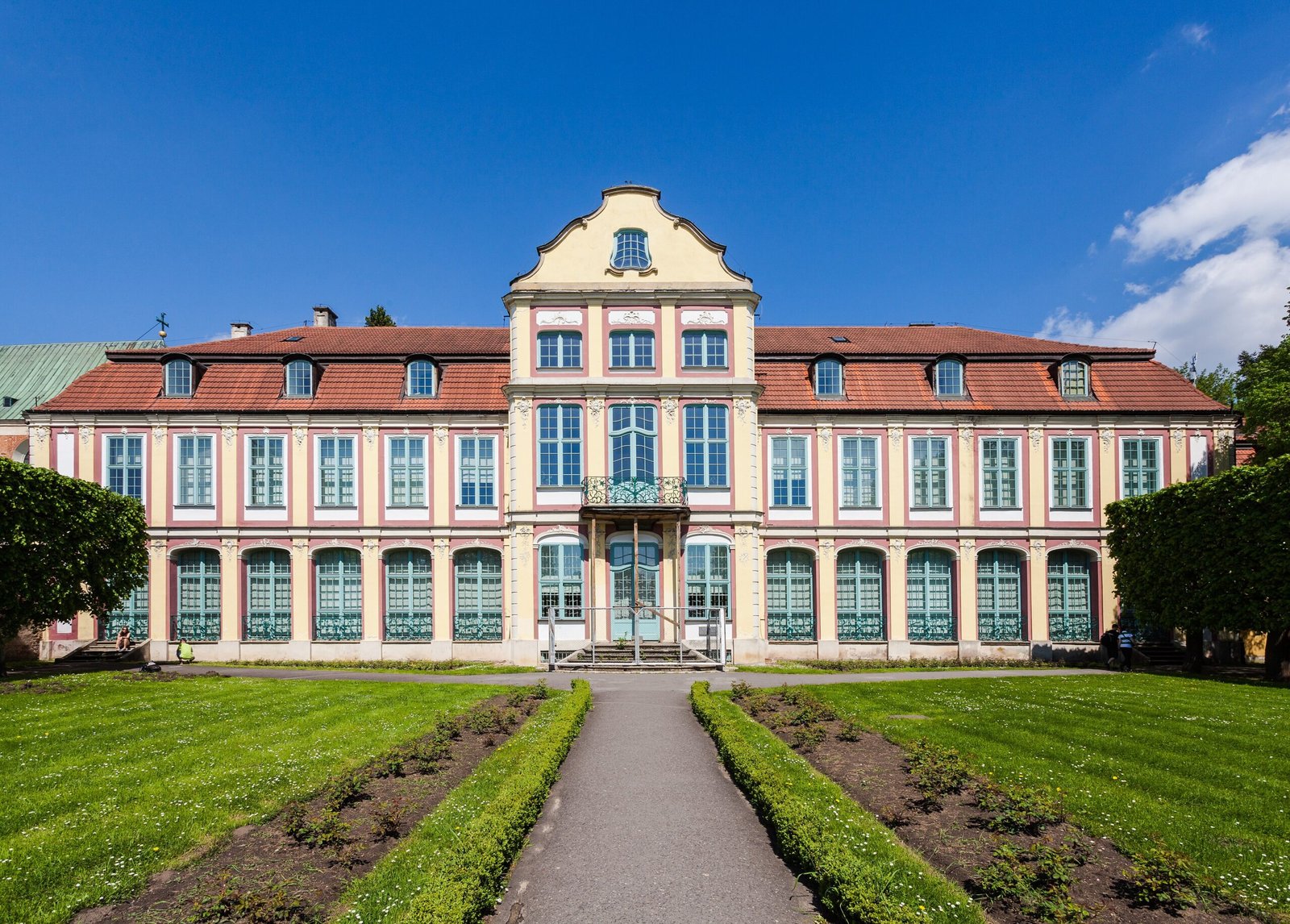
A refined rococo residence in Oliwa, once home to Cistercian abbots, now housing Poland’s modern art collections.
At a glance
The Abbot’s Palace stands as a masterpiece of rococo design in Oliwa, a historic district of Gdańsk. Originally the residence of Cistercian abbots, it has been transformed into a cultural institution and remains one of Poland’s protected monuments.
History
Built as the residence for the abbots of Oliwa’s Cistercian monastery, the palace reflects centuries of ecclesiastical patronage and architectural refinement. It has been preserved as a Historic Monument of Poland, standing witness to the region’s religious and cultural heritage.
What you see
The palace exemplifies rococo elegance with refined proportions and decorative detail characteristic of the period. Its design balances grandeur with residential comfort, featuring the ornamental flourishes and sophisticated spatial arrangements that define the rococo aesthetic.
Cultural significance
Today the palace functions as the Department of Modern Art of the National Museum in Gdańsk, bridging its historical role with contemporary cultural life. Its designation as a Historic Monument underscores its importance within Poland’s architectural and ecclesiastical landscape, particularly in relation to the adjoining Cistercian-Cathedral complex.
Key facts
- Location: Oliwa, Gdańsk, Poland
- Coordinates: 54.41083333°N, 18.56027778°E
- Architectural style: Rococo
- Current use: Department of Modern Art, National Museum in Gdańsk
- Status: Historic Monument of Poland
Practical information & getting there
The palace is accessible as part of the National Museum in Gdańsk. Located in the Oliwa district, it stands adjacent to the Cistercian-Cathedral complex. For visiting hours and current exhibitions, consult the museum’s official website.
Sources & resources
Find it on the map
See this place and what’s around it →📷 Become a Cultural Heritage Online photographer
Share your photos of places: they stay published under your name as the author. The more they're seen, the more you get noticed — and soon a contest will reward the most appreciated photos.
Log in or sign up free to add a photoIs this page about you?
This page is read by travellers and heritage enthusiasts who find it on Google. Tell us how you are connected to this place and we will take it from there.