
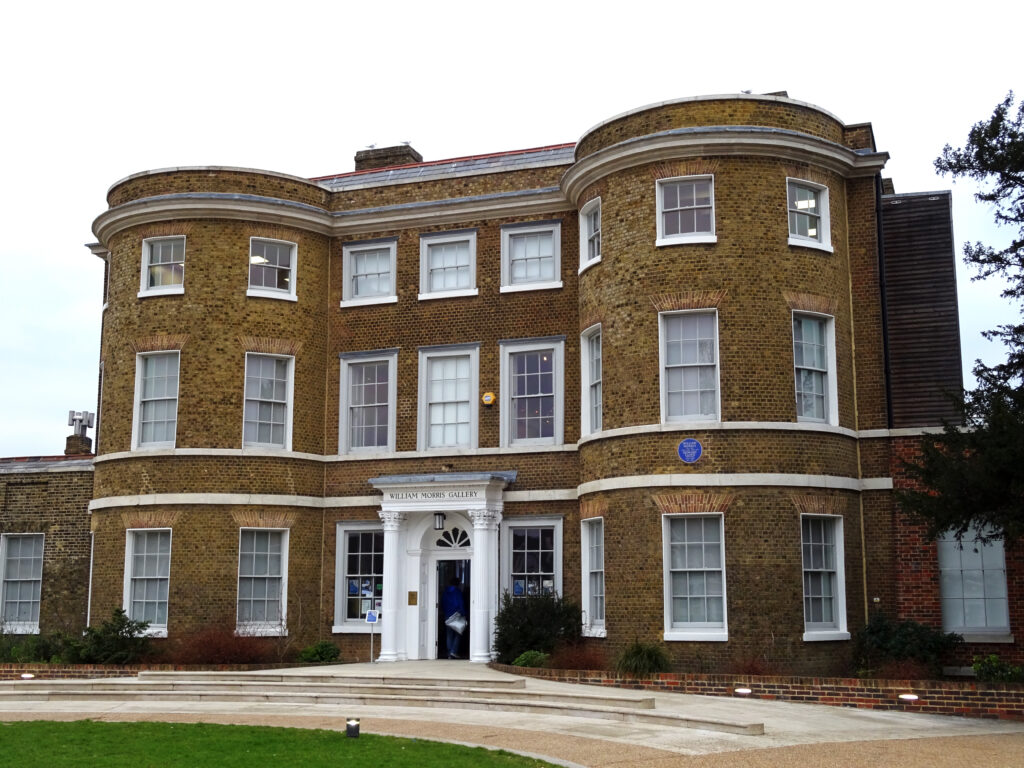

Morris lived in this house between the ages of fourteen and twenty-two. It is the only public museum anywhere devoted to him, and it stands in the garden his family once had to themselves.
At a glance
The gallery occupies the Water House on Forest Road in Walthamstow, a substantial Georgian brick house of the mid-eighteenth century, Grade II* listed. William Morris’s widowed mother moved the family here in 1848, and William lived in it until 1856. The house later belonged to the newspaper proprietor Edward Lloyd and then his son Frank, who in 1900 gave the house and ten acres of ground to the Walthamstow district council — which is how the private garden became Lloyd Park. The museum holds the national collection devoted to Morris, his firm and his circle.
Key facts
- The house: Georgian, mid-1740s by a date carved in one of its bricks; the national listing records 1762, altered and restored
- Earlier names: The Winns, and the Water House — from the ornamental moat in the garden
- Morris here: 1848 to 1856, from the age of fourteen to twenty-two
- Later owners: Edward Lloyd, newspaper proprietor, then his son Frank Lloyd
- Given to the public: 1900, house and ten acres, by Frank Lloyd — hence Lloyd Park
- Protected: Grade II* listed
- Admission: free
- GPS: 51.591294, -0.020295 — View on Google Maps
History
Morris’s father died in 1847 and the family moved to Walthamstow the following year, into a house that was already a century old and considerably grander than their reduced circumstances suggested. The moat, the garden and the Essex edge of London are the landscape of his adolescence, and they matter: the pattern designer who spent his life arguing for the countryside against the factory formed that argument here, on the boundary between the two.
The family left in 1856, the year Morris came of age and went into architecture. The house passed to Edward Lloyd, who had made a fortune from cheap fiction and then from the Daily Chronicle. In 1900 his son Frank handed the house and grounds to the local council, at a moment when English towns were acquiring parks in earnest.
The gallery opened in 1950. It holds textiles, wallpapers, furniture, stained glass and the archive of Morris & Co., together with work by the Pre-Raphaelites and by Frank Brangwyn, who gave a large part of the founding collection. Admission has always been free.
What you see
A plain, well-proportioned Georgian front of brown brick, five bays wide, with a modest doorcase. It is a merchant’s house rather than a gentleman’s seat, which is the point: this is the architecture of the London hinterland in the 1740s, and Morris grew up inside it before he ever saw a medieval building.
Go round to the park side. The moat that gave the house its name survives as water in the grounds, and the ten acres Frank Lloyd gave away still read as a garden rather than a municipal park. Inside, the galleries are modern insertions, but the plan of the Georgian house is still legible as you move between rooms.
Practical information
- Free admission; closed on some weekdays, so check before travelling
- Lloyd Park surrounds the house and is open daily
- Allow two hours for the collection; the Morris & Co. textiles alone repay a slow visit
Getting there
Forest Road runs east–west across Walthamstow in north-east London. Walthamstow Central, on the Victoria line and the Overground, is about ten minutes on foot; Blackhorse Road is a similar distance to the west.
Nearby
- Wightwick Manor — the Arts and Crafts house furnished throughout by Morris & Co.
- Sambourne House — Morris wallpapers in a Kensington terrace, left as the family had them
Sources
- Wikipedia, « William Morris Gallery » — the house and its names, the Morris family’s occupancy from 1848 to 1856, the Lloyd ownership and the gift of 1900, the collection and free admission
- Historic England, list entry 1065620, The Water House, Lloyd Park — Grade II* designation and the recorded date
- London Borough of Waltham Forest, gallery pages — opening and current arrangements
- OpenStreetMap Nominatim and Wikipedia coordinates, cross-checked — location
Find it on the map
See this place and what’s around it →📷 Become a Cultural Heritage Online photographer
Share your photos of places: they stay published under your name as the author. The more they're seen, the more you get noticed — and soon a contest will reward the most appreciated photos.
Log in or sign up free to add a photoIs this page about you?
This page is read by travellers and heritage enthusiasts who find it on Google. Tell us how you are connected to this place and we will take it from there.