
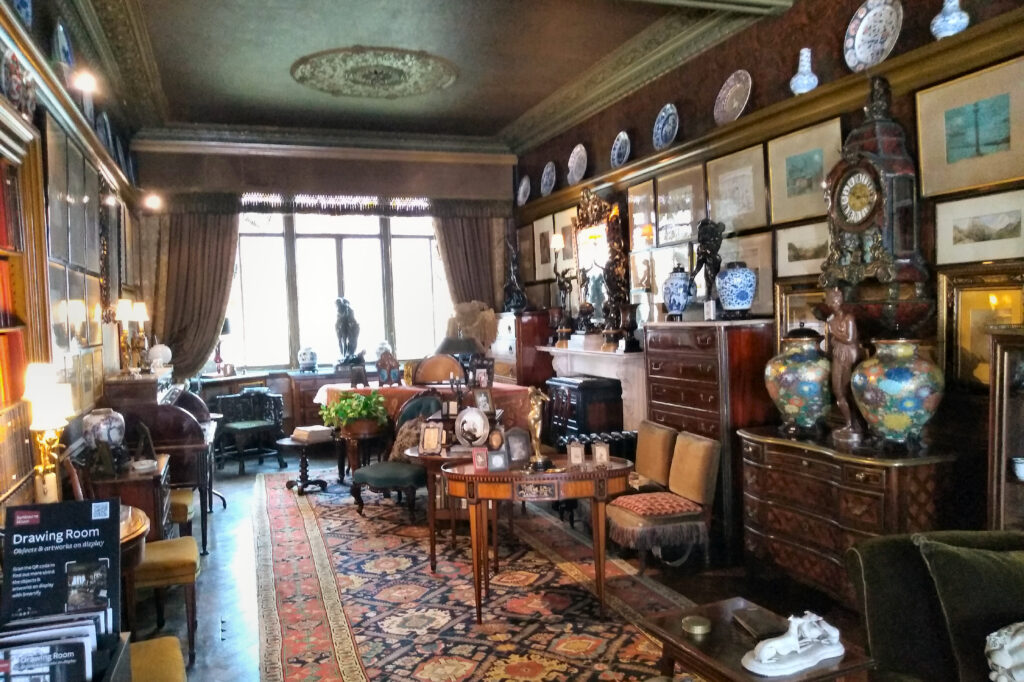

A Punch cartoonist and his wife decorated their new London house in 1875 and then, in effect, stopped. The rooms are still theirs.
At a glance
Sambourne House, long known as 18 Stafford Terrace, was the home of Edward Linley Sambourne (1844–1910), the Punch illustrator, and his wife Marion. They moved into an almost new terraced house in 1875 and decorated it in the Aesthetic manner: William Morris wallpapers, stained glass with sunflower motifs, blue-and-white Chinese export porcelain, pictures hung close. The family left the interiors substantially untouched, so the house survives as a rare complete example of middle-class Aestheticism. It is Grade II* listed, opened to the public by the Victorian Society in 1980, and has belonged to the Royal Borough of Kensington and Chelsea since 1989.
Key facts
- Occupied by the Sambournes from: 1875, when the house was almost new
- Edward Linley Sambourne: 1844–1910, illustrator and cartoonist for Punch
- Style of decoration: the Aesthetic Movement, in its middle-class form
- Interiors include: William Morris wallpapers, sunflower stained glass, blue-and-white Chinese export porcelain
- Protected: Grade II* listed
- Opened to the public: 1980, by the Victorian Society
- Owner since 1989: Royal Borough of Kensington and Chelsea
- GPS: 51.500485, -0.196875 — View on Google Maps
History
The Aesthetic Movement is usually told through its grand houses and its famous quarrels. Stafford Terrace is the other version: what the new taste looked like when a successful professional and his wife applied it to a standard London terrace, on a budget, in the year they married into their own household.
Sambourne drew for Punch for over forty years, ending as its chief political cartoonist. He was also a serious amateur photographer, and the house holds his negatives along with the family papers. That archive is part of why the place matters: it is unusual to have both the rooms and a detailed record of the people who used them.
The interiors survived because the family stayed and changed little. The Victorian Society opened the house to visitors in 1980 — the Society had in fact been founded in this drawing room in 1958, by Sambourne’s granddaughter Anne Messel, Countess of Rosse. The borough took ownership in 1989.
What you see
An ordinary Italianate stucco terrace front, and behind it rooms of extraordinary density. Pictures are hung frame to frame up the walls, the Morris papers run behind them, stained glass filters the light in the stairwell, and porcelain occupies every ledge. Aestheticism at this level was an accumulative practice, not a minimal one.
Look at the way the pictures are arranged rather than at any single one. Sambourne hung his own drawings, photographs and prints as a working reference collection, and the walls are effectively a cartoonist’s archive turned into decoration. The sunflower, the movement’s badge, recurs in the glass.
Practical information
- A house museum with limited opening — check days and book, as capacity is small
- Guided visits are the usual format and are worth taking; the interiors are dense and reward explanation
- Leighton House, the other great Kensington artist’s house, is managed by the same borough and is a natural pairing
Getting there
Stafford Terrace lies on the Phillimore Estate in Kensington, west London. High Street Kensington station, on the District and Circle lines, is about five minutes on foot; Holland Park is a short walk north.
Nearby
- Wightwick Manor — the Arts and Crafts house in the Midlands, furnished from the same Morris catalogue
- William Morris Gallery — Morris’s own boyhood home in Walthamstow
Sources
- Wikipedia, « 18 Stafford Terrace » and « Sambourne House » — the Sambournes’ arrival in 1875, Linley Sambourne’s dates and career, the Aesthetic decoration, the Morris papers, sunflower glass and porcelain, the Grade II* listing, the opening in 1980 and the transfer to the borough in 1989
- The Victorian Web, entry on 18 Stafford Terrace — the interiors and their survival
- OpenStreetMap Nominatim — coordinates verified against Stafford Terrace
Find it on the map
See this place and what’s around it →📷 Become a Cultural Heritage Online photographer
Share your photos of places: they stay published under your name as the author. The more they're seen, the more you get noticed — and soon a contest will reward the most appreciated photos.
Log in or sign up free to add a photoIs this page about you?
This page is read by travellers and heritage enthusiasts who find it on Google. Tell us how you are connected to this place and we will take it from there.