
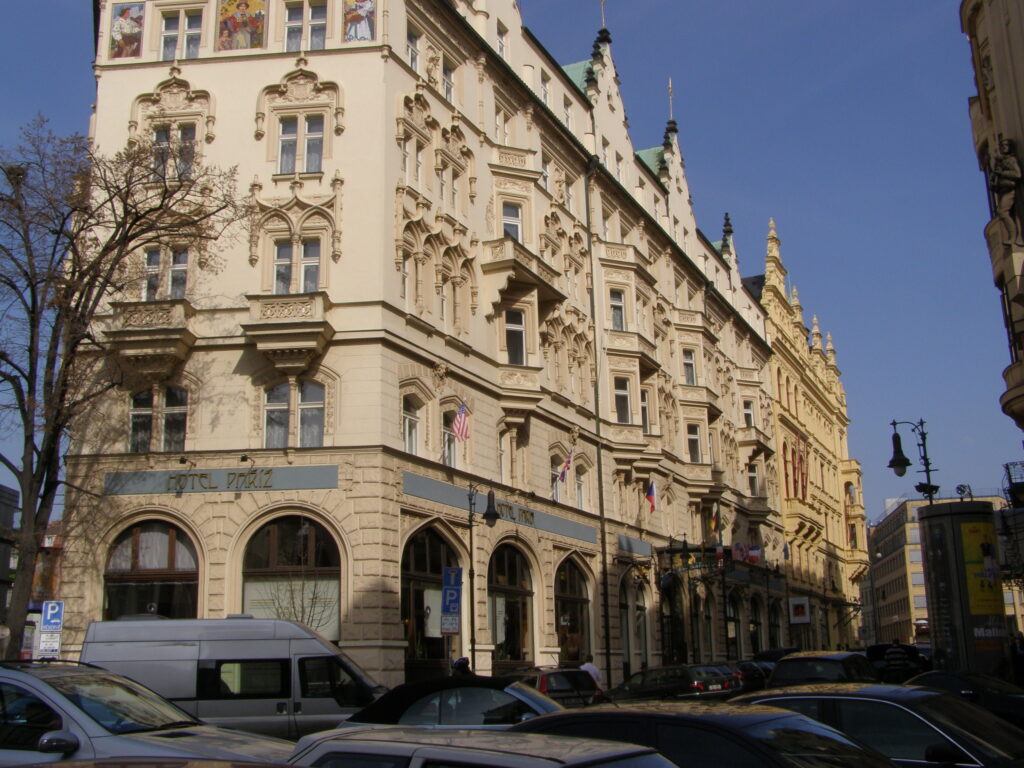

Jan Vejrych gave Prague a hotel that argues with itself: Gothic revival outside, early Secession inside, built in the three years when the city was deciding which century it belonged to.
At a glance
The Hotel Paříž stands on U Obecního domu, at the head of a block beside the Municipal House in Prague’s Old Town. It was built between 1904 and 1907 to designs by Jan Vejrych, in a mixture of Gothic Revival and early Secession — the Czech branch of Art Nouveau. The café and restaurant interiors were the work of Antonín Pfeiffer, and the ceramic mosaics on the outside were made by the painter Jano Köhler. It was declared a cultural monument in 1984 and lies inside the UNESCO-listed historic centre. Three generations of the Brandejs family have been associated with it.
Key facts
- Built: 1904–1907
- Architect: Jan Vejrych
- Interiors of café and restaurant: Antonín Pfeiffer
- External ceramic mosaics: Jano Köhler, painter
- Style: Gothic Revival outside, early Secession in the detail and interiors
- Protected: declared a cultural monument in 1984; within the UNESCO-listed historic centre of Prague
- In literature: a setting in Bohumil Hrabal’s I Served the King of England
- GPS: 50.088114, 14.427459 — View on Google Maps
History
Prague between 1904 and 1907 was building the Municipal House next door, the great statement of Czech Secession, and the hotel went up in its shadow and at the same moment. Vejrych’s answer was not to compete in the same idiom. He gave the hotel a neo-Gothic frame, with the turrets and the vertical emphasis of a revivalist civic building, and let the Secession into the ornament and the interiors.
That division of labour is why two other names matter here. Antonín Pfeiffer, who later worked with Osvald Polívka, made the café and restaurant rooms; Jano Köhler, a painter better known for church decoration in Moravia, made the ceramic mosaics on the exterior. A building of this date in Prague is rarely the work of one hand, and the Paříž wears its collaboration openly.
The hotel was declared a cultural monument in 1984, while the country was still socialist and such designations were the main protection available. Bohumil Hrabal used it as a setting in I Served the King of England, which has done more for its reputation abroad than any architectural guide.
What you see
From the street the building reads Gothic: pointed openings, turrets, a skyline broken deliberately, the whole massed to close the end of its block. Then the detail undercuts it. The mosaics, the metalwork and the lettering are Secession, and the closer you stand the less medieval the building becomes.
The café and restaurant rooms are the reason to go inside. Pfeiffer worked in the early Secession manner, before it hardened into a style, and the rooms keep the lightness of that moment. Stand at the corner where the hotel faces the Municipal House and you can see the two buildings arguing: one committed to the new century, the other hedging.
Practical information
- A working hotel; the café and restaurant are open to non-residents and are the way to see the interiors
- The exterior and the mosaics are visible from the street at any hour
- The Municipal House next door is open for guided tours and is the essential companion visit
Getting there
U Obecního domu runs beside the Municipal House at Náměstí Republiky, on the edge of the Old Town. Náměstí Republiky metro station is a minute away on line B; the Old Town Square is five minutes on foot.
Nearby
- Prague — Alphonse Mucha and the Art Nouveau Legacy — the CHO city guide
- Peterka House — Jan Kotěra’s 1899 building on Wenceslas Square
- Alfons Mucha Museum — ten minutes away
Sources
- Wikipedia, « Hotel Paris (Prague) » — the construction years, Jan Vejrych, Antonín Pfeiffer’s interiors, Jano Köhler’s mosaics, the 1984 monument declaration, the Hrabal connection
- Prague.eu, official city tourism — the building’s style and its place in the UNESCO-listed centre
- Hotel Paříž, own pages — the Brandejs family association
- OpenStreetMap Nominatim — coordinates verified against U Obecního domu
Find it on the map
See this place and what’s around it →📷 Become a Cultural Heritage Online photographer
Share your photos of places: they stay published under your name as the author. The more they're seen, the more you get noticed — and soon a contest will reward the most appreciated photos.
Log in or sign up free to add a photoIs this page about you?
This page is read by travellers and heritage enthusiasts who find it on Google. Tell us how you are connected to this place and we will take it from there.