
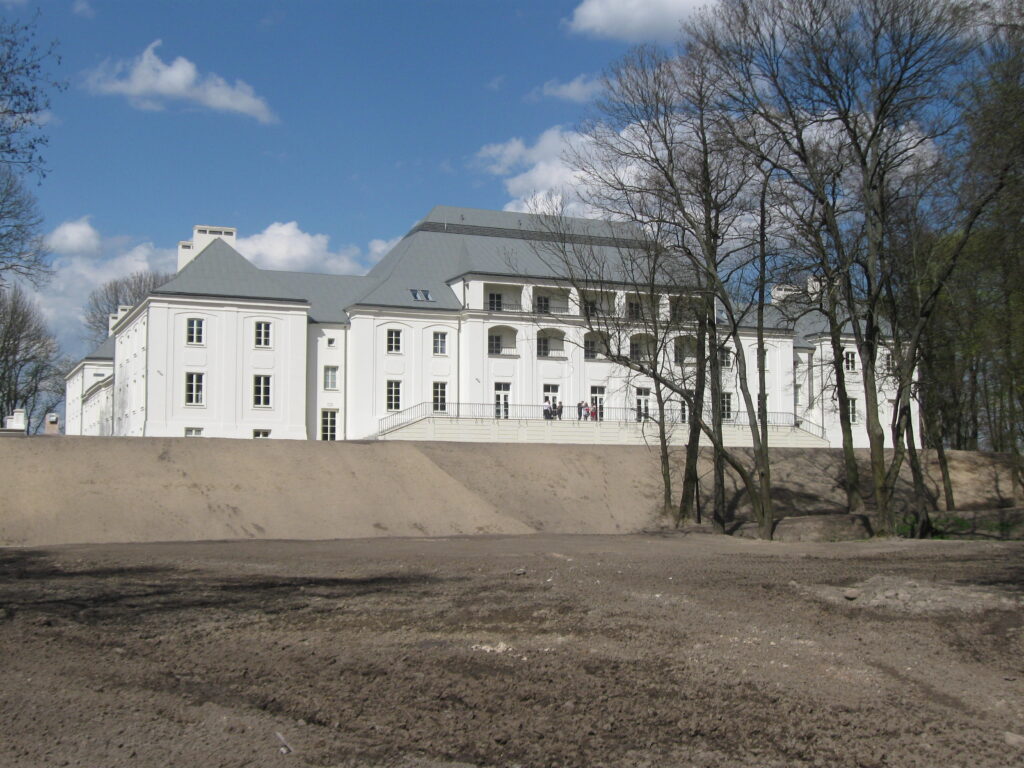

Bishops held this mound from the fifteenth century. The Swedes burned what stood on it in 1657, and what replaced it, a century later, was not a fortress but a country palace.
At a glance
Janów Podlaski lies in eastern Poland, close to the Belarusian border, and its castle was the residence of the bishops of Łuck and later of Podlasie. A bishops’ seat existed here from the fifteenth century; the Swedish invasion of 1657 destroyed it. Between 1770 and 1780, at the initiative of Bishop Feliks Paweł Turski, a Late Baroque palace went up in its place, inside a moat, with an English-style park, farm buildings and ponds around it. Two free-standing rectangular pavilions were built on the castle mound, and the eastern wing sits partly on older foundations. The complex has been restored and works as a hotel.
Key facts
- Bishops’ seat from: the fifteenth century
- Destroyed: 1657, by the Swedish invasion
- Rebuilt: 1770–1780, at the initiative of Bishop Feliks Paweł Turski
- Style: Late Baroque
- Setting: moat, English-style park, farm buildings and ponds
- Structures: two free-standing rectangular pavilions on the mound; the eastern wing partly on older foundations, with earlier earthworks preserved
- Address: ul. Zamkowa 1, Janów Podlaski
- GPS: 52.197893, 23.200605 — View on Google Maps
History
Janów took its name and its importance from the bishops of Łuck, who made it a residence in the fifteenth century. For two hundred years it was a fortified seat on a difficult frontier, which is what the mound and the earthworks are for. The Swedish campaign of 1657 — the war Polish memory calls the Deluge — burned it.
The rebuilding, more than a century later, tells you how the country had changed. Bishop Turski did not restore a castle. He commissioned a Late Baroque palace with a park laid out in the English manner, a fashion that had reached Poland from the west within a generation. The moat stayed, but by 1780 it was scenery rather than defence.
Janów Podlaski is better known internationally for its stud farm, founded in 1817 and still one of the most important Arabian horse studs in the world. The castle and the stud are separate institutions with a shared history: the same estate, the same frontier landscape, the same reason for being here. The castle complex was restored in recent years and reopened as a hotel.
What you see
The strongest impression is of an arrangement rather than a single building: a raised mound, a water line, two symmetrical pavilions standing free, and the park beyond. Late Baroque planning liked this kind of composition, where the parts are set out in relation to each other and to the ground, and the visitor assembles the whole while walking through it.
The east wing rewards a closer look, because it stands on foundations older than everything above it — the one place where the fifteenth-century seat is still doing structural work. Around it, the earthen fortifications survive as contours in the grass, which is the usual afterlife of such things.
Practical information
- Restored castle complex working as a hotel; the grounds are the public part
- The Janów Podlaski stud farm is a separate visit nearby and is the region’s main draw
- Close to the Belarusian border — check current border-zone advice if you plan to travel further east
Getting there
Janów Podlaski sits in Lublin province in eastern Poland, about thirty kilometres north of Biała Podlaska, which has rail connections on the Warsaw–Terespol line. Warsaw is roughly two and a half hours by road.
Nearby
- Branicki Palace, Białystok — the great eighteenth-century palace of the region, north of here
- Podlaskie Museum, Białystok — the regional collection for Podlasie
Sources
- Wikipedia (Polish), « Janów Podlaski » — the bishops’ residence from the fifteenth century, the destruction of 1657, the rebuilding of 1770–1780 under Bishop Feliks Paweł Turski, the moat, park, pavilions and earthworks
- Stadnina Koni Janów Podlaski, historical pages — the stud farm, founded 1817, and the shared estate history
- Polskie Zabytki, catalogue entry for Janów Podlaski — the castle complex
- OpenStreetMap Nominatim — coordinates verified against ul. Zamkowa
Find it on the map
See this place and what’s around it →📷 Become a Cultural Heritage Online photographer
Share your photos of places: they stay published under your name as the author. The more they're seen, the more you get noticed — and soon a contest will reward the most appreciated photos.
Log in or sign up free to add a photoIs this page about you?
This page is read by travellers and heritage enthusiasts who find it on Google. Tell us how you are connected to this place and we will take it from there.