
.jpg)
The same door on Floriańska has taken in travellers for well over two hundred years. In 1879 the police came through it to arrest the man who founded Poland’s first revolutionary party.
At a glance
The house at Floriańska 42 stands a few steps inside the Florian Gate, on the street that carried every royal entry into Kraków. It belongs to the city’s merchant tradition: a tenement, recorded on this plot from around 1600, with medieval ownership behind that. An inn called « Pod Białym Orłem », under the white eagle, is mentioned near the gate in the eighteenth century; in 1825 Franciszek Staniszewski leased and then bought the building and ran an inn in it, and in the nineteenth century the business expanded toward St John Street and took the name Hotel Polski. It entered the national heritage register on 8 March 1966.
Key facts
- Plot recorded: from around 1600, with fourteenth-century ownership documented
- Inn « Pod Białym Orłem »: mentioned near the Florian Gate in the eighteenth century
- 1825: leased, then bought, by Franciszek Staniszewski, who ran it as an inn
- Nineteenth century: enlarged toward St John Street and renamed Hotel Polski
- 5 February 1879: Ludwik Waryński, founder of the Polish party Proletariat, arrested in the building
- 1913: acquired by Prince Adam Ludwik Czartoryski
- Protected: heritage register of the Małopolska voivodeship, 8 March 1966, number A-202
- GPS: 50.064606, 19.941037 — View on Google Maps
History
Floriańska is the northern end of the Royal Route, and the houses on it have been trading for as long as Kraków has had merchants. The plot at number 42 is documented from about 1600, with earlier owners named in the medieval record. What makes it unusual is the continuity of use: the inn trade here has run, with interruptions, from the eighteenth century to now.
Staniszewski is the figure who fixed that. He took a lease in 1825, bought the place, and set up an inn; over the following decades the premises grew through the block toward St John Street and acquired the name Hotel Polski — the Polish Hotel — which in a city under Austrian rule was not a neutral choice of name.
On 5 February 1879 Ludwik Waryński was arrested here. Waryński went on to found Proletariat, the first Polish revolutionary socialist party, and died in the Schlüsselburg fortress in 1889. In 1913 the building passed to Prince Adam Ludwik Czartoryski, of the family whose collection is a few minutes away. The heritage listing came in 1966.
What you see
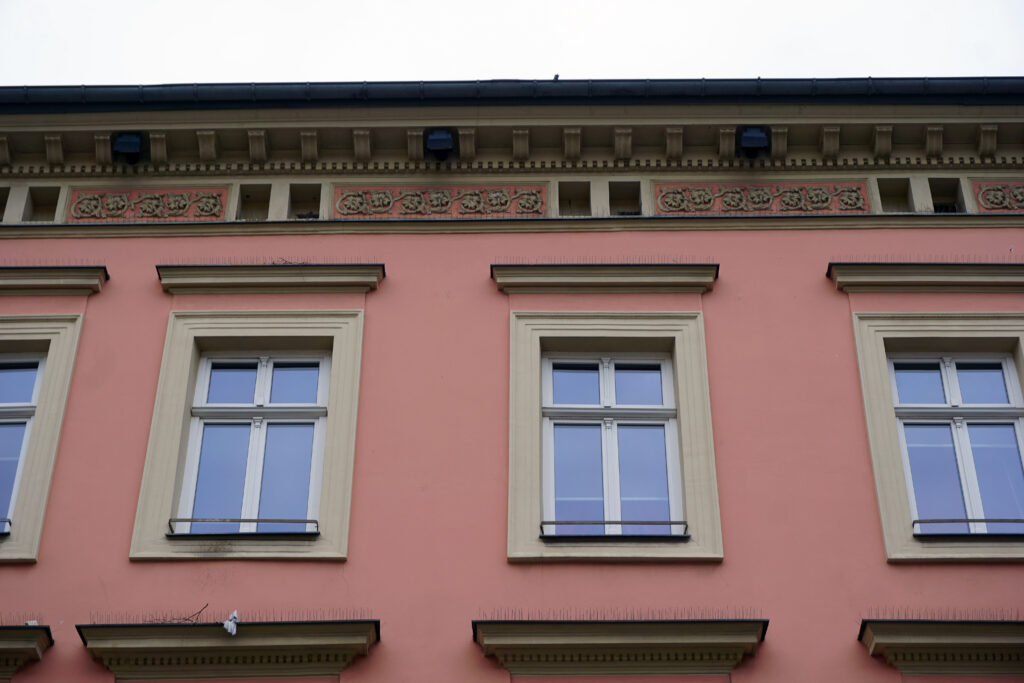
A Baroque tenement front, narrow in the way Kraków plots are narrow, with the vertical emphasis that comes from building upward on a medieval lot. The white eagle of the old inn sign survives as the name rather than as an object, but the house carries its sign board in the traditional position, and the doorway is the original point of entry to the courtyard behind.
The thing to notice on Floriańska is the depth. Each of these houses runs a long way back from a modest frontage, through a passage to a yard, and the nineteenth-century expansion of this one toward St John Street followed exactly that grain. Stand in the entrance passage and the medieval plot shape is still readable under the later decoration.
Practical information
- In use as a hotel — the facade and the entrance are freely visible from the street
- Two minutes from the Florian Gate and the Barbican, five from the Main Square
- The Czartoryski Museum, whose founding family later owned this house, is a short walk away
Getting there
Floriańska runs from the Florian Gate south to the Main Square, in the Old Town. Kraków Główny station is about five minutes on foot, just beyond the Barbican; the whole Old Town is pedestrianised.
Nearby
- Wawel Castle — the royal seat at the far end of the Royal Route
- Wawel Cathedral — the coronation and burial church of the Polish kings
- Aquarium and Natural History Museum — also in the Old Town
Sources
- Wikipedia (Polish), « Kamienica przy ul. Floriańskiej 42 w Krakowie » — the plot history, Maciej Kossowicz, the 1825 lease and purchase by Franciszek Staniszewski, the expansion and renaming, the arrest of Ludwik Waryński in 1879, the Czartoryski purchase of 1913
- Małopolska heritage register, entry A-202, 8 March 1966 — protected status
- Wikidata Q30168397 — identification of the building
- OpenStreetMap Nominatim — coordinates verified against Floriańska 42
Find it on the map
See this place and what’s around it →📷 Become a Cultural Heritage Online photographer
Share your photos of places: they stay published under your name as the author. The more they're seen, the more you get noticed — and soon a contest will reward the most appreciated photos.
Log in or sign up free to add a photoIs this page about you?
This page is read by travellers and heritage enthusiasts who find it on Google. Tell us how you are connected to this place and we will take it from there.