
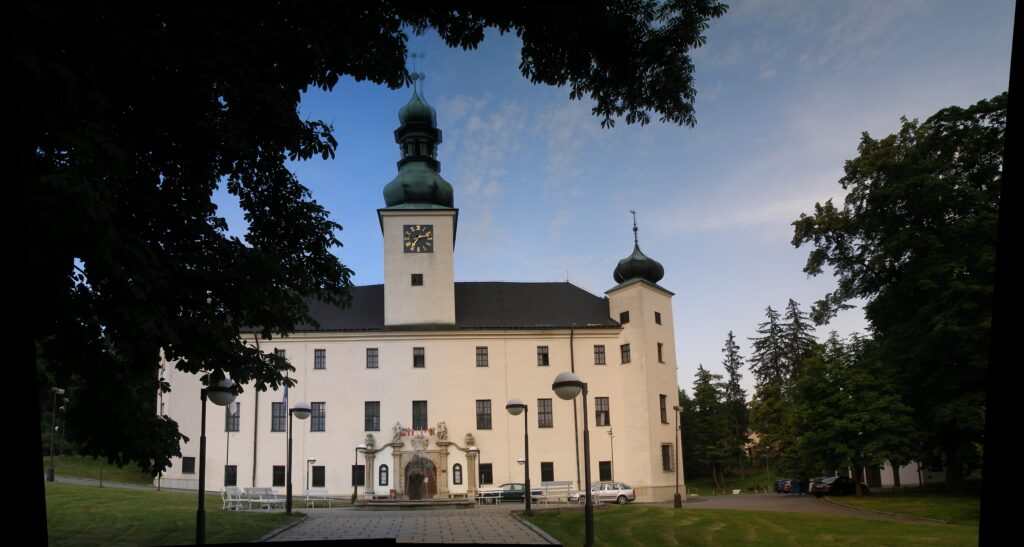

Five centuries of owners each rebuilt this house in their own idiom. What you see is the last of them, 1860, wrapped around a Renaissance courtyard nobody dared touch.
At a glance
Třešť stands in the Vysočina highlands of Moravia, between Jihlava and Telč. A fortified house on the site is recorded in 1513; by the later sixteenth century it had become a Renaissance castle with arcaded courtyard and sgraffito; the Baroque got hold of it in 1714; and in 1860 the Sternbach family gave it the neo-Renaissance dress it still wears. The plan is four wings around a closed courtyard, three storeys with a habitable attic over vaulted cellars. Since 1984 it has belonged to the Czech Academy of Sciences, which runs it as a conference centre and hotel — a rare case of a castle whose modern use is closer to its original one than most.
Key facts
- First recorded: 1513, as a fortified house built by Václav Vencelík
- Renaissance rebuilding: second half of the sixteenth century, for Kryštof Vencelík; the sources credit an Italian builder recorded as M. Grimm
- Baroque alterations: 1714, under Václav Eberhard, after earlier work by the Gayer family in 1660
- Present appearance: neo-Renaissance remodelling of 1860, for Ferdinand and Leopold von Sternbach
- Plan: four wings around a closed courtyard, three storeys, habitable attic, vaulted cellars
- Owner since 1984: Academy of Sciences of the Czech Republic
- GPS: 49.294601, 15.487582 — View on Google Maps
- Latest restoration: completed 2022
History
The Vencelík family held Třešť through the sixteenth century, and it was Kryštof Vencelík who turned the defensive house into a residence. The Renaissance arcades and the sgraffito on the courtyard walls belong to that campaign, and they are the oldest thing at the castle that is still meant to be looked at rather than merely stood on.
Ownership then moved repeatedly, as Moravian estates did. The Gayers altered the house in 1660, and in 1714 Václav Eberhard had it done over in Baroque taste. The decisive change came late: the Wenzel-Sternbach family acquired the estate in 1844, and in 1860 Ferdinand and Leopold von Sternbach commissioned the neo-Renaissance remodelling that fixed the silhouette we see. It is worth noticing what they chose. In 1860, with every revival style available, they reached back to the sixteenth century — to the courtyard they already owned.
The Academy of Sciences took the castle and its park in 1984 and began a long reconstruction that adapted it to a residential conference centre, trading from 1994. A further restoration, taking in the gardens and the pond, was completed in 2022.
What you see
From outside, a long, even, pale front of 1860: regular bays, a restrained cornice, the calm of nineteenth-century neo-Renaissance rather than the drama of the Baroque. It reads as a single design, which is exactly what the Sternbachs were paying for.
The courtyard corrects that impression. Step through and the building is suddenly three hundred years older: arcades running along the inner walls, sgraffito scratched into the render, the proportions of the late 1500s. The 1860 architect wrapped a modern skin round a Renaissance core and left the core alone. Walking from the forecourt to the courtyard takes about twenty seconds and crosses three centuries.
Practical information
- Run as a hotel and conference centre by the Czech Academy of Sciences, and open to the public as well as to researchers
- The park and pond are part of the grounds; check access before travelling, since conference use can close parts of the house
- Telč, a UNESCO-listed Renaissance town square, is about twenty minutes away by road and makes the obvious pairing
Getting there
Třešť lies in the Vysočina region of the Czech Republic, roughly fifteen kilometres south-west of Jihlava and about two hours by road from either Prague or Vienna. Jihlava is the nearest railway hub, with buses on to Třešť.
Nearby
- Telč — the arcaded Renaissance square, UNESCO-listed, twenty minutes away
- Brno — Villa Tugendhat and Czech Functionalism — the CHO guide to Moravia’s other architectural claim
Sources
- Wikipedia (Czech), « Třešť (zámek) » — the 1513 fortified house, the Renaissance rebuilding and its builder, the 1660 and 1714 alterations, the Sternbach purchase of 1844 and the neo-Renaissance remodelling of 1860, the Academy of Sciences acquisition in 1984
- Akademie věd České republiky, announcements on the castle hotel — the reconstruction and the reopening to researchers and the public
- Památkový katalog (Czech national heritage catalogue), entry for the castle — plan and protected status
- OpenStreetMap Nominatim — coordinates verified against the castle
Find it on the map
See this place and what’s around it →📷 Become a Cultural Heritage Online photographer
Share your photos of places: they stay published under your name as the author. The more they're seen, the more you get noticed — and soon a contest will reward the most appreciated photos.
Log in or sign up free to add a photoIs this page about you?
This page is read by travellers and heritage enthusiasts who find it on Google. Tell us how you are connected to this place and we will take it from there.