
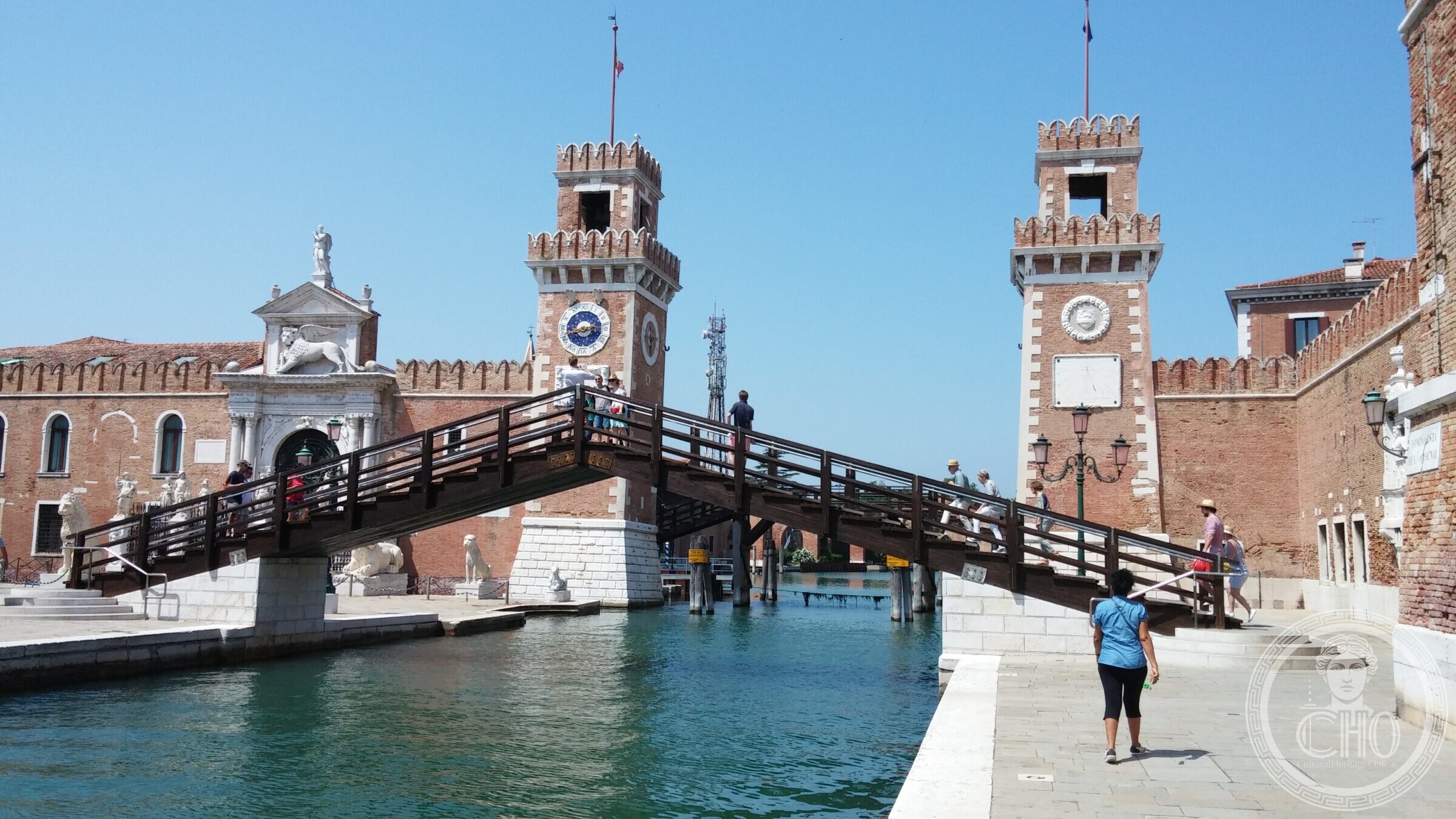
A bridge of the 1930s that was built to look four centuries older. Eugenio Miozzi took his model from the drawbridge that Guardi and Tintoretto had painted, in front of the gate it still serves.
At a glance
This is the bridge in every photograph of the Venice Arsenal: the wooden span in front of the Porta Magna, between the two crenellated brick towers, with the marble lions on the bank to one side. It is not old. It was built in the nineteen-thirties to a design by Eugenio Miozzi, the city’s chief engineer, who deliberately copied the drawbridge that stood here when the Arsenal was still a shipyard of the Republic.
Key facts
- It spans: the Rio de l’Arsenal, between Campo de l’Arsenal and Fondamenta de l’Arsenal, Castello
- Built: in the 1930s, to a design by the engineer Eugenio Miozzi (1889–1979)
- Structure: a wooden bridge — deck and bands in timber on an iron-and-wood frame, carried on stone abutments
- Its model: the old drawbridge of the Arsenal, as painted by Guardi and Tintoretto
- The name: from the Palazzo del Paradiso, one of three palaces inside the Arsenal
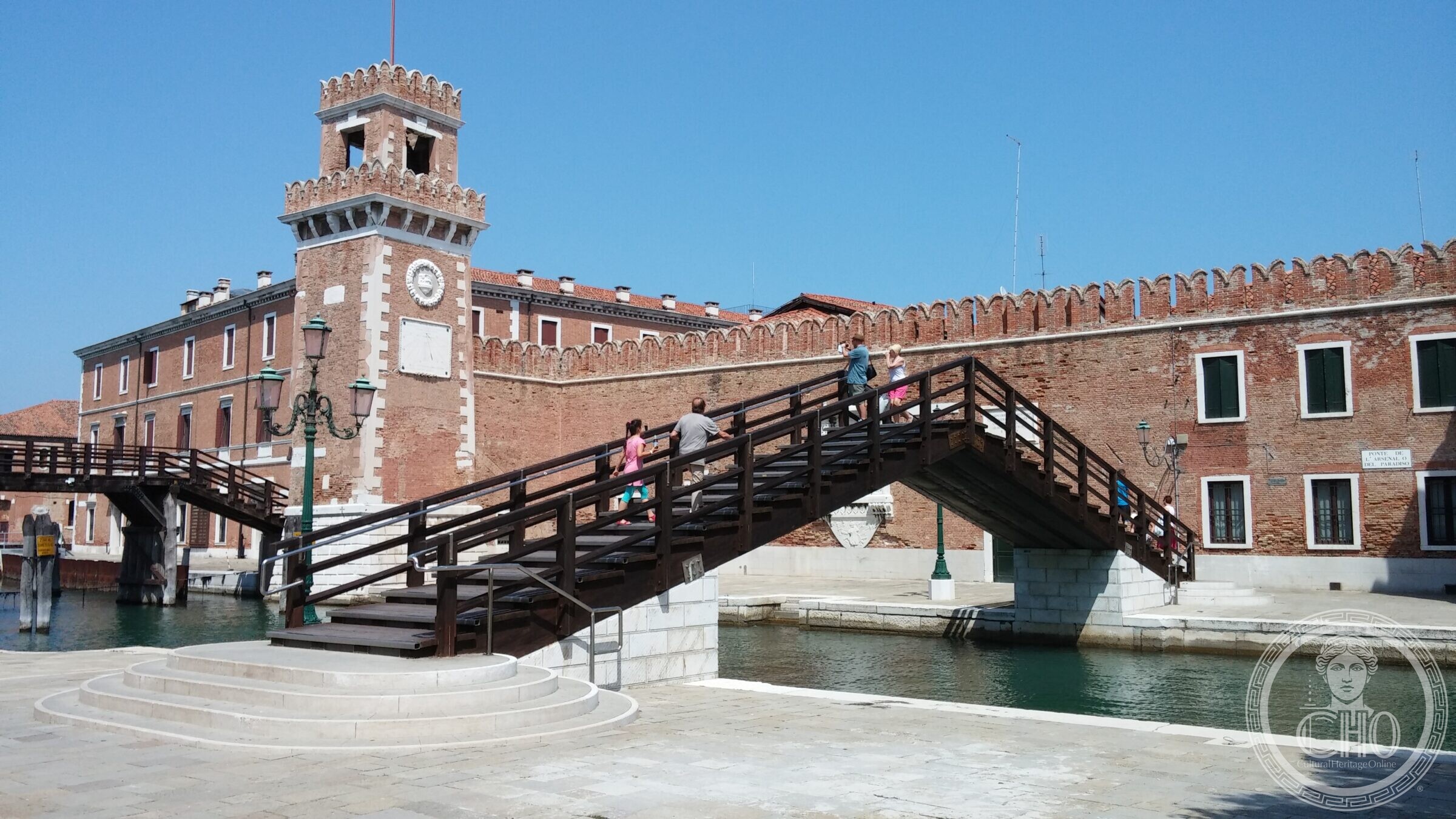
- The street sign on the wall reads: Ponte de l’Arsenal o del Paradiso
History
Three palaces stood in the Arsenal, the seats of its Patroni and Provveditori. The first was called del Paradiso, and stood near the chapel of the Madonna by the Arsenal bridge; in Paganuzzi’s survey the crossing is accordingly named the Ponte de l’Arsenale, called del Paradiso. The other two were the Purgatorio and the Inferno, facing the fondamenta opposite, and were turned into Arsenal offices. All of this is in Giuseppe Tassini’s catalogue of vanished and repurposed Venetian buildings, printed in 1885 — and the two names survive a hundred metres away, on the Ponte del Purgatorio and the Ponte de l’Inferno, which cross the same small canal.
Eugenio Miozzi ran the public works of Venice from 1931 to 1954, and most of what he built here was frankly modern: the road bridge across the lagoon, the Rio Novo and its crossings, the municipal garage at Piazzale Roma. In front of the Arsenal gate he did the opposite. He built a timber bridge on the model of the drawbridge the painters had recorded, so that the approach to the Porta Magna would read as it had read for centuries.
What you see
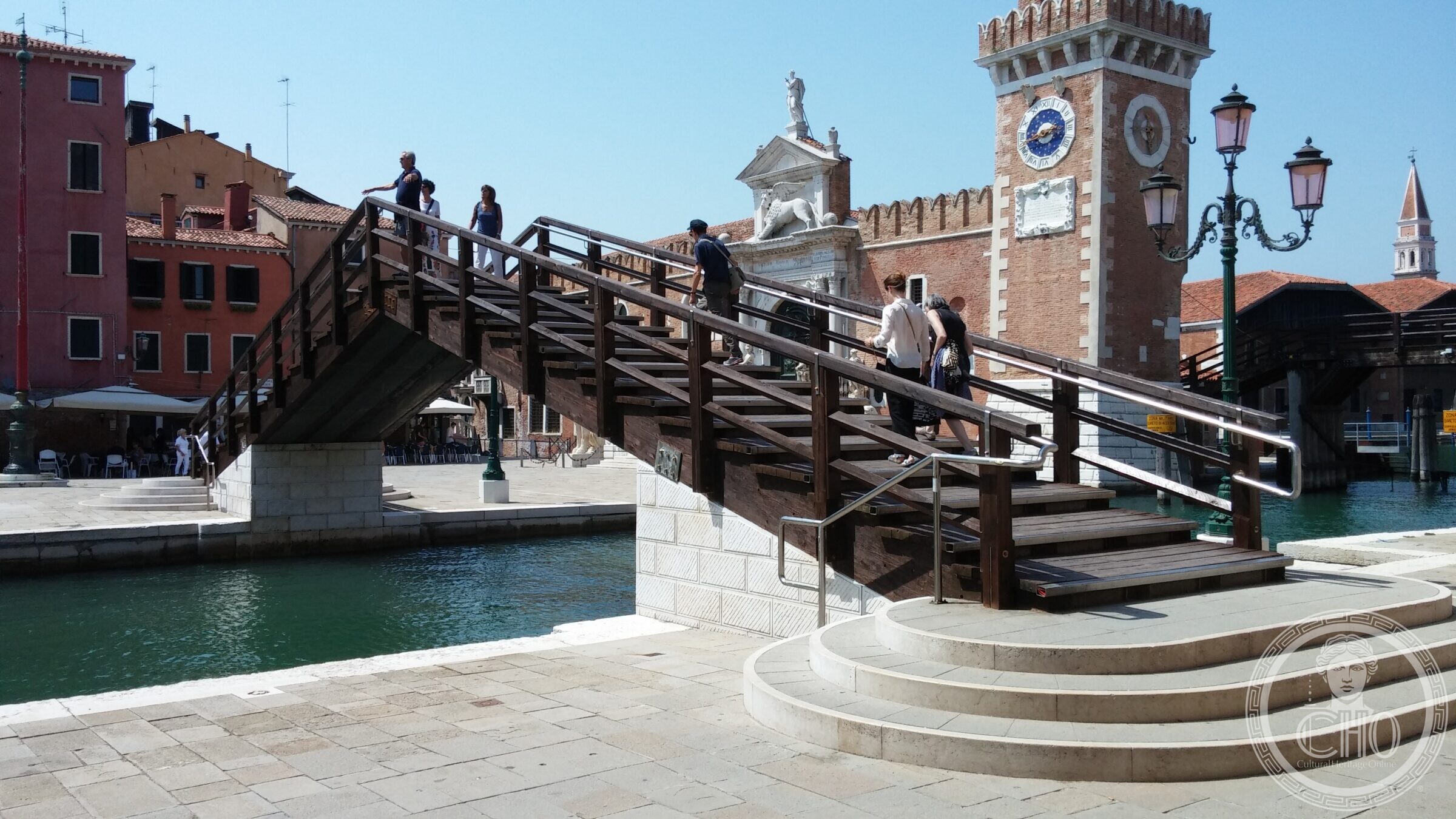
A dark timber deck with a plain timber balustrade, rising to a flat crown and coming down in short flights at either end, set on two pale stone abutments and stone steps that fan out in curves onto the pavement. Everything around it is older and heavier: the brick water-gate towers with their crenellations and their clock, the long crenellated wall of the Arsenal, and the white marble gate of 1460 with the lion of Saint Mark above it and the row of antique marble lions along the bank.
The bridge is the one light thing in the composition, and that is the point of it. Stand on the fondamenta opposite and you are looking at a view that was arranged in the twentieth century to look like the seventeenth.
Getting there
The Arsenale vaporetto stop is two minutes away, and it is about fifteen minutes on foot east from Piazza San Marco along the waterfront. The bridge is a public crossing, open at all hours; the Arsenal itself opens only for the Biennale and for particular events.
Nearby
- The Venice Arsenal, immediately across the bridge.
- Ponte San Biasio delle Catene, where the same canal reaches the lagoon.
- Ponte de la Veneta Marina, at the head of the Riva dei Sette Martiri.
- The Ponte del Purgatorio and the Ponte de l’Inferno, the other two palaces’ bridges, a hundred metres upstream.
Sources
- Conoscere Venezia, Ponte de l’Arsenal o del Paradiso, sul Rio de l’Arsenal — the timber structure, the construction in the 1930s to Eugenio Miozzi’s design on the model of the old drawbridge painted by Guardi and Tintoretto, and Tassini’s account of the three Arsenal palaces.
- Giuseppe Tassini, Edifici di Venezia distrutti o vòlti ad uso diverso da quello a cui furono in origine destinati, Venice, Reale Tipografia Giovanni Cecchini, 1885 — cited there.
- G. P. Meneghin, I ponti di Venezia — Ponte dell’Arsenale — a modern bridge in place of the drawbridge recorded by the Venetian painters.
- The street sign on the Arsenal wall, photographed on site, which gives the double name.
- OpenStreetMap — coordinates.
Gallery
Photographs by Stefano Vigolo, 2015.
Find it on the map
See this place and what’s around it →Record researched and written by Stefano Vigolo for Cultural Heritage Online, 2026.
📷 Become a Cultural Heritage Online photographer
Share your photos of places: they stay published under your name as the author. The more they're seen, the more you get noticed — and soon a contest will reward the most appreciated photos.
Log in or sign up free to add a photo