
Eger, Hungary · begun 1715 · open to visitors since 2016
At a glance
Behind a wrought-iron gate on Eger’s main street stands the palace the town’s bishops built for themselves and then went on rebuilding for a hundred and thirty years. It began in 1715 as a single storey set among gardens and pools; a floor was added on top, then a whole new range to the south. The bishops of Eger have lived here since 1740, and since 1804 they have been archbishops. Part of the building has been open to visitors since 2016: the baroque garden and the ground floor cost nothing, the state rooms upstairs need a ticket, and the cellars under the courtyard have been let back in.
Key facts
- Address: Széchenyi István utca 3, 3300 Eger — the monument register lists the complex at numbers 1–3
- Protected monument, register number 2029
- 1715–1732 — begun by Bishop Gábor Erdődy, reusing sixteenth-century fabric, to designs by Giovanni Battista Carlone
- 1761–1775 — enlarged by Bishop Károly Eszterházy; the staircase of the middle wing is dated 1765 and is the work of Jakab Fellner
- 1827–1847 — the neoclassical southern range raised under Archbishop János László Pyrker, carried out by the younger József Zwanger
- Inside: barrel-vaulted ground floors, a staircase with stucco and carved stone, and a two-storey chapel with an oratory on the west side, some of its eighteenth-century furnishings still in place
- Residence of the bishops of Eger since 1740; the see was raised to an archbishopric in 1804
- Visitor centre opened in 2016
- Coordinates of the gate on Széchenyi utca: 47.90080, 20.37437
What you see
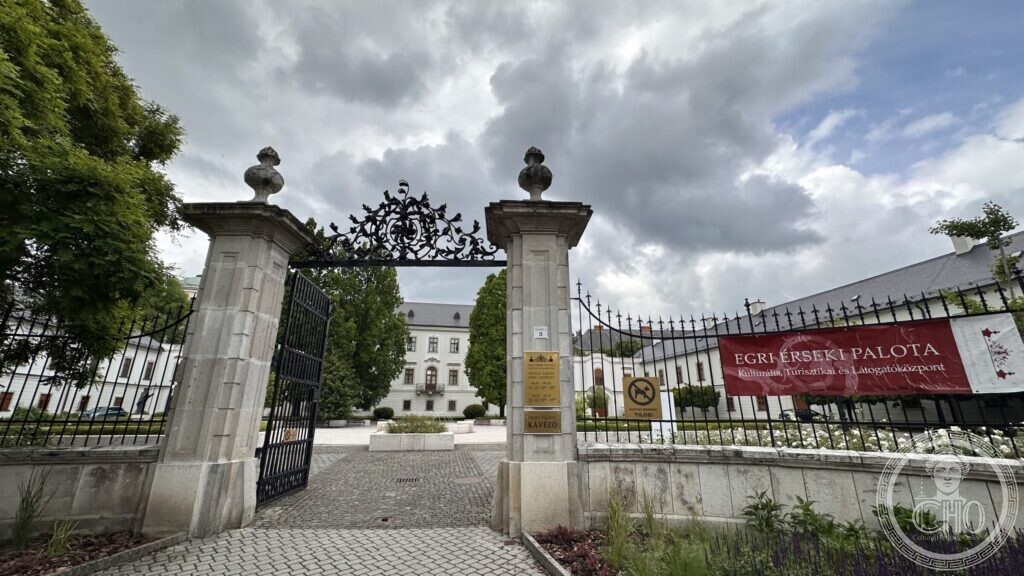
From the pavement the palace is a gate rather than a façade. Two rusticated stone piers carry carved finials shaped like flaming urns, and between them a wrought-iron overthrow of scrolling foliage closes the gap; the enamel number plate on the right-hand pier reads Széchenyi u. 3. Through the opening a paved path runs between clipped box and beds of white roses to a low white wing with a grey mansard roof, three windows to each side of a shallow central bay with a balcony. That is the quiet part. The building history is easier to read from the courtyard than from here: the middle is the eighteenth century, the long plain range to the south is Pyrker’s nineteenth.
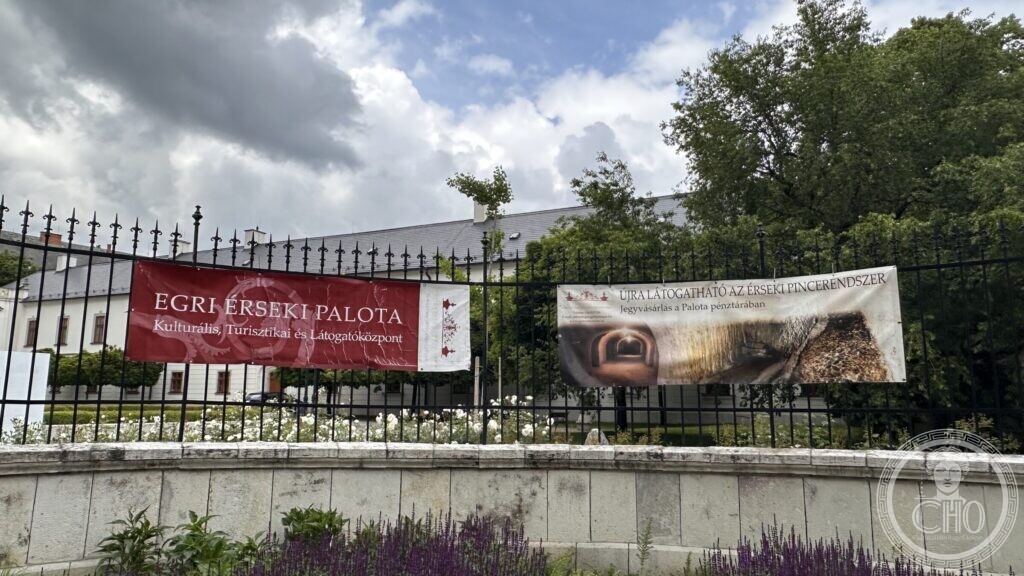
Along the railing, banners. One names the place — Egri Érseki Palota, Kulturális, Turisztikai és Látogatóközpont — and the other announces that the archiepiscopal cellar system can be visited again, with tickets at the palace box office. Both were hanging in May 2026, when these photographs were taken.
Photographs

Visiting
- The brass plate at the gate gives the hours: 1 April to 30 September, 10:00–18:00; 1 October to 31 March, 10:00–16:00
- The baroque ornamental garden and the ground floor of the palace are free to everyone, on the archdiocese’s own statement
- The exhibition rooms — the bishop’s picture gallery, wardrobe, study and treasury, the historic interiors, the portrait gallery of the archbishops and the episcopal wine collection — are ticketed
- There is a café with a terrace and a shop on the ground floor
Sources
- Műemlékem.hu, national monument database — Érseki palota, Eger, Széchenyi u. 1–3, register number 2029: dating 1715–1732, extension 1761–1775, southern wing 1827–1847; Erdődy, Carlone, Eszterházy, Fellner, Pyrker, Zwanger; the vaults, staircase and chapel
- Egri Főegyházmegye (Archdiocese of Eger), Érseki Palota Turisztikai Látogatóközpont — address 3300 Eger, Széchenyi u. 3; residence of the archbishops since 1740; visitor centre opened 2016; the rooms on show
- egriersekipalota.hu, the palace’s own site — «A barokk díszkert, valamint a palota földszintje mindenki által ingyenesen látogatható»
- The opening hours and the reopening of the cellars are read from the plate and the banner in the photographs, 19 May 2026
Record researched and written by Luigi De Marchi for Cultural Heritage Online, 2026.
Find it on the map
See this place and what’s around it →📷 Become a Cultural Heritage Online photographer
Share your photos of places: they stay published under your name as the author. The more they're seen, the more you get noticed — and soon a contest will reward the most appreciated photos.
Log in or sign up free to add a photoIs this page about you?
This page is read by travellers and heritage enthusiasts who find it on Google. Tell us how you are connected to this place and we will take it from there.