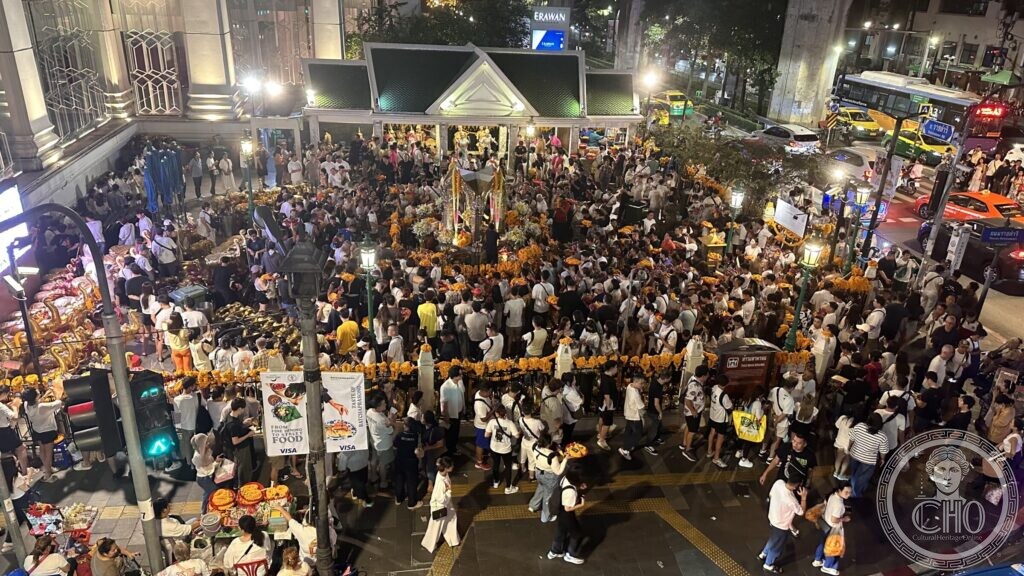
At the Ratchaprasong intersection in Bangkok, between four shopping malls and an elevated railway, there is a shrine. On a Saturday evening in November the crowd around it is six or seven deep: people holding trays of marigold garlands, teak-coloured incense, thin candles; dancers in gold headdresses performing in the side pavilion; a queue that does not resolve into a line. Strung on the railing that separates the shrine from the pavement, two banners hang from a lamp post. One carries the Tourism Authority of Thailand’s Amazing Thailand mark and the words From fine dining to street food. The other says Taste of Ratchaprasong, above the name of the business district. At the bottom of each, a payment company’s logo.
The state, the district and the card network, on one banner, on the railing of a working shrine. It is as neat a picture of Thailand’s cultural policy as anything in a strategy document — and Thailand has a strategy document.
Thirteen industries
Since 2023 the Thai government has run its cultural sector as an economic programme. A National Soft Power Strategy Committee oversees thirteen industries: tourism, cuisine, film and television, fashion, festivals, sports, music, arts, design, gaming, literature, wellness and healthcare, and performing arts. A new agency, THACCA — the Thailand Creative Culture Agency — was set up to drive it and to stand between the ministries, the private sector and foreign investors.
Underneath sits a training programme with an unusually direct name: One Family, One Soft Power. Its target is to train twenty million Thais in creative and service skills by 2027, through more than a hundred free courses in hospitality, creative industries, digital media, design and wellness. The Government Public Relations Department states the figures plainly, and the Prime Minister has framed the whole thing as moving Thailand’s international image from tourist destination to creative economy.
The context for all of it is a number that has just been confirmed. In the Top 100 City Destinations Index published by Euromonitor International on 5 December 2025, Bangkok is first in the world for international arrivals, with 30.3 million — ahead of Hong Kong, London and Macau. The hundred cities in the index took 702 million arrivals between them; Asia Pacific grew fastest, at 10 per cent.
A word on that figure, because a different one circulates. You will often read that Bangkok is “in the world’s top ten” with “over 32 million visits in 2024”. That is not what the ranking says. It says first, and 30.3 million, for 2025. Tourism numbers travel badly, and it is worth going back to the source before repeating one.
The soup on the list
In 2024, at its nineteenth session, the UNESCO committee for intangible cultural heritage inscribed Tomyum Kung — the hot and sour prawn soup — on the Representative List of the Intangible Cultural Heritage of Humanity, on a file submitted by Thailand.
The file is worth reading rather than summarising, because it is not a menu. UNESCO describes a dish that came out of the Buddhist riverside communities of Thailand’s Central Plains, where people avoided killing large animals and ate the freshwater prawns that were abundant instead, combining them with local knowledge of medicinal herbs; a soup understood to sustain the body, particularly in the monsoon. Transmission, the file says, happens orally within families and at social gatherings — and, increasingly, “through restaurants, organizations, schools, and universities as popularity has grown nationally and internationally”.
That last clause is the whole argument in one line, and UNESCO wrote it, not us. The channel through which the practice is now passed on is also the channel through which it is sold. Recognition and commerce are not running on separate tracks here; they are the same track. Whether that safeguards a tradition or hollows it is not a question the inscription answers.
What the critics have documented
The strategy has a serious critique, and it is worth citing precisely rather than gesturing at. In an ISEAS Perspective paper published on 17 June 2025 by the ISEAS – Yusof Ishak Institute in Singapore, Kittiya Moonsarn, a lecturer at Chiang Mai University, examines what the national strategy is doing to cultural groups in Chiang Mai.
Her findings are three. First, the policy conflates economic output with cultural influence, assuming that expanding the creative industries through training will automatically produce soft power. Second, official initiatives favour what she calls nostalgic representations, which “in effect limit the space available for contemporary or diverse cultural representations”. Third, the policy machinery “emphasises output-driven metrics, training schemes, and cultural showcases while underestimating the importance of organic cultural expression”. Her conclusion is that Thailand should move “from managing culture as a product to nurturing creative ecosystems that allow culture to evolve organically” — and her counter-example is not a heritage site but Chiang Mai’s art toy scene, where artists reinterpret local material without being told to.
That is a critique of method, made by someone inside the country’s academic system, and it is the kind we are willing to report. It is not the same as the argument we can make ourselves, which is narrower and comes from the street.
Two addresses where you can see the cost
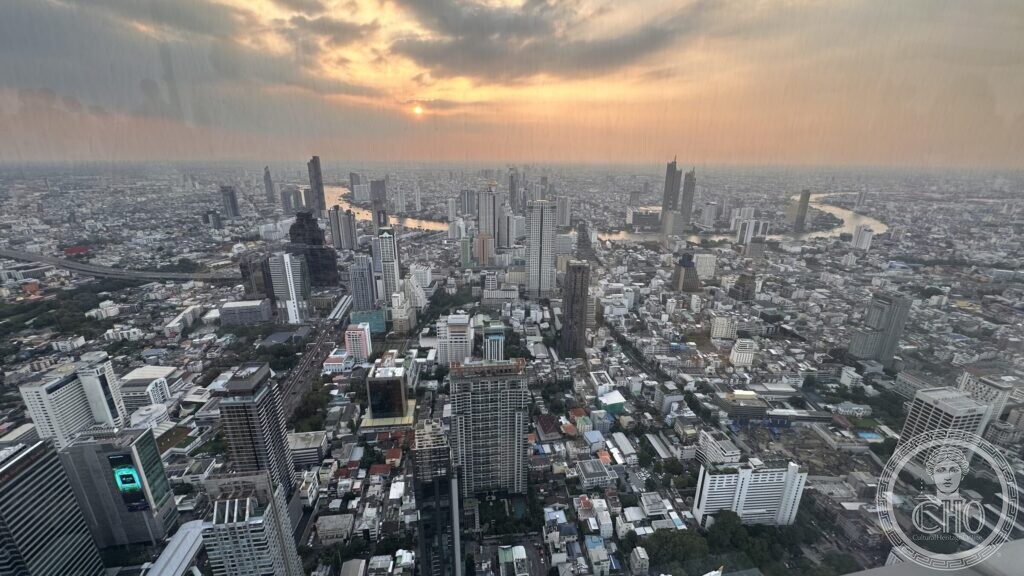
At the eastern edge of the old city stands Pom Mahakan, one of the few surviving forts of the wall Rama I built round his new capital in the 1780s. It is a white octagonal tower, registered as a national monument in 1949, excavated for the first time in 2020. Behind it there is now lawn.
There used to be a neighbourhood. Wooden houses, a few hundred residents, some of the buildings dating to the early Rattanakosin period; a community almost as old as Bangkok. The city administration asked the residents to leave, against compensation, in 1992. They refused, and spent twenty-five years proposing a land-sharing arrangement that would have kept the houses standing and opened the ground to the public. Conservationists and architects, Thai and foreign, argued the same case: that the wooden houses were themselves heritage, and that a living quarter inside the old wall was worth more than a lawn. Twelve houses came down in 2016. The last families were ordered out by 25 April 2018; three days before, the community held an event it called Farewell Mahakan. The park opened that July, and the Thai press that had followed the case reported it as little visited.
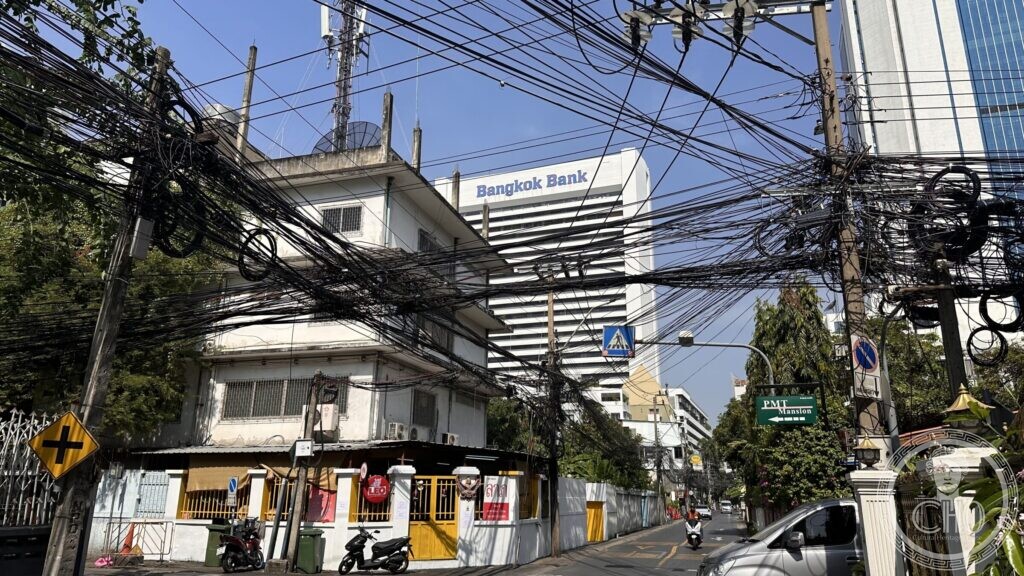
A gentler version of the same logic is visible a kilometre away, at Khlong Lot Wat Ratchabophit. For the coronation of King Rama X the canals of the old city were dredged and treated, their embankments cleaned and painted along 2,300 metres, their banks lit and repaved, their overhead cables put underground. It is a real improvement and it looks like one: planters, lamp standards, tables out on the strip in front of the shophouse doors. The official account of the programme also records, in the same list of works, that people who had been living along the banks were moved into state welfare facilities. Nobody has hidden this. It is in the report, between the lighting and the walkways.
What we are not saying
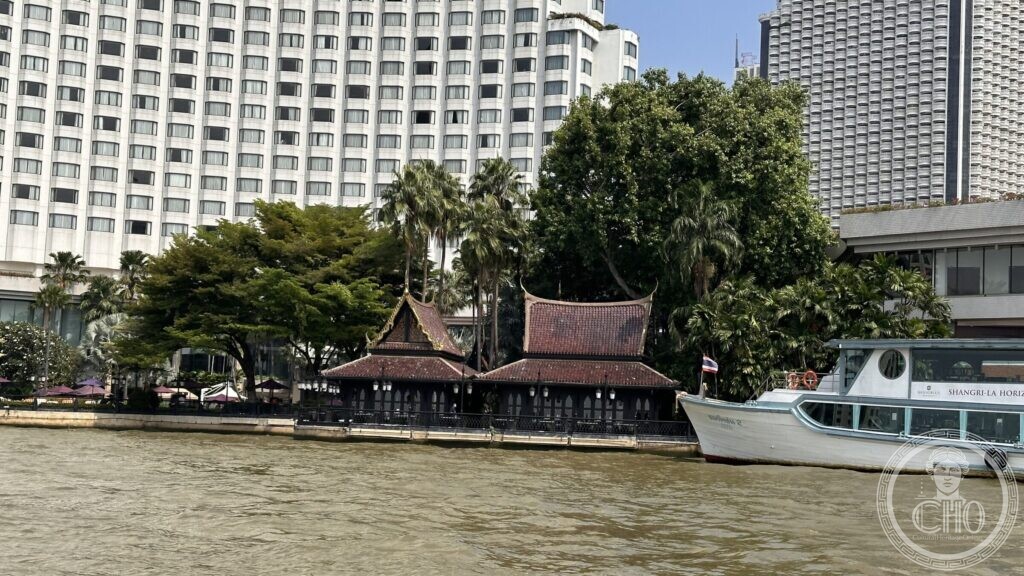
We are not arguing that Thailand should stop. A country is entitled to promote its culture, and the alternative to a strategy is usually not authenticity but neglect — the canal that stays black, the fort that falls down. The banner on the shrine railing is paid for by somebody, and so is the restoration.
What an archive can do is keep the two halves of the account on the same page. The gain is real: a canal that people walk along, a fort that is standing, a soup on a list that will outlive the ministry that filed it. The cost is also real, and it is specific, and it has names and dates: 1992, 2016, 25 April 2018, fifty-nine houses. A promotional text will carry the first half. Our job is that the second half does not have to be looked for.
Back at the shrine
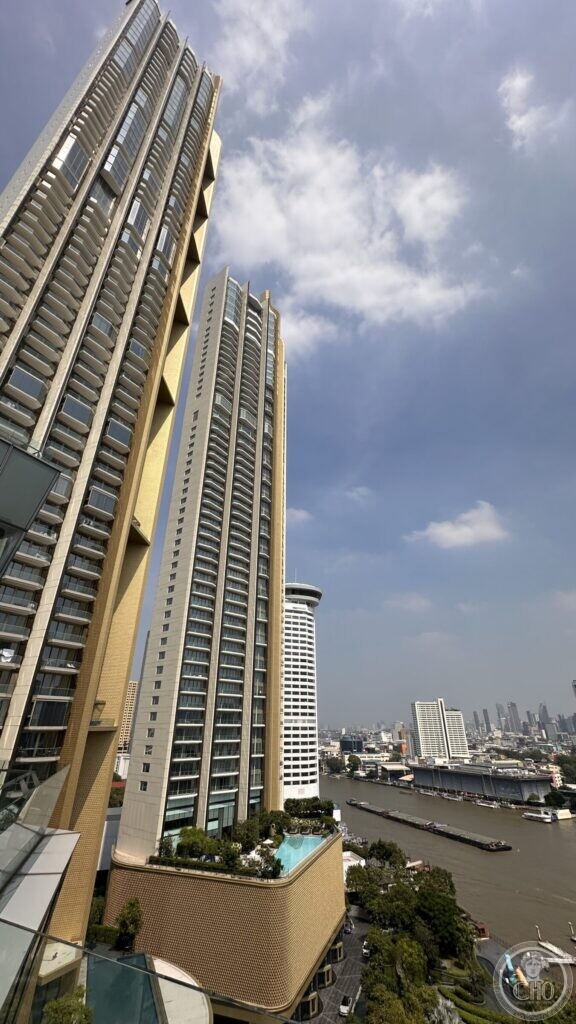
The thing about the Ratchaprasong shrine is that it works. Nobody in that crowd is there because of a strategy committee. They are there with garlands and incense at nine in the evening on the way home, in a place that is loud and lit and completely surrounded by retail, and the practice has absorbed the setting without apparently noticing it. The dancers perform, the smoke goes up, the malls stay open, and the banner about street food hangs on the railing.
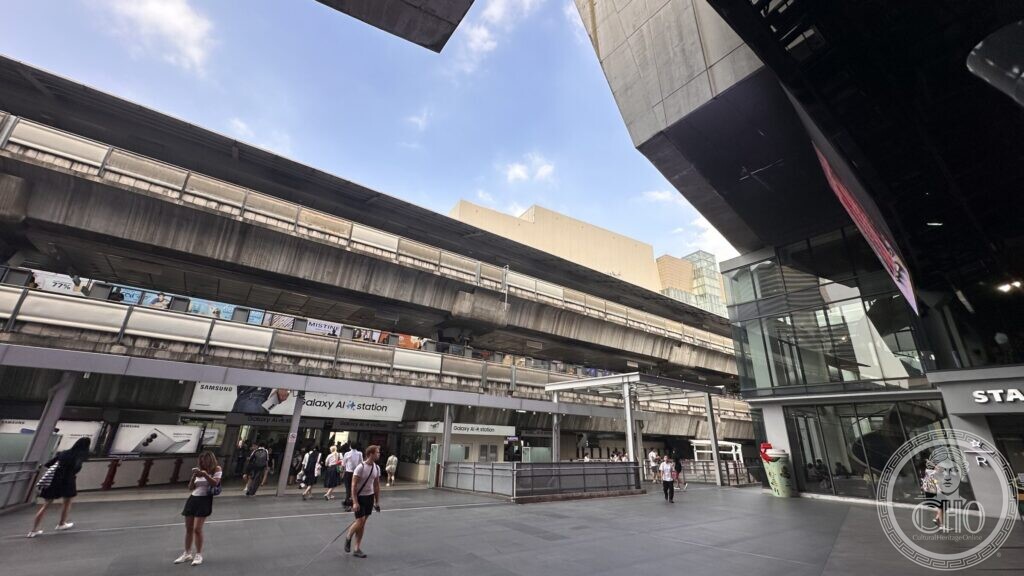
That is the honest end of the story. A culture strong enough to be exported is usually strong enough to survive being exported. The question a heritage archive has to keep asking is not whether the policy works — by its own numbers it does — but who is standing where the frame is cropped. At Pom Mahakan the answer is nobody, now, and that was a decision.
Sources
- Government Public Relations Department, Office of the Prime Minister of Thailand (thailand.prd.go.th) — the National Soft Power Strategy Committee and its thirteen industries, the role of THACCA, and the One Family, One Soft Power target of twenty million people trained by 2027 through more than a hundred free courses.
- THACCA — Thailand Creative Culture Agency (thacca.go.th) — the agency’s own description of its role and of the OFOS upskilling target.
- UNESCO, Intangible Cultural Heritage, Tomyum Kung, element 01879, inscribed 2024 on the Representative List (19.COM), file submitted by Thailand — the origin among the Buddhist riverside communities of the Central Plains, the avoidance of killing large animals, the freshwater prawns and medicinal herbs, and the modes of transmission.
- Euromonitor International, Top 100 City Destinations Index 2025, press release of 5 December 2025 — Bangkok first for international arrivals with 30.3 million, ahead of Hong Kong, London and Macau; 702 million arrivals across the top hundred cities; Asia Pacific growing 10 per cent.
- Kittiya Moonsarn, “The Thai Government’s National Soft Power Strategy: Impact on Cultural Groups in Chiang Mai”, ISEAS Perspective 2025/44, ISEAS – Yusof Ishak Institute, 17 June 2025 — the conflation of economic output with cultural influence, the preference for nostalgic representations, the emphasis on output-driven metrics, and the conclusion on creative ecosystems.
- Official website of the coronation of King Rama X (phralan.in.th) — the Rattanakosin canal programme, the works carried out, the agencies involved, and the relocation of people living on the banks.
- Fine Arts Department of Thailand and the Princess Maha Chakri Sirindhorn Anthropology Centre (SAC), database of archaeological sites, record 773 — Pom Mahakan: construction, registration in 1949, the 2020 excavation, and the community at the fort.
- Thai press coverage of the Pom Mahakan eviction, 2016–2018 (Bangkok Post, The Nation, Prachatai English, Khaosod English) — the 1992 origin of the dispute, the survey figures, the demolitions of 2016, the departure of the last families on 25 April 2018 and the Farewell Mahakan event, and the opening of the park in July 2018. Cited as press.
Photographs by Luigi De Marchi, Bangkok, October and November 2024. The places named in this article have their own pages in the Cultural Heritage Online archive: Pom Mahakan, Khlong Lot Wat Ratchabophit, Wat Suthat Thepwararam, Loha Prasat, Saranrom Park and Wat Saket.