
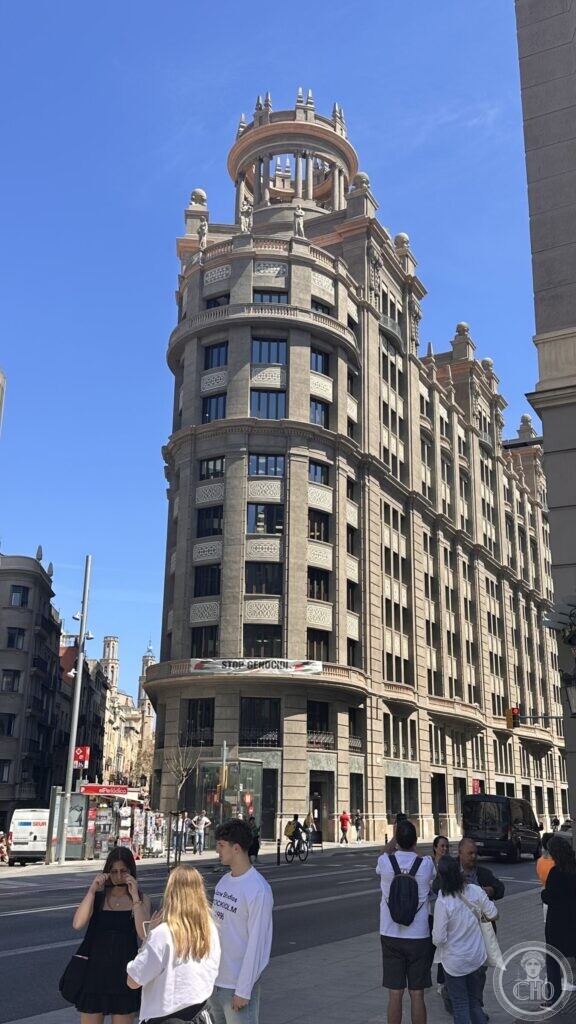
Barcelona, Catalonia · 1923–1925 · Josep Domènech i Mansana
At a glance
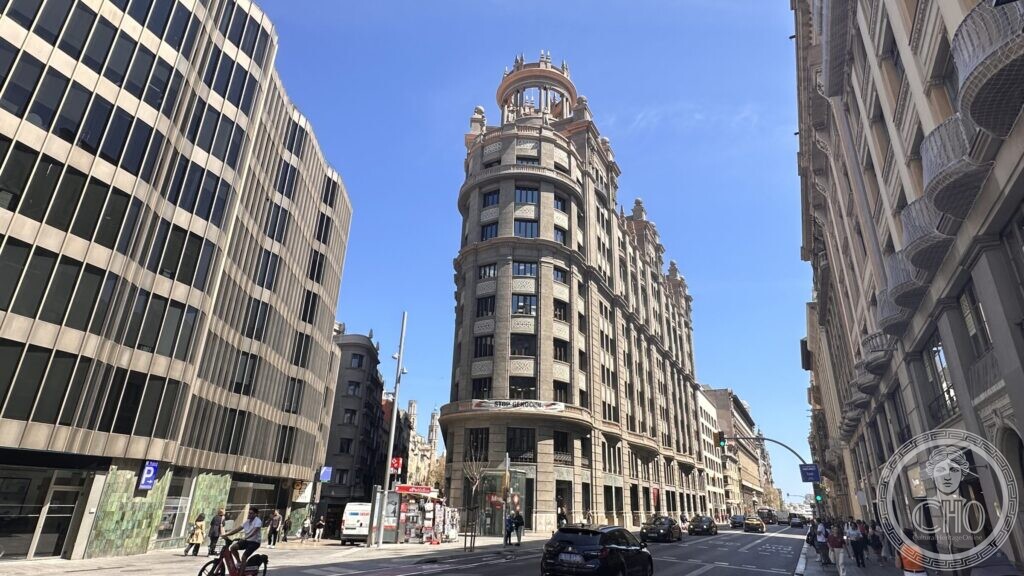
Via Laietana was cut through the medieval city in 1913, and the buildings that went up along it are a catalogue of what Barcelona’s money wanted to look like in the 1920s. Number 16 is the sharpest of them: a triangular block whose corner is rounded into a prow where the avenue meets Carrer de l’Argenteria, with a circular colonnaded temple standing on the roof above it. It was built as a bank. It is now the headquarters of a trade union confederation.
Key facts
- Built: 1923–1925, on the avenue opened in 1913
- Architect: Josep Domènech i Mansana, son of Josep Domènech i Estapà
- Model: the Flatiron Building in New York
- Plan: triangular, with a semicircular chamfered corner between Via Laietana and Carrer de l’Argenteria
- First occupant: the Caixa Mútua Popular, the Güell family’s bank
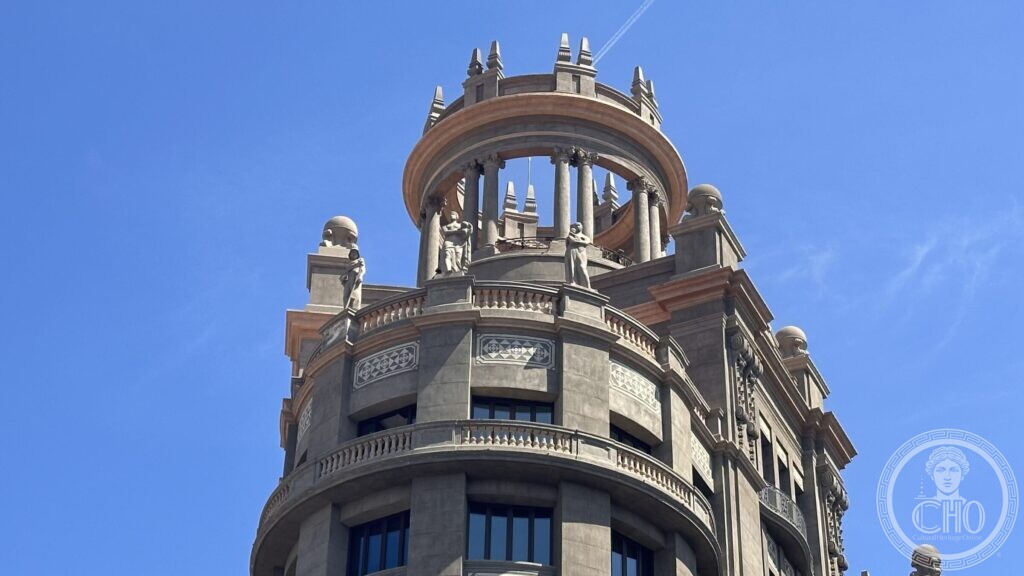
- Crowning: a classical circular temple at the vertex, with statues at the balustrade
- After the Civil War: seat of the Francoist vertical syndicate, which put employers and workers under one structure
- Today: the seat of CCOO de Catalunya, which also keeps the old Banco Vizcaya strongroom on the ground floor
- Coordinates: 41.3835511, 2.1795548
What you see
From the pavement the prow reads as a single curved surface of grey stone, ruled by vertical window bays and cut across by the horizontals of the balconies. The building holds the line of the avenue and then lets go of it at the top: above the last cornice comes a balustrade with figures, and above that the rotunda, its double columns closed with wrought-iron rails and finished with obelisk finials. It is the flourish of a bank that wanted to be seen from Plaça de l’Àngel.
The banner across the first floor is the current tenant’s. Reading the two together — the temple and the banner — is a quick lesson in the century that separates them.
Photographs

Practical information
- An office building in use: the exterior is the visit. The best view of the crown is from the far pavement of Via Laietana, near Plaça de l’Àngel.
Sources
- Pobles de Catalunya — Edifici de Sindicats, Via Laietana 16: Josep Domènech i Mansana, the triangular plan and semicircular chamfer, the classical temple at the vertex, the Caixa Mútua Popular, and the later occupation by the vertical syndicate and then by democratic unions
- Ara — «De banc burgès a seu sindical: 100 anys de l’emblemàtic edifici de Via Laietana, 16»: the 1923–1925 construction, the Flatiron model, the Güell family’s bank, the architect’s parentage, the Banco Vizcaya strongroom, and the building’s present use
Record researched and written by Luigi De Marchi for Cultural Heritage Online, 2026.
Find it on the map
See this place and what’s around it →📷 Become a Cultural Heritage Online photographer
Share your photos of places: they stay published under your name as the author. The more they're seen, the more you get noticed — and soon a contest will reward the most appreciated photos.
Log in or sign up free to add a photoIs this page about you?
This page is read by travellers and heritage enthusiasts who find it on Google. Tell us how you are connected to this place and we will take it from there.