
Barcelona, Catalonia · museum since 1943 · Roman and medieval city
At a glance
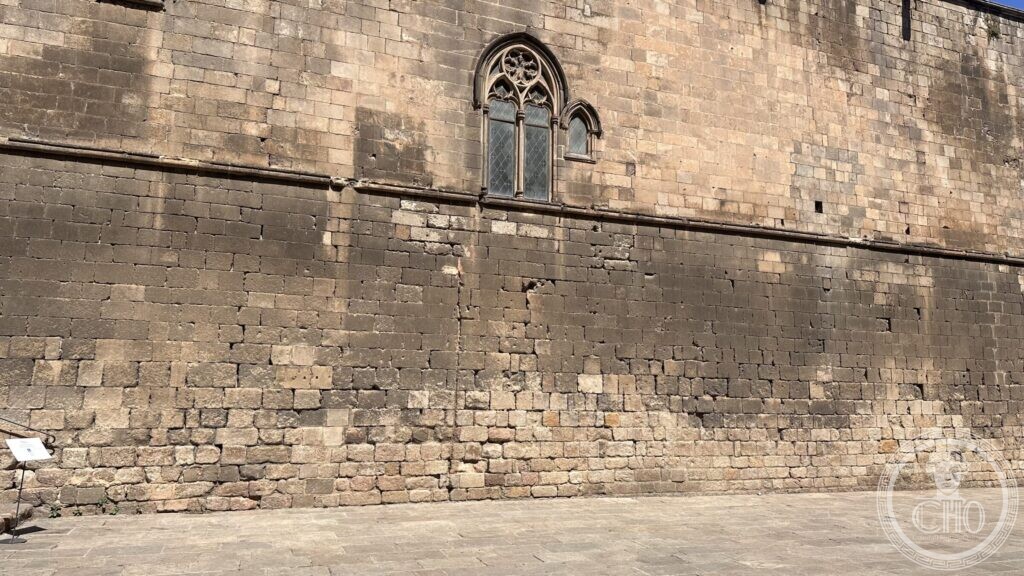
Plaça del Rei is the courtyard of the old royal palace of the counts of Barcelona, closed on three sides by the Saló del Tinell, the chapel of Santa Àgata and the Palau del Lloctinent. The fourth side is a 16th-century palace that did not start here: the Casa Padellàs was taken down on Carrer dels Mercaders and rebuilt on this square when the city was assembling its “Gothic quarter”. Digging its foundations is how the Roman city underneath was found.
Key facts
- The monumental complex of Plaça del Rei has been the founding core of the Barcelona History Museum since 1943
- Casa Padellàs: an early-16th-century palace, moved here from Carrer dels Mercaders
- Underground: about 4,000 square metres of Roman and medieval remains — streets, a 2nd-century dyeing works, the early Christian quarter
- The ground-floor Àgora BCN and the Clock Courtyard are free to walk into
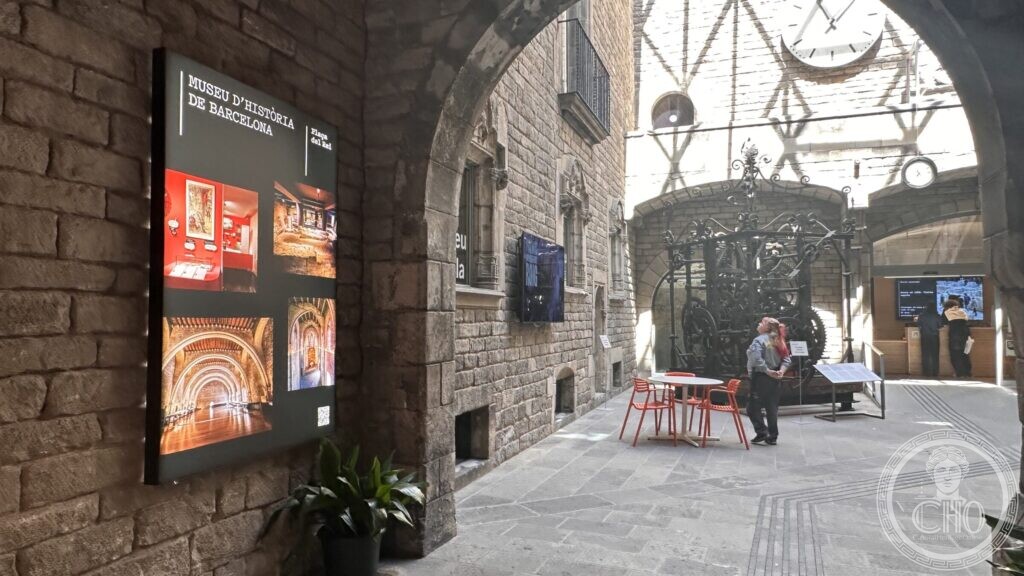
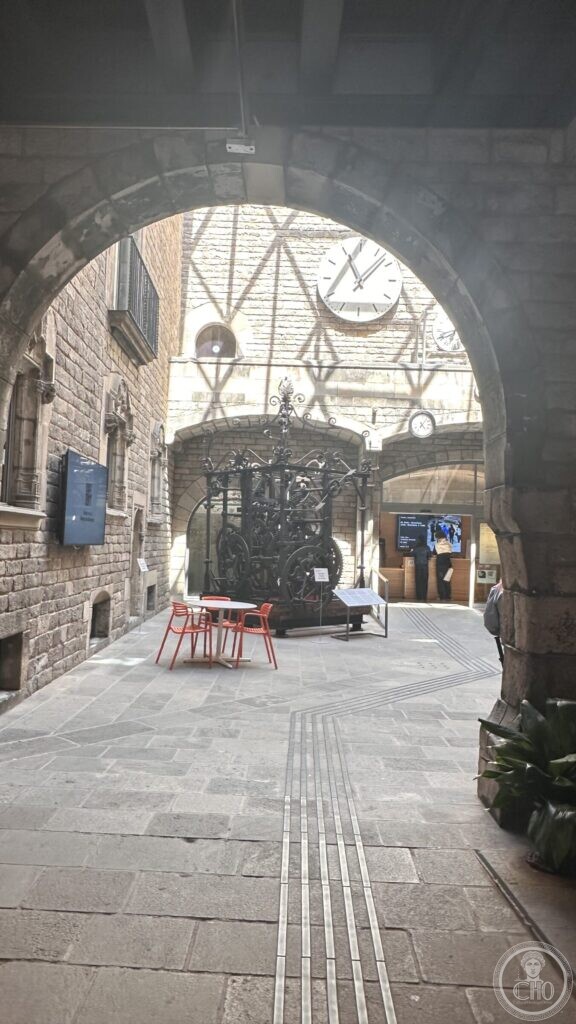
- In the courtyard: the rellotge dels flamencs, the clock that ran on the cathedral bell tower from 1576 to 1864
- Its makers: the Flemish clockmakers Simó Nicolau and Climent Ossen
- Weight: over five tonnes
- Coordinates: 41.3841563, 2.1773945
What you see
From Carrer del Veguer an arch opens into a courtyard roofed in glass, and the first thing in it is a black iron machine the height of a room: gears, a great toothed wheel, a crown of wrought-iron scrollwork, with clock faces mounted on the wall above. This is the rellotge dels flamencs — or rather a full-size reconstruction of it, built by engineers at the Universitat Politècnica de Catalunya and weighing more than five tonnes. The original told Barcelona the time from the cathedral tower for nearly three hundred years, until a smaller and cleverer clock replaced it in 1864.
Around it are café tables, a ticket desk, and people sitting down who have not bought anything. That is deliberate: the museum treats this courtyard as an extension of the street, free to walk through, with a planetarium of cities and a historical map of Barcelona for anyone who wants them. The ticket is for the floor below, where the Roman streets are.
Photographs

Practical information
- The Àgora BCN and the Clock Courtyard are free. The archaeological subsoil is ticketed.
- The entrance is on Plaça del Rei; the courtyard also opens from Carrer del Veguer.
Sources
- Ajuntament de Barcelona, Museu d’Història de Barcelona — MUHBA Padellàs: the palace moved from Carrer dels Mercaders for the “Gothic quarter” plan, the 4,000 square metres of remains, and the Àgora and Clock Courtyard as free-circulation space
- Ajuntament de Barcelona, MUHBA — Plaça del Rei: the monumental complex as the founding core of the museum since 1943
- betevé — on the rellotge dels flamencs: Simó Nicolau and Climent Ossen, the installation on the cathedral bell tower, its replacement in 1864, the five-tonne reconstruction and its move to the Casa Padellàs courtyard
Record researched and written by Luigi De Marchi for Cultural Heritage Online, 2026.
Find it on the map
See this place and what’s around it →📷 Become a Cultural Heritage Online photographer
Share your photos of places: they stay published under your name as the author. The more they're seen, the more you get noticed — and soon a contest will reward the most appreciated photos.
Log in or sign up free to add a photoIs this page about you?
This page is read by travellers and heritage enthusiasts who find it on Google. Tell us how you are connected to this place and we will take it from there.