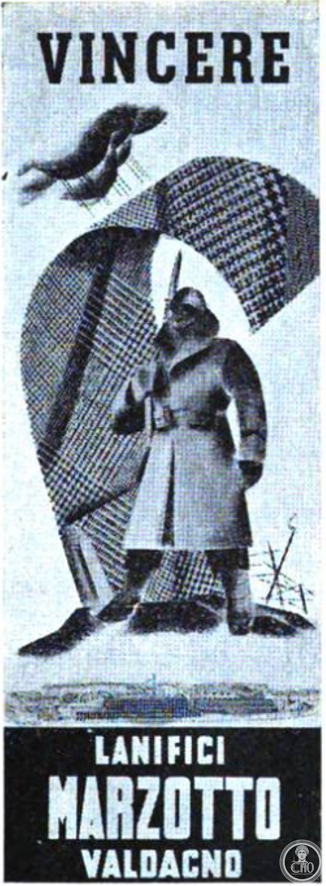
A soldier stands in a long greatcoat, collar up, seen from behind against the smoke of industry, and above him the word of the hour: VINCERE. The wool house of Valdagno is no longer advertising cloth. It is advertising the coat on the army’s back.
Beside the figure a swatch of checked fabric hangs like a flag — the product, reduced to a corner of the page. At the foot: LANIFICI MARZOTTO, VALDAGNO. The drawing’s soft greys and monumental single figure mark it as belonging to the same war group as the Ansaldo gun and the Pirelli tyre.
From autarky to uniform cloth
Marzotto appears twice in this collection, and the pair measures the change of era exactly. The 1938 sheet, published here separately, argued wool autarky with a photographed flock of sheep and the language of prosperity and independence; this banner, printed in the war years the «Vincere» watchword defines — the word Mussolini’s declaration of 10 June 1940 ended on — needs only a greatcoat. For a wool house, war was demand: uniforms and blankets for an army are cut from exactly the cloth Valdagno wove. The company outlived both campaigns to become today’s largest Italian textile group.
Marks
The collector attributes the sheet to Erberto Carboni, placing an EC monogram beside the word VINCERE; nothing resolves there on our scan, and the sheet is published without an attribution.
About this image. The work is still protected by copyright: under Italian law (L. 633/1941) rights run for 70 years from the death of the author. Since the author has not been identified, that term cannot be considered expired, and the image is treated as fully protected. It is reproduced here for documentation, study and critical purposes only, under Art. 70 of L. 633/1941 and the fair-use provision of 17 U.S.C. §107. The scan was made by the collector from his own copy of the sheet, part of the period material he keeps in a private archive: owning the physical sheet is not the same as holding the rights to the work. The image is not offered for sale, no reproduction rights are granted, and any request concerning the work should be addressed to the rights holders. Cultural Heritage Online publishes this material to document it, with no celebratory intent; see our terms and the DMCA contact published there.