
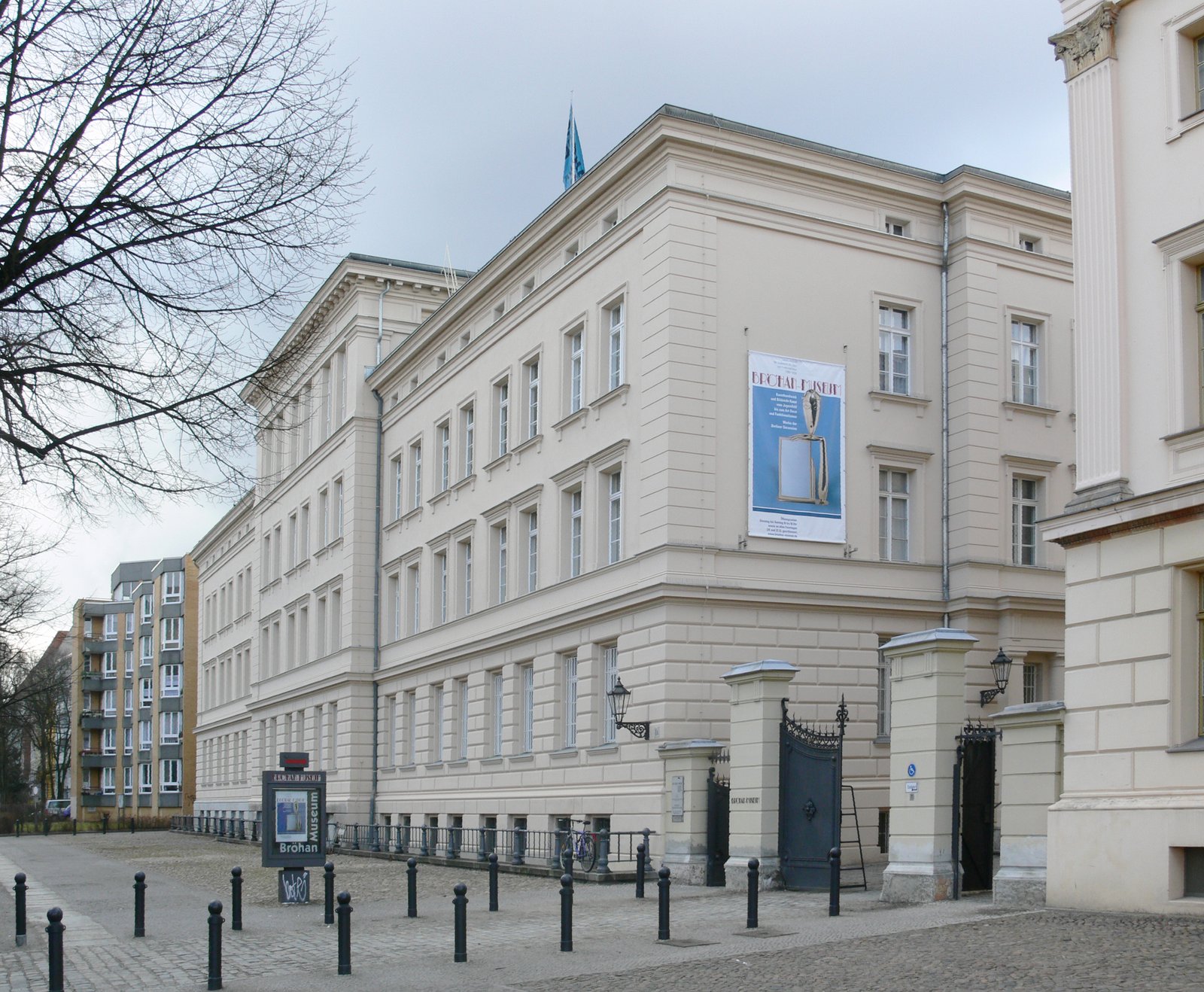

A businessman spent two decades buying what fashion had discarded, and Germany’s only state museum built entirely around Art Nouveau and Art Deco is what he left behind.
At a glance
Karl H. Bröhan started out buying eighteenth-century porcelain in the early 1960s, then redirected his money toward Jugendstil and Art Deco around the mid-1960s, when both styles were unfashionable and cheap. Two decades of collecting produced a body of furniture, glass, porcelain and painting that no German public museum then held together in one place. He opened it to visitors in his own Dahlem residence in 1973, then gave the entire collection to the city of Berlin. It found a permanent home in 1983 inside a late-classical barracks built for the Charlottenburg Palace guard regiment, and has been a Berlin state museum since 1994.
Key facts
- Founder: Karl H. Bröhan (1921-2000), Berlin businessman and collector
- Collecting began: early 1960s (porcelain), redirected to Jugendstil and Art Deco from the mid-1960s
- First public showing: 1973, a private museum inside Bröhan’s own residence in Dahlem
- Museum opened: 14 October 1983, at Schloßstraße 1a, in a former guard-regiment barracks of the Charlottenburg Palace ensemble
- Official Berlin state museum since: 1994
- Collection: Art Nouveau (Jugendstil), Art Deco and Functionalism, late 19th century to WWII — furniture by Hector Guimard and Jacques-Émile Ruhlmann, glass by Émile Gallé and Loetz, porcelain from KPM Berlin, Meissen, Royal Copenhagen and Sèvres
History
Bröhan was still in his early forties when he shifted his buying from porcelain to Jugendstil, a decision that looked eccentric at the time: the style had been out of critical favour for a generation, and pieces by makers who are now museum staples could be had for little money. He kept buying through the 1960s and 1970s, adding Art Deco and Functionalist design as the collection grew, until he held one of the most complete private assemblies of turn-of-the-century applied art in Germany.
In 1973 he opened part of the collection to the public inside his own villa in Dahlem, a private museum run on his own terms. On his sixtieth birthday he gave the entire collection to the State of Berlin, an act that created, at a stroke, a public museum the city had never had. It reopened in 1983 at Schloßstraße 1a, inside a barracks originally built to house the guard regiment of Charlottenburg Palace — a military building from an earlier century repurposed to hold furniture and glass from the eve of a war it long predates.
The museum became a full Berlin state institution in 1994 and has kept expanding its holdings since, under director Tobias Hoffmann since 2013. It remains the only German Landesmuseum built specifically around Jugendstil and Art Deco.
What you see
The building itself is late-classical and military in origin, plain where the collection inside it is not. Room after room is arranged less like a conventional museum hall and more like a sequence of period interiors: Guimard’s cast furniture, Ruhlmann’s exotic-wood cabinets, and complete Art Deco ensembles by the Paris workshops of Süe et Mare and Dominique sit alongside vitrines of Gallé and Loetz glass, catching light the barracks windows were never designed to flatter.
The porcelain galleries hold the other half of Bröhan’s original obsession — services and figures from KPM Berlin, Meissen, Scèndinavian houses like Royal Copenhagen and Rörstrand, and the French Manufacture de Sèvres — a reminder that the collection began as a porcelain habit two decades before it became a design museum.
Practical information
- Opening hours: Tuesday-Sunday, 11:00-18:00; closed Mondays
- Admission: €9 standard, €6 concession, free under 18, €4 on the first Wednesday of each month
- Accessibility: wheelchair accessible, accessible restrooms, service animals and deaf visitors accommodated on request
- Time needed: 1-1.5 hours
Getting there
The museum stands at Schloßstraße 1a, directly beside Charlottenburg Palace in western Berlin. Buses 309 and M45 stop at “Schloss Charlottenburg,” a few steps from the entrance; Berlin Brandenburg Airport is roughly 45 minutes away by car or public transport.
Nearby
- Charlottenburg Palace, the Baroque residence the guard barracks once served
- Museum Berggruen, Picasso and Klee collection, on the same stretch of Schloßstraße
- Sammlung Scharf-Gerstenberg, Surrealist art, directly opposite
Sources
Find it on the map
See this place and what’s around it →📷 Become a Cultural Heritage Online photographer
Share your photos of places: they stay published under your name as the author. The more they're seen, the more you get noticed — and soon a contest will reward the most appreciated photos.
Log in or sign up free to add a photo