
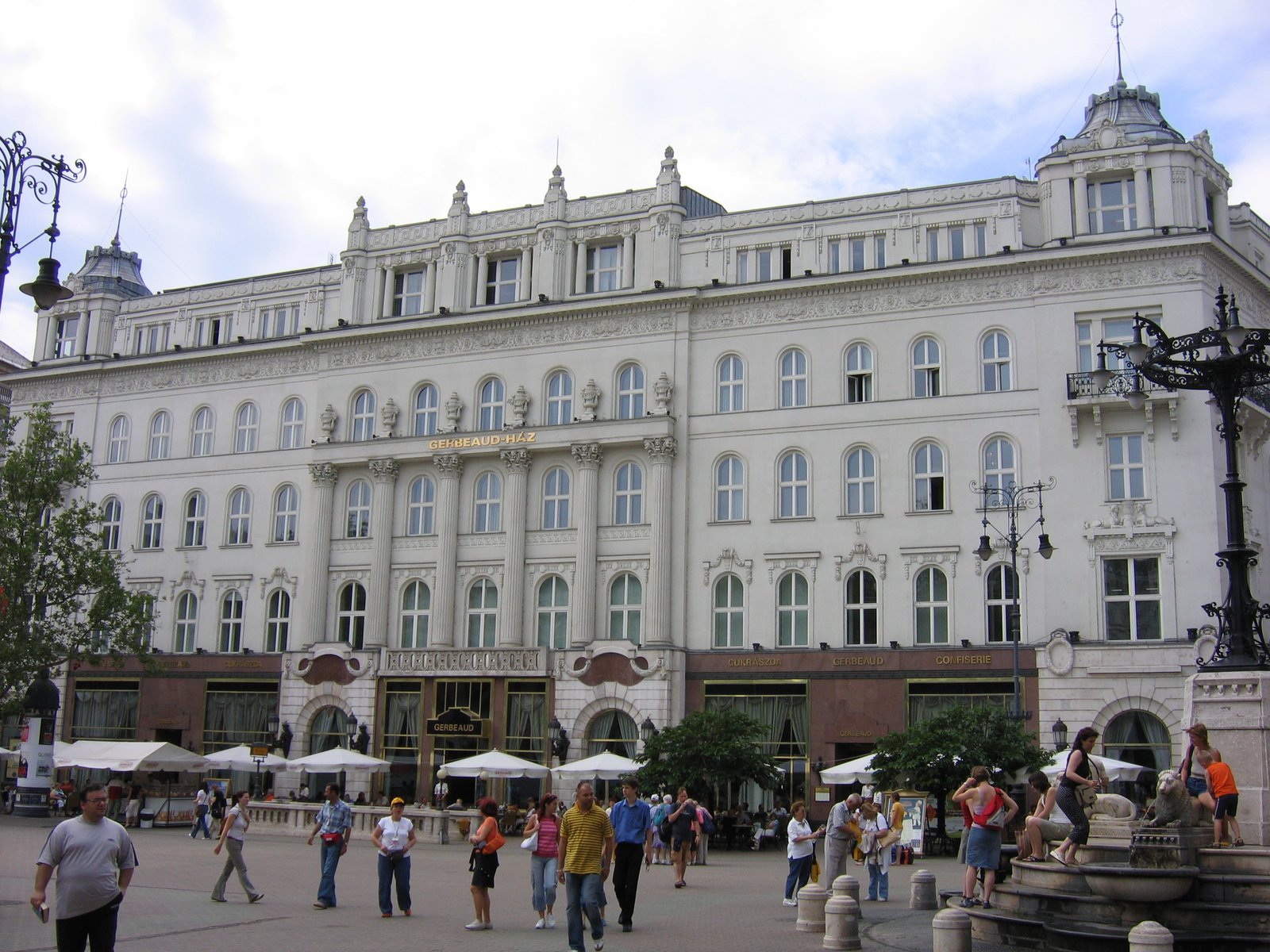

A bank’s Corinthian facade became a confectioner’s stage, and the stage outlived the bank by a century and a half.
At a glance
Café Gerbeaud occupies the ground floor of a building it was never designed for. József Hild, the architect who had already given Pest its Basilica plans, drew this corner block in 1861 as the head office of the Hungarian Commercial Bank. Confectioner Henrik Kugler moved his shop into that ground floor in 1870; his successor Emil Gerbeaud turned it into the most recognized coffeehouse name in Central Europe. The bank is long gone. The columns, the square, and the cake counter remain.
Key facts
- Address: Vörösmarty tér 7-8, 1051 Budapest
- Building built: 1861, architect József Hild (with Antal Gottgeb), for the Hungarian Commercial Bank of Pest
- Confectionery founded: 1858, Henrik Kugler; renamed for Emil Gerbeaud after 1884
- Interior redesign: 1910, Henrik Darilek — marble, exotic woods, bronze, Louis XV-style stucco ceiling
- Style: Gründerzeit / eclectic-classical facade, Art Nouveau-era interior fittings
- Ownership: nationalized 1948 as “Vörösmarty”; reclaimed its name in March 1984; bought and renovated by Erwin Franz Müller in 1995
History
Hild’s building went up in 1861 for a bank, not a bakery: a four-storey block on the newly laid-out Gizella tér (renamed Vörösmarty tér in 1900), its front carried by a row of Corinthian columns and finished with mascarons and festoons. It was one of Hild’s last commissions before his death, disciplined in its proportions but richer in surface ornament than his earlier civic work.
Henrik Kugler took the ground floor for his confectionery in 1870. His junior partner Emil Gerbeaud, a Swiss-trained pastry chef, took over the business in 1884 and expanded it into an export brand: millions of bonbons a year, a jury seat at the Brussels world’s fair of 1897 and the Paris exposition of 1900, and the Legion of Honour for the man behind the counter. When Gerbeaud died in 1919 he left the shop to his wife Ester, who ran it until 1940.
The state nationalized the café in 1948 and stripped the Gerbeaud name, calling it simply “Vörösmarty” after the square. It took until March 1984 for the family name to return to the sign, and 1995 for a private buyer — German businessman Erwin Franz Müller — to fund a full renovation. In 2009 the brand opened a second confectionery in Tokyo, a long way from the bank that built its home.
What you see
From the square, the building still reads as a bank: the Corinthian order marches across the facade with a gravity no pastry shop would have commissioned on its own. Step inside and the register changes. Darilek’s 1910 refit dropped marble, exotic timber and bronze fittings into the old banking hall, and topped it with a stuccoed ceiling worked in a Rococo idiom borrowed from Louis XV interiors — an Art Nouveau-era decorator’s answer to a mid-century classical shell.
The two registers rarely agree, and that tension is the point: a 19th-century financial facade wrapped around an early-20th-century confectioner’s room, both still doing their original jobs a century on.
Practical information
- Opening hours: Monday-Thursday and Sunday 9:00-20:00, Friday-Saturday 9:00-21:00
- Seating: no reservations — first-come, first-served at whichever table is free
- What to try: the Gerbeaud slice (Gerbeaud-szelet), a layered walnut-and-apricot cake the house has served since the Kugler era
- Beyond cake: the house runs “Gerbeaud Kult”, an events series of theatre, live music and talks inside the historic rooms
- Time needed: 30-60 minutes for coffee and cake; longer for an evening Kult event
Getting there
Vörösmarty tér sits at the top of Váci utca in Budapest’s fifth district, Lipótváros, one stop from the river on the M1 metro line — the square takes its name from the same station, Vörösmarty tér. Ferenc Liszt International Airport is a 25-30 minute taxi or airport-shuttle ride away.
Nearby
- Váci utca, Budapest’s principal pedestrian shopping street, runs south from the square
- The Danube promenade and Chain Bridge are a short walk west
- St. Stephen’s Basilica, whose original plans Hild also drew, stands a few minutes north
Sources
Find it on the map
See this place and what’s around it →📷 Become a Cultural Heritage Online photographer
Share your photos of places: they stay published under your name as the author. The more they're seen, the more you get noticed — and soon a contest will reward the most appreciated photos.
Log in or sign up free to add a photoIs this page about you?
This page is read by travellers and heritage enthusiasts who find it on Google. Tell us how you are connected to this place and we will take it from there.