
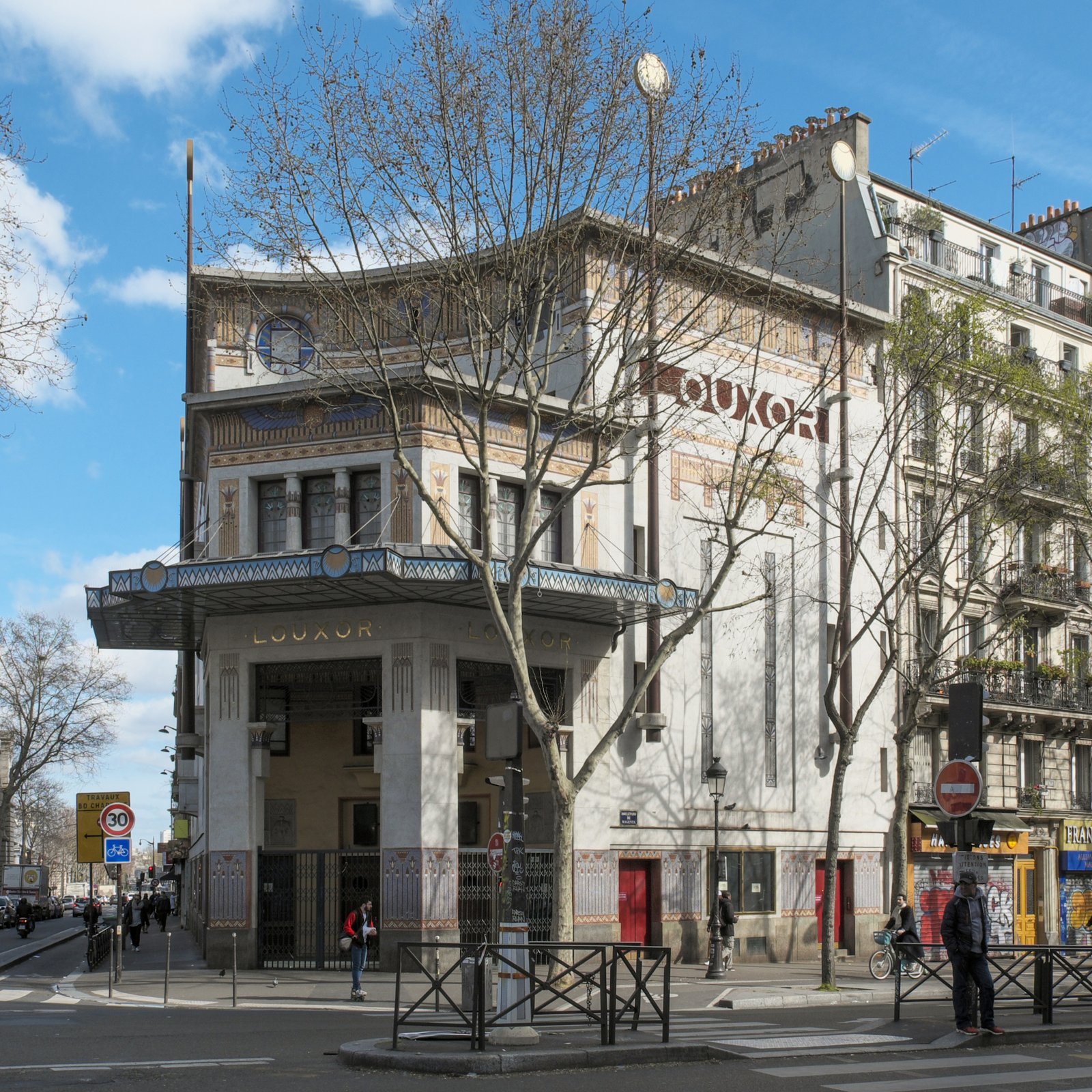
The only Egyptian-style cinema ever built in Paris, put up in 1921 for a working-class boulevard. It spent fourteen years as a nightclub and disco, then fourteen more empty, before the city bought it and gave it back.
At a glance
- Type
- Cinema, three screens; municipal property run as a public cinema
- Promoter
- Henry Zilberberg, who commissioned the building and first ran it
- Architect
- Henri Zipcy; interior decoration by Amédée Tiberti
- Opened
- 1921, with 1,195 seats
- Protection
- Facades and roof inscribed on the Inventaire supplémentaire des Monuments Historiques, 1981
- Restoration
- Philippe Pumain, appointed 2008; work from 2010; reopened 17 April 2013. Cost €24 million
- Now
- Main auditorium 342 seats, plus two screens below ground
- Address
- 170 boulevard de Magenta, 75010 Paris
- Coordinates
- 48.88348° N, 2.34985° E
Overview
Egyptomania is usually dated to the opening of Tutankhamun’s tomb. That was November 1922. The Louxor had already been showing films for more than a year by then, which makes it a building that anticipated the craze rather than followed it — and which places it instead in the older French fascination with Egypt, running from Bonaparte’s expedition through Champollion’s reading of the hieroglyphs a century before.
What Zipcy built was not a temple. It was a corner cinema for a poor quarter, given a temple’s clothes: a place where a neighbourhood that could not travel could sit inside something extraordinary for the price of a ticket.
History
Henry Zilberberg set out to build and run a cinema at 170 boulevard de Magenta and chose Henri Zipcy to design it. Amédée Tiberti decorated the interior in the same Egyptian manner. It opened in 1921 with 1,195 seats, and in 1930 passed to Pathé.
The long decline began in 1983, when Pathé sold the building to a textile firm and the cinema closed. What followed is the part most heritage accounts skip. From 1986 to 1988 it was a West Indian nightclub called La Dérobade; from 1988 to 1989, a gay disco named Megatown. Then it was shut and left empty for fourteen years.
Two years before the cinema closed, in 1981, the facades and the roof had been inscribed on the supplementary inventory of Monuments Historiques. That listing is the reason there was still a building to save.
The City of Paris bought it in 2003. In 2008 the restoration was entrusted to a team led by the architect Philippe Pumain, work began in 2010, and the Louxor reopened on 17 April 2013 at a cost of €24 million. The main auditorium came back at 342 seats — a third of the original house — with two further screens dug in below.
What you see
The building takes the corner at an angle, so the decoration is arranged to be read from the crossing rather than from either street. Above the ground floor, a band of mosaic in blue, gold and ochre carries a winged sun disc; the first-floor windows sit between engaged columns with papyrus capitals, and the cornice curves out at the top over another mosaic frieze.
Below all this projects a flat canopy, its edge banded with chevrons and set with sun-disc roundels. Under it, in gold capitals on each face of the corner, the single word LOUXOR. The same name is painted much larger, in red, across the blank flank wall on Magenta — not part of the original scheme, but the sign that tells you what the building is from the far end of the boulevard.
The Egyptian language continues inside, where it is not mosaic but ironwork and paint: a winged disc worked in black metal above a doorway, lotus friezes running the walls, capitals picked out in tesserae.
Cultural significance
Picture palaces are among the most-lost building types of the twentieth century. They were built in quantity, they were built for a technology that changed, and their sites are usually worth more than they are. The Louxor lost every round of that argument: it stopped being a cinema, it was taken over for other trades, it was abandoned. It survived because a listing in 1981 made demolition difficult, and because a city decided in 2003 that the building was worth buying back.
It matters as evidence, too. Egyptian revival cinemas were built across Europe and North America, and most are gone or unrecognisable. This is the only one Paris ever had, and it still works as what it was made for.
Practical information
- Access
- A working cinema, open to the public at screening times; programming is arthouse and repertory
- Exterior
- Free to see at any hour. The corner is the view, and it takes the afternoon light
Getting there
Barbès–Rochechouart station (metro lines 2 and 4) is at the door, where the elevated line crosses the boulevard. Gare du Nord is a few minutes’ walk south.
Sources
- Le Louxor — L’histoire du Louxor (official site) — promoter, architect, decorator, opening and seat count, Pathé, the 1981 listing, the nightclub and disco years, the 2003 purchase, Pumain, the 2013 reopening and the cost
- Dezeen — Le Louxor cinema in Paris
- OpenStreetMap Nominatim — coordinates verified against 170 boulevard de Magenta, Paris 10e
Find it on the map
See this place and what’s around it →📷 Become a Cultural Heritage Online photographer
Share your photos of places: they stay published under your name as the author. The more they're seen, the more you get noticed — and soon a contest will reward the most appreciated photos.
Log in or sign up free to add a photoIs this page about you?
This page is read by travellers and heritage enthusiasts who find it on Google. Tell us how you are connected to this place and we will take it from there.