
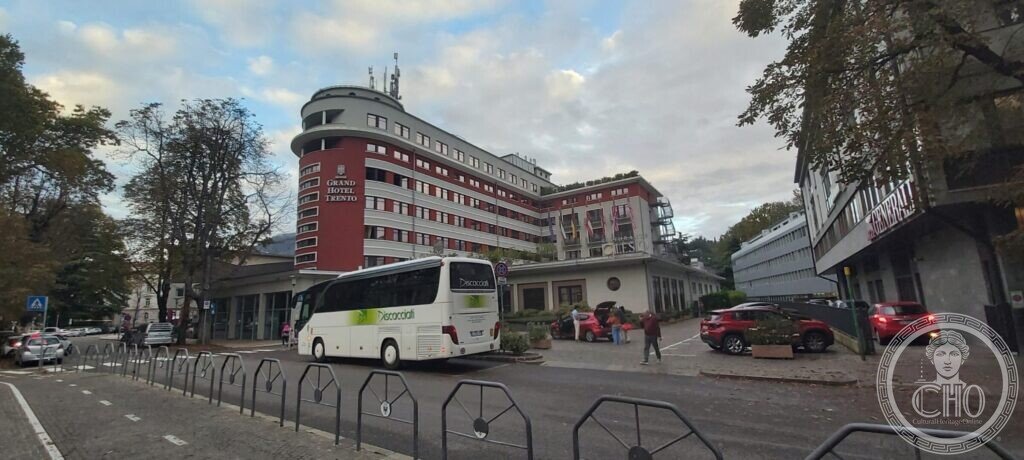
A hotel designed in 1939 and opened in the spring of 1943, in a city under bombardment. Its curved end is a direct quotation from Weimar Germany, and it is still an hotel.
At a glance
- What — a rationalist grand hotel, still in use as one
- Where — via Alfieri 1/3, on the edge of the historic centre of Trento
- Architect — Giovanni Lorenzi (Lavis, 1901 – Trento, 1962)
- Built — designed from 1939; inaugurated 4 April 1943
History
Trento was rebuilt on a large scale in the 1930s. The railway station went up between 1934 and 1936 to Angiolo Mazzoni’s design, the post office was finished in 1934, whole quarters of the old town were cleared and replaced, and the city acquired the public architecture of the period in a concentrated dose. A modern hotel of a size the city had never had was part of that programme, and the commission went to Giovanni Lorenzi, a Trentino engineer and architect who was by then building the most visible public works in the province.
The design dates from 1939. The building then went straight into the war: materials, labour and money all became difficult, the site dragged, and the hotel finally opened on 4 April 1943, five months before the Allied bombing raids that killed some two hundred people in Trento. Lorenzi’s own account treats it as his most representative work; he continued to build in the city and the province until his death in 1962.
What you see
The building turns the corner with a cylindrical drum, wrapped in continuous horizontal bands of window that run round the curve without interruption, and it is this element that carries the design. It descends directly from the department stores of Erich Mendelsohn in Weimar Germany — the Schocken store at Stuttgart of 1926 is the usual comparison, and it is a fair one: the same glazed curve, the same insistence on the horizontal, the same idea of a building that reads as a moving surface rather than a stack of storeys.
Behind the drum the block runs long and straight, six storeys of regular windows over a lower base, with the entrance canopy and the restaurant wing spread out at ground level. The present dark red and grey colouring is a later scheme; what has not changed is the massing, which was designed to be seen from a distance, with the curve turned towards the mountains that close the valley to the north.
Cultural significance
Interwar Italian rationalism is usually met in public buildings — stations, post offices, party headquarters, schools. Hotels are rarer, because a hotel has to keep working commercially long after the regime that encouraged it has gone, and most of them were remodelled out of recognition. The Grand Hotel Trento is one that did not: it is still a functioning hotel, on its original site, with its defining architectural gesture intact. For the history of Trento it also marks the moment when the city equipped itself for a tourism it would only really receive after the war.
Practical information & getting there
The hotel stands a few minutes’ walk north-west of Trento station, on the route between the station and Piazza Dante. It is a working hotel and the interiors are for guests, but the exterior — which is the point — is fully visible from the street; the curve reads best from the open ground on the far side of via Alfieri.
Sources & resources
- Grand Hotel Trento — the hotel’s own history page, for the 1939 design, the wartime construction and the opening on 4 April 1943.
- Giovanni Lorenzi (1901–1962) — biography and works.
- Architettura fascista a Trento — survey of the city’s interwar building programme.
Find it on the map
See this place and what’s around it →Record researched and written by Stefano Vigolo for Cultural Heritage Online, 2026.
📷 Become a Cultural Heritage Online photographer
Share your photos of places: they stay published under your name as the author. The more they're seen, the more you get noticed — and soon a contest will reward the most appreciated photos.
Log in or sign up free to add a photoIs this page about you?
This page is read by travellers and heritage enthusiasts who find it on Google. Tell us how you are connected to this place and we will take it from there.