
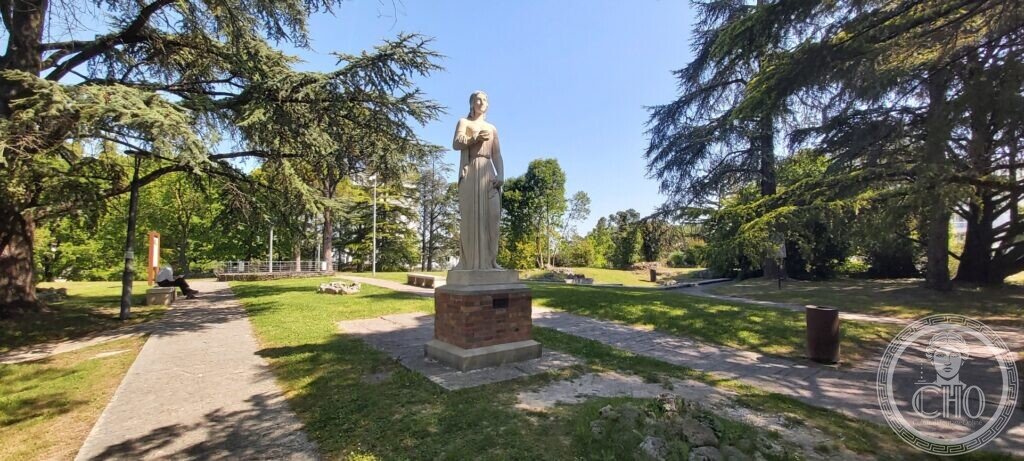
A goddess of health, in stone, standing over the hot spring that made the town. She was put there in 1942, and her name is on the brickwork under her feet.
At a glance
- What — a stone statue of Hygieia, the Greek goddess of health, on a brick pedestal
- Where — the Montirone, the thermal hill in the centre of Abano Terme, province of Padua
- Made — 1942, by the sculptor Paolo Boldrin (1887–1965)
- Access — a public park, open and free, a few minutes from the town centre
History
The Montirone is the reason Abano Terme exists. It is a low hill of thermal deposit in the middle of the town, built up over millennia by the hot mineral water that rises here at around 80 °C, and the Romans already knew it — Aponus, the spring that takes away pain, appears in Latin poetry. Around the hill the modern spa town grew: colonnades, an oratory, the eighteenth-century bathing establishment, and a public park of cedars and holm oaks.
In 1942 a statue was set on the summit of that hill: Hygieia, daughter of Asclepius and the personification of health in Greek religion, carved in stone by Paolo Boldrin. The choice was not decorative. A spa town claiming an ancient healing spring puts the goddess of health at the top of it: the statue is an argument about what the place is for, made in the classicising language that Italian public sculpture used in those years.
What you see
The figure stands upright and frontal, draped in a long tunic that falls in close vertical folds to the ankles, with a shawl gathered at the shoulders. The head is inclined slightly and the hair is bound low. She holds a shallow vessel at her breast — the patera from which Hygieia, in classical iconography, feeds the sacred serpent. The carving is smooth and unhurried, the surfaces broad, the detail concentrated in the face and in the fall of the cloth: a deliberately calm, archaic manner rather than a naturalistic one.
She stands on a plinth of red brick, itself set on a low stone base, at the end of a paved path in the park. Set into the brick is a small brass plate, and this is the statue’s own documentation:
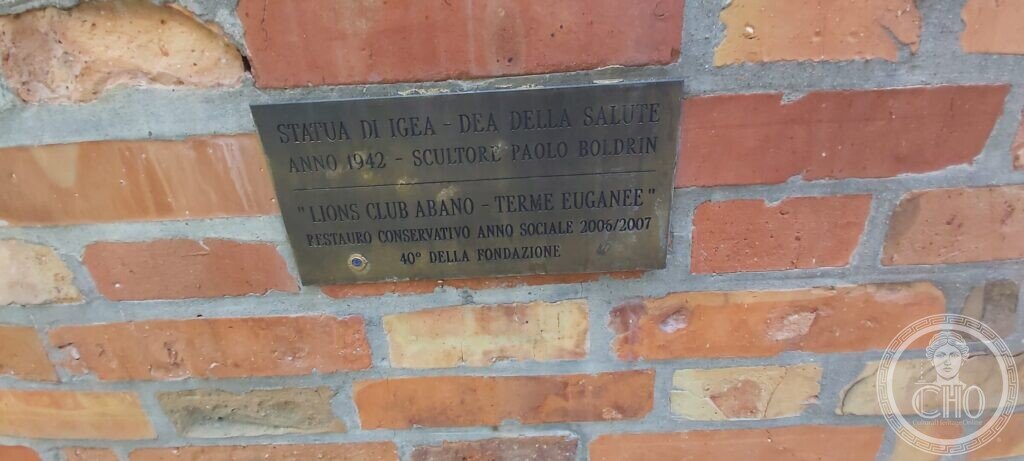
It reads Statua di Igea — dea della salute / Anno 1942 — scultore Paolo Boldrin, and below, in a second panel, records that the Lions Club Abano – Terme Euganee paid for a conservation restoration in the club year 2006/2007, on the fortieth anniversary of its foundation. A statue that carries its own attribution on the plinth is rarer than it sounds, and it is the reason everything above can be said without hedging.
Cultural significance
Paolo Boldrin (1887–1965) trained at the academies of Venice and Bologna and worked for most of his life in the Padua district, where a good deal of public and religious sculpture is his; among his other works at Abano is the fountain-monument to Christopher Columbus. He was among the promoters of the International Exhibition of Sacred Art held in Padua in 1931. Like most Italian sculptors who took public commissions between the wars, he worked inside the cultural institutions of the Fascist regime, and this Hygieia belongs to the last years of that period — 1942, with Italy at war and the spa town’s hotels being turned over to military convalescence.
What survives is not a political monument, though, and that is why it is still standing where it was put. It is a classical health-goddess over a classical healing spring, and the town has kept it, cleaned it, and left the sculptor’s name on it.
Practical information & getting there
Abano Terme is about 10 km south-west of Padua, reached by frequent buses from Padua station or by car from the A13 motorway. The Montirone park is in the centre of the town, beside the historic bathing establishment and the ex-oratory; entry is free and the paths are level, with the final approach to the statue on a gentle rise. The best light is in the morning, when the cedars are behind the figure rather than across it.
Sources & resources
- The plate on the pedestal, photographed on site, for the subject, the date of 1942, the name of the sculptor and the 2006/2007 restoration.
- Montirone (Abano Terme) — for the placing of the statue on the summit of the hill in 1942.
- Ossicella — on the sculptor Paolo Boldrin (1887–1965).
Find it on the map
See this place and what’s around it →Record researched and written by Stefano Vigolo for Cultural Heritage Online, 2026.
📷 Become a Cultural Heritage Online photographer
Share your photos of places: they stay published under your name as the author. The more they're seen, the more you get noticed — and soon a contest will reward the most appreciated photos.
Log in or sign up free to add a photoIs this page about you?
This page is read by travellers and heritage enthusiasts who find it on Google. Tell us how you are connected to this place and we will take it from there.