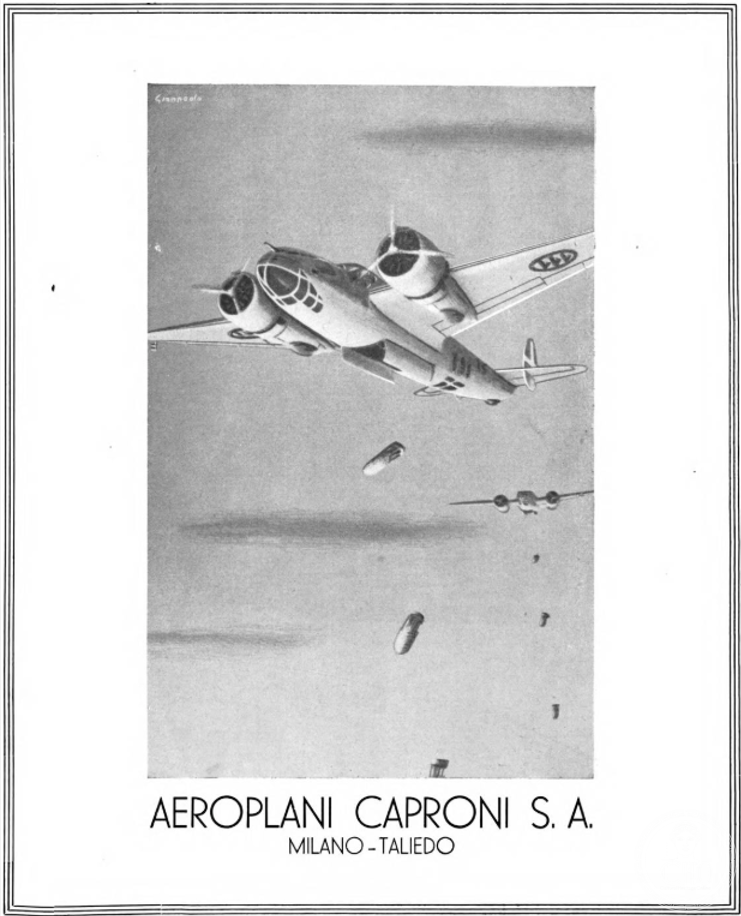
A twin-engine bomber banks out of the frame, and four bombs are already falling away from it. The drawing is soft, almost tender in its greys. What it advertises is a factory.
The plate is monochrome, worked in airbrush and pencil over a grey ground, and framed by a thin triple rule of the kind used for magazine advertising pages rather than street posters. The aircraft fills the upper half at a steep angle, seen from below and behind: two radial engines in smooth cowlings, a glazed nose, twin fins, national fasces marked on the wing. Beneath it the bombs are drawn falling in sequence, and a second aircraft crosses the middle distance in silhouette. At the foot, in modern sans capitals: AEROPLANI CAPRONI S. A. — MILANO-TALIEDO.
What is striking, seventy-odd years later, is the register. There is no explosion, no target, no ground at all. The bombs fall into empty air, drawn with the same delicacy as the clouds, and the composition asks to be read as a study of flight rather than of bombing. That evasion is itself a document: it is how the Italian aeronautical industry chose to picture its own product for the reading public.
Taliedo
Taliedo, on the eastern edge of Milan, was the home plant of Aeronautica Caproni and the origin of the whole group — Giovanni Battista Caproni was known as Caproni di Taliedo. By the outbreak of the Second World War the group was an industrial giant, controlling four companies in Lombardy alone: Aeronautica Caproni at Taliedo, Caproni Aeronautica Bergamasca at Ponte San Pietro, Isotta Fraschini at Milan and Saronno, and Caproni Vizzola at Vizzola Ticino, with some twenty-five thousand employees between them. In the post-war years the group was dismantled for financial and political reasons; only Vizzola survived, working as a subcontractor for other firms.
Gianpaolo
In the top left corner, in a small white cursive, the plate is signed Gianpaolo — a single name, without a surname.
That is precisely how Giampaolo Lazzaro signed his paintings. Born at Padua on 4 February 1911 and dead in Milan on 20 December 1977, Lazzaro studied at the Accademia di Brera and was active in the Italian avant-garde from the 1930s to the 1970s; in 1927, aged sixteen, he had travelled to Siam with Francesco Dal Pozzo, called to teach drawing at the Royal Academy in Bangkok. His paintings pass regularly through Italian salerooms.
The identification is the collector’s, and we report it with the qualification it deserves: the signature on this plate matches the name Lazzaro used, and no other Italian illustrator signing simply «Gianpaolo» has come to light, but we have found no catalogue entry, no exhibition record and no monograph that ties this particular advertising plate to him. Commercial work of this kind rarely enters an artist’s catalogue at all, which is one reason it disappears.
About this image. The work is still protected by copyright: under Italian law (L. 633/1941) rights run for 70 years from the death of the author, and Giampaolo Lazzaro died in 1977. It is reproduced here for documentation, study and critical purposes only, under Art. 70 of L. 633/1941 and the fair-use provision of 17 U.S.C. §107. The scan was made by the collector from his own copy of the sheet, part of the period material he keeps in a private archive: owning the physical sheet is not the same as holding the rights to the work. The image is not offered for sale, no reproduction rights are granted, and any request concerning the work should be addressed to the rights holders. Cultural Heritage Online publishes this material to document it, with no celebratory intent; see our terms and the DMCA contact published there.
Sources
- S1 — Curami, Andrea, e Gianni Rocca. I Caproni: Aerei e progetti dell'ingegner Gianni Caproni. La Bancarella Aeronautica, 1999. ISBN 978-88-88402-07-9.
- S2 — Castronovo, Valerio. L'industria italiana dall'Ottocento a oggi. Mondadori, 1980. ISBN 978-88-04-17765-4.
Spotted an error? Write to editorial@culturalheritageonline.com and we correct it the same day.