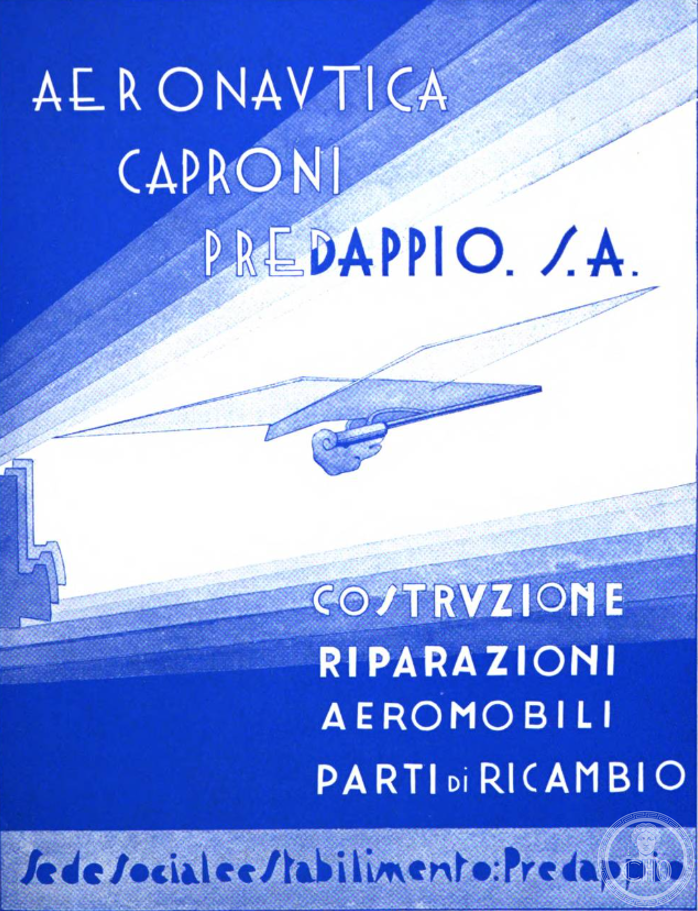
An aircraft drawn as pure outline, flying out of a fan of light, above four words of plain trade language: construction, repairs, airframes, spare parts. And at the bottom, the address that explains why this factory existed at all — Predappio.
The sheet is printed in one blue. Diagonal bands of light open from the upper left; across them an aeroplane is drawn in nothing but contour line, transparent, with a stub of engine and a suggestion of undercarriage, so that the rays pass straight through it. The lettering is the interesting part: AERONAVTICA in outline capitals with a V for U in the Roman manner, CAPRONI solid, and then PREDAPPIO built half and half — PRE in outline, DAPPIO filled in heavy blue, so that the eye is pulled to the second half of the word. Down the right runs the list of services: COSTRUZIONE, RIPARAZIONI, AEROMOBILI, PARTI DI RICAMBIO. A band across the foot, in a fast script, gives the registered office and works: Predappio.
A factory placed by decision, not by geography
Predappio is the birthplace of Benito Mussolini, and in the 1930s it was rebuilt as a showcase of the regime. An aircraft works there was not the product of industrial logic — there was no aeronautical district in that part of Romagna — but of the wish to put modern industry in the Duce’s home town, under the direction of Giovanni Battista Caproni himself.
Construction began in 1933, incorporating two existing buildings that had belonged to the Società Zolfi, a sulphur-mining concern; the two floors separated milling and turning below from welding and airframe assembly above. The workshop was finished in 1935 and began with the Savoia Marchetti S.M.81 trimotor. From 1937 it produced the Caproni Ca.164 training biplane exclusively, a hundred and fifty of them, built at Predappio, dismantled, carted to the airfield at Forlì and reassembled there — the town had the factory but not the runway. The plant was enlarged in 1940 for fighter production after Italy entered the war, and its workforce went from six hundred to more than a thousand. In 1944 German troops in retreat stripped the machinery out and production stopped. In the 1950s a Dutch entrepreneur used the buildings as a poultry hatchery. They stand today, empty.
All of which gives this modest trade sheet an afterlife its designer would not have expected. It advertises spare parts; it also documents a complex of industrial buildings that is now one of the more substantial abandoned sites in Romagna.
On the attribution
The collector attributes the sheet to Nino Dabaz, whom he gives as the pen name of Giovanni Battista Dabusti, born at Voghera in 1908 and dead at Milan in 1980. We have not been able to confirm that artist in any accessible source: the name returns nothing in Italian poster literature, in auction records or in biographical repertories, and we can find no independent trace of the dates. This sheet carries no visible signature.
We therefore publish it without asserting an author. The attribution is recorded here as the collector’s, and anyone able to confirm or correct it — a printer’s mark, a signed variant, a catalogue entry — is asked to write to us. A companion sheet for Caproni Aeronautica Bergamasca, from the same collection, does carry a cursive signature beginning with a D, which is the only material support the attribution has.
About this image. The work is still protected by copyright: under Italian law (L. 633/1941) rights run for 70 years from the death of the author, and since the author of this sheet is not established that term cannot be considered expired. It is reproduced here for documentation, study and critical purposes only, under Art. 70 of L. 633/1941 and the fair-use provision of 17 U.S.C. §107. The scan was made by the collector from his own copy of the sheet, part of the period material he keeps in a private archive: owning the physical sheet is not the same as holding the rights to the work. The image is not offered for sale, no reproduction rights are granted, and any request concerning the work should be addressed to the rights holders. Cultural Heritage Online publishes this material to document it, with no celebratory intent; see our terms and the DMCA contact published there.
Sources
- S1 — Curami, Andrea, e Gianni Rocca. I Caproni: Aerei e progetti dell'ingegner Gianni Caproni. La Bancarella Aeronautica, 1999. ISBN 978-88-88402-07-9.
- S2 — De Felice, Renzo. Mussolini il duce: Gli anni del consenso 1929-1936. Einaudi, 1974. ISBN 978-88-06-03730-7.
Spotted an error? Write to editorial@culturalheritageonline.com and we correct it the same day.