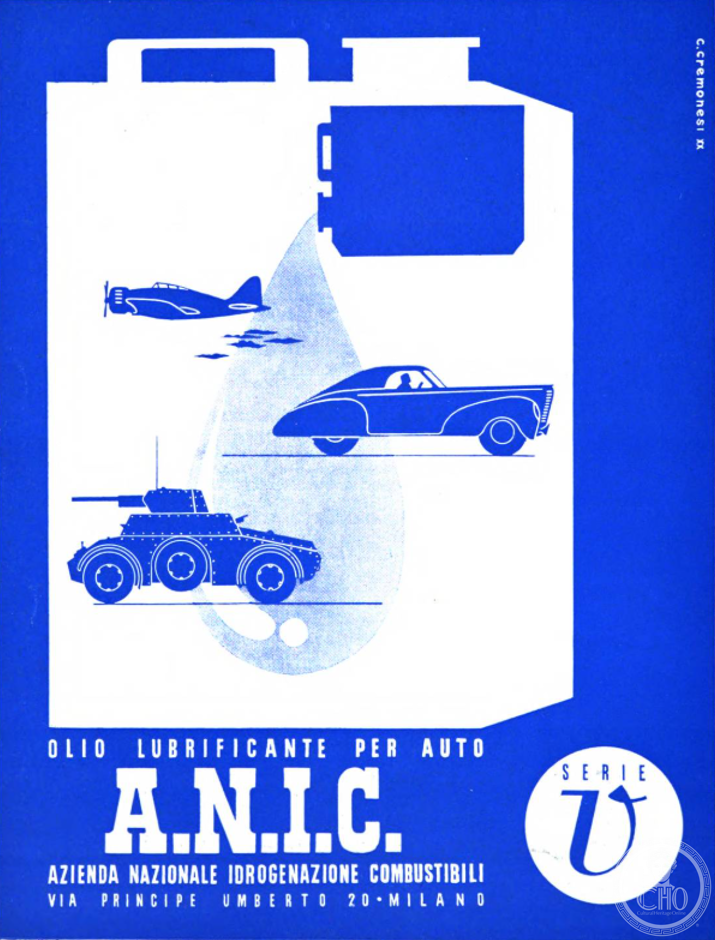
One colour, one idea: a drop of oil falling through the shape of a can, and inside it three vehicles that have nothing to do with one another — a fighter, a sports car and an armoured car. The same oil for all three. That is the whole argument of Italian autarky, drawn on a single sheet.
The sheet is printed in a single blue, in the flat poster manner of the early 1940s. A white silhouette of a two-handled fuel can fills the upper two thirds; over it falls a pale drop, and against the drop three vehicles are drawn in outline — a low-wing fighter trailing exhaust, a streamlined coupé with a driver just sketched in, and, below, a six-wheeled armoured car with its turret and gun. At the foot, in fat sans capitals: OLIO LUBRIFICANTE PER AUTO — A.N.I.C. — AZIENDA NAZIONALE IDROGENAZIONE COMBUSTIBILI — VIA PRINCIPE UMBERTO 20, MILANO. A roundel at the lower right reads SERIE V.
The three vehicles are the message. A private car, a warplane and an armoured vehicle share one lubricant, which is another way of saying that the private motorist and the armed forces are drinking from the same barrel — a barrel Italy was trying, at that moment, to fill without importing anything.
Petrol out of coal
A.N.I.C. was set up in 1936 as a joint venture between the state oil company Agip and the chemical group Montecatini. Its purpose was written into its name: idrogenazione combustibili, the hydrogenation of fuels — making petrol and lubricants out of brown coal and out of heavy Albanian crude. The reason was the sanctions imposed on Italy by the League of Nations in November 1935 after the invasion of Ethiopia, which pushed the regime towards autarky at a moment when roughly three quarters of Italian energy came from abroad. Patents were bought from I.G. Farben and from the International Hydrogenation Engineering & Chemical Company. Once the refineries were running, Italian petrol production rose from about 290,000 tonnes in 1937 to 520,000 in 1939. In 1953 the company was absorbed into Eni.
Synthetic oil was therefore not a product like any other. Advertising it meant advertising a policy, and this sheet does the job without a word of politics: it just puts the car and the tank in the same drop.
The signature, and the year
Down the right edge, set vertically in small capitals, the sheet is signed C. CREMONESI XX. The XX is not a serial number: it is the year of the Fascist era, which ran from 29 October 1941 to 28 October 1942 — and it matches the date of 1941–42 given by the collector.
The name points to Carmelo Cremonesi, known professionally as Lelo Cremonesi, born in Milan in 1919 and dead there on 5 November 2018. According to the historical archive of the Fondazione Fiera Milano, he trained and served his apprenticeship in the artistic studio of the printing house Amilcare Pizzi, and in 1939 entered the studio of Gino Boccasile — then the most conspicuous poster designer in Italy. In 1950 he founded Studio Stile with Gian Carlo Rossetti; in the 1960s the studio joined the Plan International network and worked as correspondent for the American Grant Advertising group; between 1978 and 1985 Cremonesi drew the official posters of the Milan Trade Fair. A sheet signed with that surname in 1941–42, drawn in Milan for a Milanese advertiser, sits exactly where a young draughtsman in Boccasile’s orbit would have been. No published catalogue of this particular poster has been found, so the attribution rests on the signature and on that fit, not on a documented record.
About this image. The work is still protected by copyright: under Italian law (L. 633/1941) rights run for 70 years from the death of the author, and Lelo Cremonesi died in 2018. It is reproduced here for documentation, study and critical purposes only, under Art. 70 of L. 633/1941 and the fair-use provision of 17 U.S.C. §107. The scan was made by the collector from his own copy of the sheet, part of the period material he keeps in a private archive: owning the physical sheet is not the same as holding the rights to the work. The image is not offered for sale, no reproduction rights are granted, and any request concerning the work should be addressed to the rights holders. Cultural Heritage Online publishes this material to document it, with no celebratory intent; see our terms and the DMCA contact published there.
Sources
- S1 — Pozzi, Daniele. Dai gatti selvaggi al cane a sei zampe: Tecnologia e organizzazione nell'Agip. Marsilio, 2009. ISBN 978-88-317-9712-2.
- S2 — Castronovo, Valerio. L'industria italiana dall'Ottocento a oggi. Mondadori, 1980. ISBN 978-88-04-17765-4.
Spotted an error? Write to editorial@culturalheritageonline.com and we correct it the same day.