
A rock in the Channel, barely a kilometre long, garrisoned by German sailors, Italian marines still fighting for a republic that no longer controlled Italy, and Soviet volunteers fighting for neither side they were born into. It took nearly 20,000 bombs, and reportedly Europe’s first use of napalm, to end it.
At a glance
Six French naval guns, recovered and repurposed by German forces, sat on Cézembre inside a ring of 35 bunkers built between 1943 and June 1944 — strong enough, and isolated enough at sea, that when Saint-Malo fell to American forces on 14 August 1944, the island simply kept fighting. It had its own water supply, its own command, and no reason under German orders to surrender because the mainland had.
What followed was one of the most intense bombardments applied to any single position in the Western European campaign, against a garrison of perhaps 400 men on an island most of them could have walked across in twenty minutes.
Key facts
- Armament: six 194.4 mm Schneider guns of French naval origin (model 1870–93), installed by German forces in 1942, 360° traverse, range about 18 km
- Fortification: 35 bunkers built 1943 – June 1944 (command bunker, paired shelters, ammunition depots), designated Stützpunkt Ostwall by the German command; anti-aircraft defence of six 7.5 cm guns plus 20 mm and 40 mm cannon
- Garrison: around 300–400 men — German Kriegsmarine personnel, some 53–75 Italian marines of the pro-German Repubblica Sociale Italiana’s 1st Atlantic Rifle Division, around 20 Soviet volunteers, and Moroccan and Polish prisoners; commanded by Oberleutnant Richard Seuss
- Saint-Malo fell to the US 83rd Infantry Division on 14 August 1944; Cézembre, isolated and self-sufficient, fought on
- Bombardment: from 6 August, intensifying from 17–18 August after the garrison refused to surrender; between 28 August and 2 September, 19,729 bombs were dropped, leaving more than 2,000 craters, alongside some 20,000 rounds of land and naval artillery, including the battleship HMS Malaya‘s 380 mm guns
- 31 August 1944: an attack by 24–33 P-38 Lightning fighter-bombers used napalm (76 bombs) and phosphorus against the island — documented in French sources as the first recorded use of napalm in Europe
- Surrender: 2 September 1944, white flag at 7:30, formal surrender at 9:30 to General Robert Macon; 322 Germans (90% wounded) and 67 Italians taken prisoner
- Coordinates: 48.6768° N, 2.0715° W
How it held
What let Cézembre outlast Saint-Malo was not the strength of any single bunker but the fact that it did not need the mainland at all. Its own water distillation plant, its own ammunition stores, and a chain of command answerable to the German naval authorities for the Channel Islands rather than to whoever held the city across the water meant the garrison had no operational reason to treat the fall of Saint-Malo as its own defeat. The island’s six naval guns, decades old but still functional, covered the approaches to the city and the coast; taking them out meant taking the island, and taking the island meant doing it from the air and by sea, against a target with nowhere to retreat to.
Nineteen days under fire
From 17 or 18 August, when the garrison rejected the first demand to surrender, to 2 September, the island absorbed a concentration of firepower disproportionate to its size: nearly 20,000 bombs in the final week alone, tens of thousands of artillery rounds from guns on land and from warships including a battleship’s main armament, and, on 31 August, an attack with napalm and phosphorus that French sources record as the first use of that weapon in the European theatre — though napalm had already been used weeks earlier in the Pacific, at Tinian. English-language accounts of the siege describe the eventual German and Italian casualties as comparatively light, a detail that sits uneasily beside more than 2,000 bomb craters on an island a little over a kilometre long.
Who tells it, and where the accounts diverge
The island’s own commemorative framing today, on the coastal path the Conservatoire du littoral opened to visitors in 2018, treats Cézembre chiefly as a landscape — a scar, thousands of craters still visible, ordnance still buried in places, the physical record of what nineteen days of bombardment leaves behind. It is not a triumphal story, and it does not need to argue with anyone about the war’s outcome.
What that framing tends not to foreground is the specific, documented claim that this is where napalm was first used against a European target — a fact recorded plainly in French historical sources but rarely singled out as the historically notable first it would be treated as almost anywhere else. It sits inside the general account of «one of the last pockets to fall» rather than being flagged on its own terms. Nor does either the landscape framing or the operational history dwell long on who was actually holding the island when the bombs fell: German sailors, Italian marines loyal to a government that existed only on paper by 1944, and Soviet men fighting in German uniform against the country of their birth — a garrison assembled from the wreckage of several collapsing allegiances, defending six antique guns on a rock in the Channel.
What you see today
- A coastal path across the island, opened to the public in 2018, passing bunker ruins, gun emplacements and bomb craters largely as the 1944 bombardment left them.
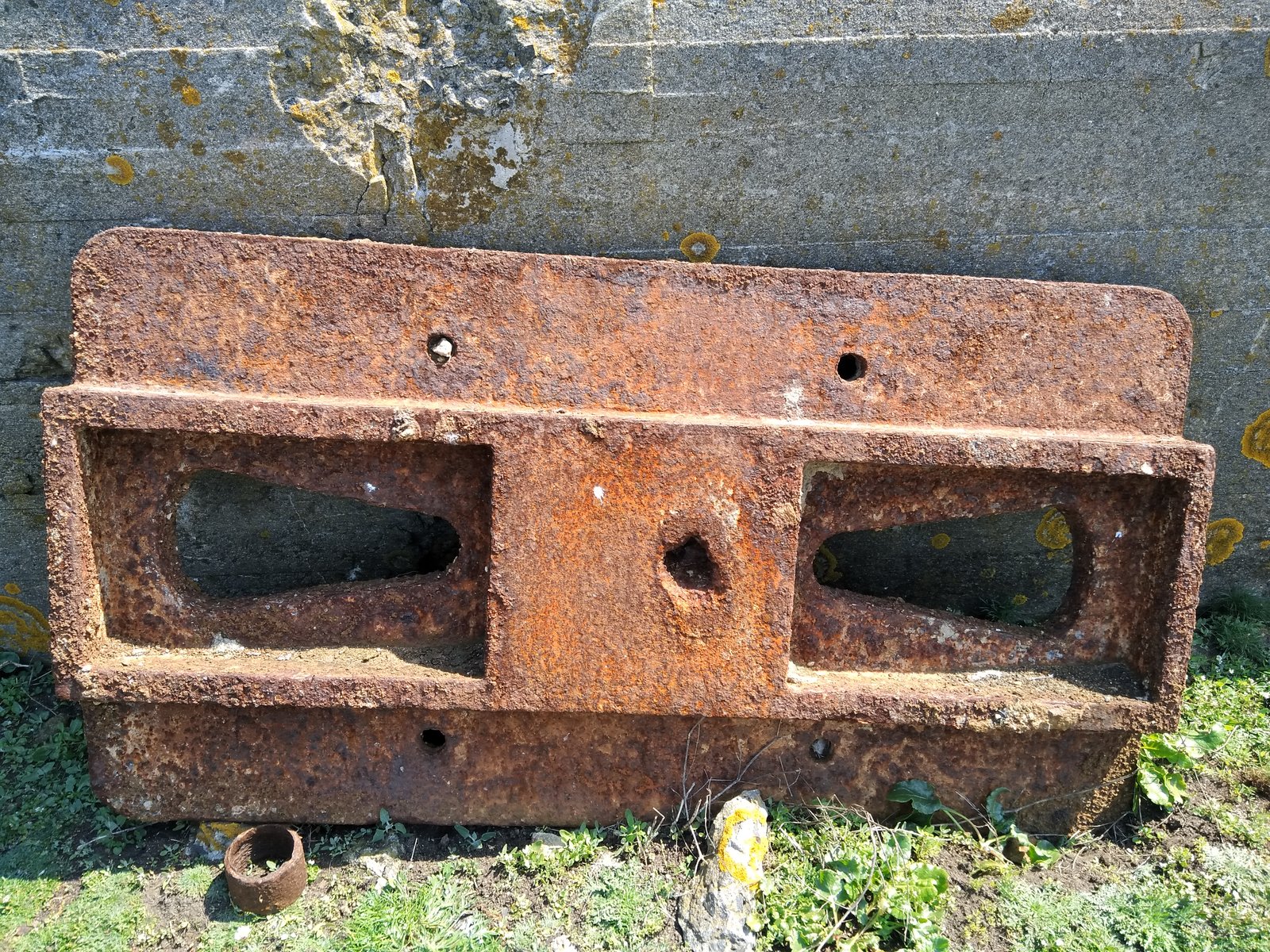
- Remains of several of the six 194 mm gun positions and surrounding bunkers.
- The island remains partially affected by unexploded ordnance in places; visits follow marked routes.
Getting there
Cézembre lies about 4 km off Saint-Malo, Brittany, reached by seasonal boat service from the town’s port.
Nearby
- Saint-Malo’s walled old town, largely rebuilt after the 1944 fighting on the mainland
- The Fort National and other Atlantic Wall remains along the Emerald Coast
Sources
- Wikipedia (English and French), Battle of Saint-Malo and Bombardement de Cézembre — garrison composition, bombardment figures, the napalm attack, surrender terms, cross-checked between language versions.
- Inventaire Général du Patrimoine Culturel, Région Bretagne, dossier IA35032908 — fortification details and construction dates.
Find it on the map
See this place and what’s around it →📷 Become a Cultural Heritage Online photographer
Share your photos of places: they stay published under your name as the author. The more they're seen, the more you get noticed — and soon a contest will reward the most appreciated photos.
Log in or sign up free to add a photo