

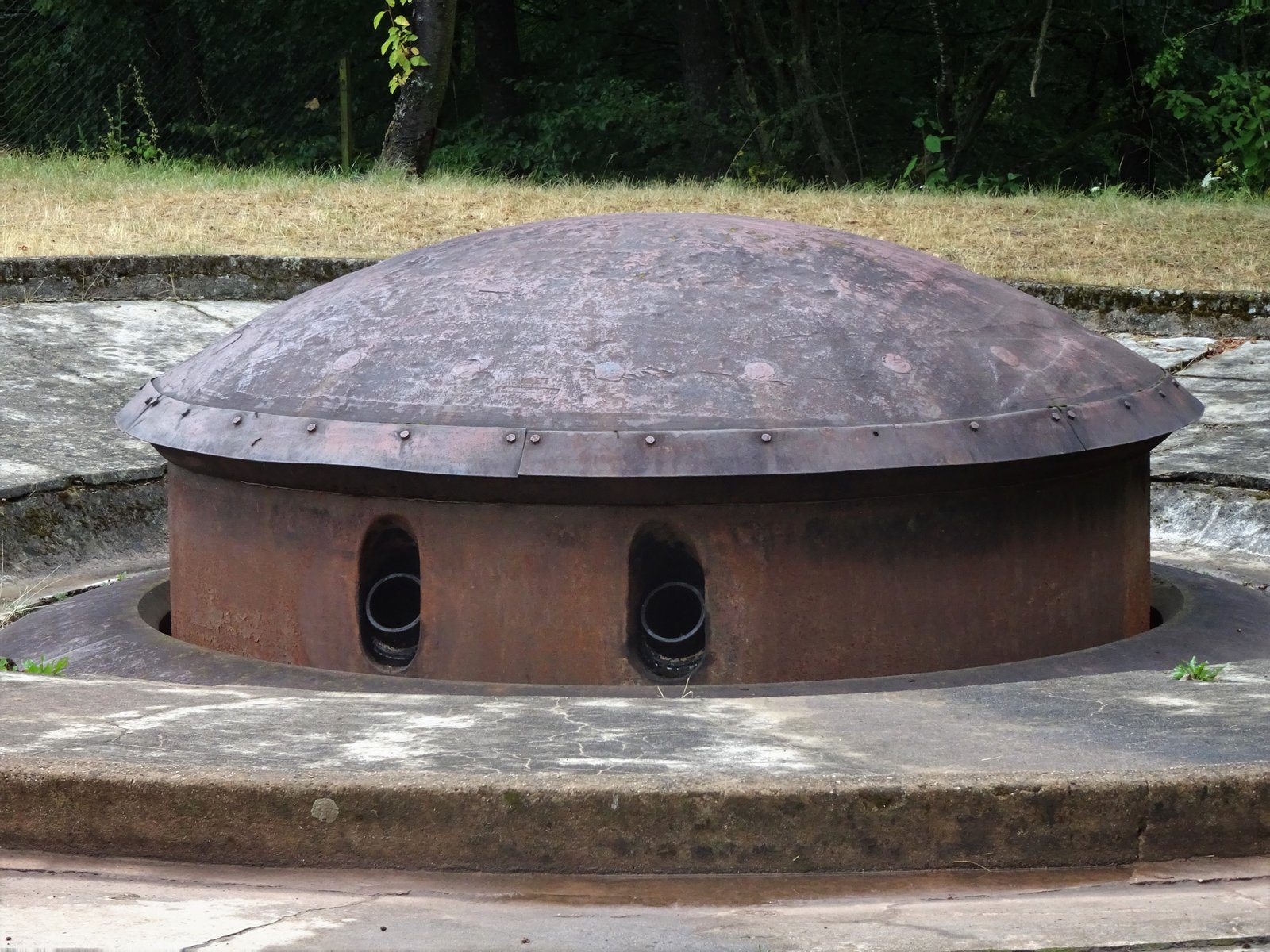
The largest fortress of the Maginot Line is called, in the same breath, part of a strategic failure. It is a fair verdict about where the line ran out. It is not a fair verdict about this fort, which was never broken through — not in 1940, and not until an American armoured division did it in a week in November 1944.
At a glance
Ten kilometres of galleries, nineteen surface blocks, and an internal electric railway to move men and ammunition between them — the Ouvrage du Hackenberg, built between 1930 and 1935 at a cost of roughly 200 million francs, was the biggest single work of the Maginot Line, France’s fortified answer to the trauma of 1914–18. It is remembered today mostly as part of a line that failed. It held, on its own ground, for longer than the line itself lasted.
Key facts
- Built: 1930–1935, roughly 1,800 workers, cost around 200 million francs
- Scale: 10 km of underground galleries, 19 surface blocks (17 combat blocks plus 2 entrances), an internal electric railway still functional today, the largest single ouvrage on the Maginot Line
- Garrison: sources give a range — roughly 940–1,040 men and 41–43 officers in June 1940
- 1940: never directly attacked; provided covering fire to neighbouring positions (Block 5 fired on Dalstein, 22 June); the armistice was signed 22 June 1940, effective from the 25th — the garrison evacuated only on 4 July, over a week later, among the last French units to leave their positions
- German occupation 1940–44: used as an underground factory by Klöckner-Humboldt-Deutz, producing transmission components, with deported labour from 1943; two explosions damaged the ammunition depot and an entrance
- November 1944: attacked by the US 90th Infantry Division (Patton’s Third Army), 15–19 November; Block 8’s 75 mm guns fired 99 rounds onto the American position in 90 seconds before a self-propelled 155 mm gun breached the facade on the 16th; the fort was fully occupied on 19 November
- Coordinates: 49.3462° N, 6.3674° E (main entrance)
How it was built
Hackenberg was built to a logic the rest of the Maginot Line shared: a continuous fortified front along France’s border with Germany, thick enough and deep enough that no direct assault could break through. Ten kilometres of tunnels connected nineteen armoured blocks, each a self-contained fighting position, linked by an internal railway so that men, shells and supplies never had to move above ground under fire. It was, by design, meant to be the hardest single point on the entire line to take — and for as long as anyone tried to take it directly, it was.
Two campaigns, four years apart
In 1940, no one tried. German forces broke into France through the Ardennes and Belgium, north of where the Maginot Line’s heaviest fortifications ran, and Hackenberg spent the six-week campaign firing in support of neighbouring sectors rather than defending itself against direct assault. When the armistice took effect on 25 June, the fort was still intact, still armed, and still manned; its garrison left on 4 July only because they were ordered to, more than a week after the fighting had officially stopped.
The test it never faced in 1940 came in November 1944, from the other direction. American infantry and armour spent five days reducing a position the Germans, now defending it, had reoccupied. Block 8 fired nearly a hundred rounds in a minute and a half against the attacking force before heavier American armour finally breached its facade. It took a modern armoured division the better part of a week to do what six weeks of the 1940 campaign never asked of the fort at all.
Who tells it, and where the accounts diverge
The Maginot Line’s reputation as a failure is well earned, but it is earned by geography, not by combat record: the line was strong exactly where France expected the attack to come, and the German army came somewhere else. Hackenberg, one of the strongest single points on that line, was never tested by the failure it is remembered for. What broke the Maginot Line’s reputation in 1940 was the ground it did not cover, not the ground it did.
Hackenberg’s own record makes the distinction concrete. Untouched by direct assault in 1940, evacuated only on order after the war had already ended around it, then genuinely fought for and taken by an American division four years later — the fort’s history separates the line’s strategic failure from its tactical strength more clearly than almost any other position on the Line. It held where it stood. The Line simply did not stand everywhere it needed to.
What you see today
- Ten kilometres of galleries and multiple combat blocks open to guided visits, including armoured turrets and the internal electric railway, still used to move visitors between sections.
- Original 1930s equipment, including the 1935 electric locomotive, preserved in working order.
- One of the most extensive Maginot Line sites open to the public, run today as a private museum.
Getting there
The Ouvrage du Hackenberg lies near Veckring, Moselle, close to the German and Luxembourg borders, roughly 30 km north of Metz.
Nearby
- Thionville, the nearest larger town, on the Moselle river
- Other Maginot Line ouvrages in the Moselle sector, part of the same fortified system
Sources
- Wikipedia (English and French), Ouvrage Hackenberg / Ouvrage du Hackenberg — construction, garrison figures, 1940 and 1944 campaigns, cross-checked between language versions for the discrepancies noted.
- Chemins de mémoire (cheminsdememoire.gouv.fr), Gros ouvrage Maginot du Hackenberg — official French government heritage account, construction cost and 1940 role.
Find it on the map
See this place and what’s around it →📷 Become a Cultural Heritage Online photographer
Share your photos of places: they stay published under your name as the author. The more they're seen, the more you get noticed — and soon a contest will reward the most appreciated photos.
Log in or sign up free to add a photo