
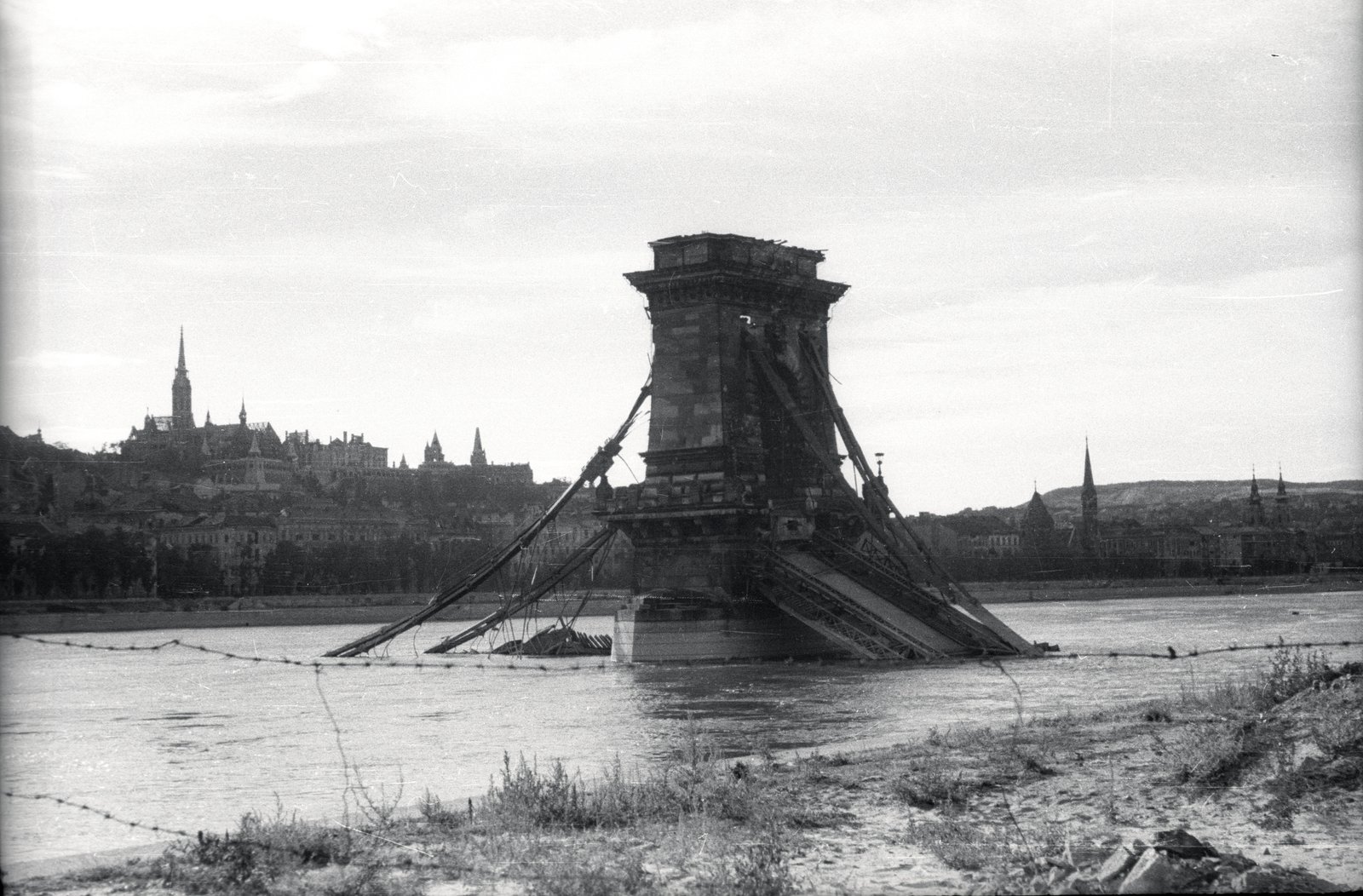
Between November 1944 and January 1945, every bridge across the Danube in Budapest went down: six by a retreating army’s deliberate demolition, and one by accident, at rush hour, for no military reason at all. Both stories are usually told as one. They are not the same story.
At a glance
By early November 1944, Soviet forces stood some 20 km east of Pest, and German engineers had already wired every bridge across the Danube for demolition, to be blown when the retreat across the river became final. On 4 November, before that moment came, a spark or a passing boat set off the charges on Margaret Bridge in the middle of the afternoon rush hour. Between 100 and 600 people died, by accounts that still disagree on the number and the cause.
The deliberate demolitions came later and followed a military logic the accident had none of: the two railway bridges on 29 December, the Horthy (now Petőfi) Bridge on 14 January 1945, the Franz Joseph (now Liberty) Bridge on 16 January, the Chain Bridge and the Elizabeth Bridge on 18 January. By the time the guns fell silent in February, every crossing in the city was down.
Key facts
- Margaret Bridge: destroyed by an accidental, premature explosion at approximately 14:00 on 4 November 1944 — an estimated 100–600 dead, including civilians, tram passengers, roughly 40 German soldiers and Jewish forced labourers; cause still disputed
- Deliberate demolitions: the two railway bridges, 29 December 1944; Horthy Bridge (now Petőfi Bridge), 14 January 1945; Franz Joseph Bridge (now Liberty Bridge), 16 January — its cantilever design left the Buda and Pest approach spans standing; Chain Bridge and Elizabeth Bridge, 18 January
- Chain Bridge: only its two stone towers survived; rebuilt and reopened on 20 November 1949, the year of its own centenary
- Liberty Bridge: handed back into service in 1946, its ornament and some details changed in the rebuilding
- Margaret Bridge: fully rebuilt and reopened in 1947
- Coordinates: 47.4990° N, 19.0436° E (Chain Bridge)
Six bridges, one plan
The deliberate destruction of Budapest’s Danube crossings was standard doctrine for an army retreating across a river it did not want followed across: deny the enemy every crossing behind you. German sappers had charges laid on all seven bridges well before any of them were blown, and the dates track the retreat itself — railway bridges first, as German and Hungarian forces pulled back from Pest toward Buda in late December, then the road bridges one by one through mid-January as the last positions on the Pest side collapsed. The Franz Joseph Bridge’s cantilever structure meant the demolition charge only had to take out the central span to achieve the goal; the Buda and Pest ends stood untouched, a rare case of a bridge partly surviving its own destruction.
The bridge that fell for no reason
Margaret Bridge was not supposed to go down on 4 November. The charges were in place for a demolition that, by every account of the wider plan, was meant to happen weeks later, timed to the actual retreat. Instead, at the height of the afternoon rush, a spark from a passing tram, or a boat passing underneath and fouling a primer — the sources disagree, and neither claim has settled the question — set off the explosives early. The bridge’s Pest-side span went into the river with the traffic on it: a tram plunged in with its passengers, and the dead included civilians on their way home, roughly forty German soldiers, and Jewish forced labourers working nearby. Nobody has ever produced a reliable single figure for how many died; the range given across different accounts runs from about 100 to as many as 600.
The Buda-side sections of Margaret Bridge that survived the November accident were destroyed anyway, deliberately, in January — folded into the same demolition sequence as the other six crossings, as though the accident had simply been an early instalment of the plan rather than a catastrophe the plan never called for.
Who tells it, and where the accounts diverge
The story told about Budapest’s bridges is usually one story: the Germans blew them all up in the winter of 1944–45, and the city rebuilt them after the war. That framing is accurate for six of the seven, and it has a coherent, if brutal, military logic behind it — deny the river to the army following you across it. It does not fit Margaret Bridge at all.
Margaret Bridge went down five weeks before the deliberate campaign began, killed people who were not soldiers of any army and were not part of a retreat, and its own cause is unresolved: primary accounts split between a spark from a tram and a boat fouling a fuse, and the range of dead — anywhere from about 100 to 600, depending which account is followed — has never converged into an agreed number. Where the other six bridges have a clear answer to «why», Margaret Bridge only has competing answers to «how», and no satisfying answer to why the charges were live weeks before anyone needed them to be.
Telling both as one event — «the bridges were destroyed in the siege« — is not false. It simply erases the difference between a war doing what wars do to infrastructure, and an accident that happened to be standing in a war’s path.
What you see today
- All seven bridges stand again, rebuilt between 1946 and the early 1950s, most on their original piers and, in the Chain Bridge’s case, its original 1849 stone towers.
- The Chain Bridge’s lion statues and cast-iron chainwork are largely postwar reconstruction on the historic design; only the towers are original fabric.
- No public marker at Margaret Bridge specifically commemorates the November 1944 accident as distinct from the general wartime destruction of the city’s crossings.
Getting there
The Chain Bridge connects Széchenyi István tér on the Pest side with Clark Ádám tér in Buda, at the foot of the Castle Hill Funicular; all seven bridges are within walking distance of one another along the Danube embankments, served by trams 2 (Pest side) and 19/41 (Buda side).
Nearby
- Buda Castle and the Castle Hill sites, reached from the Chain Bridge’s Buda end via the Funicular
- The Hungarian Parliament Building, on the Pest embankment north of Margaret Bridge
Sources
- Wikipedia, Margaret Bridge and Széchenyi Chain Bridge — demolition dates, casualty range and disputed cause for Margaret Bridge, Chain Bridge destruction and 1949 reopening.
- Pestbuda.hu, coverage of the Margaret Bridge and Liberty Bridge reconstructions (75th-anniversary retrospectives) — rebuilding dates and changes to ornament.
- Budapest Főváros Levéltára (bparchiv.hu), «Budapest ostroma» collection — Soviet-era documentation of the siege and the bridges, cited for the general demolition sequence.
Find it on the map
See this place and what’s around it →📷 Become a Cultural Heritage Online photographer
Share your photos of places: they stay published under your name as the author. The more they're seen, the more you get noticed — and soon a contest will reward the most appreciated photos.
Log in or sign up free to add a photo