

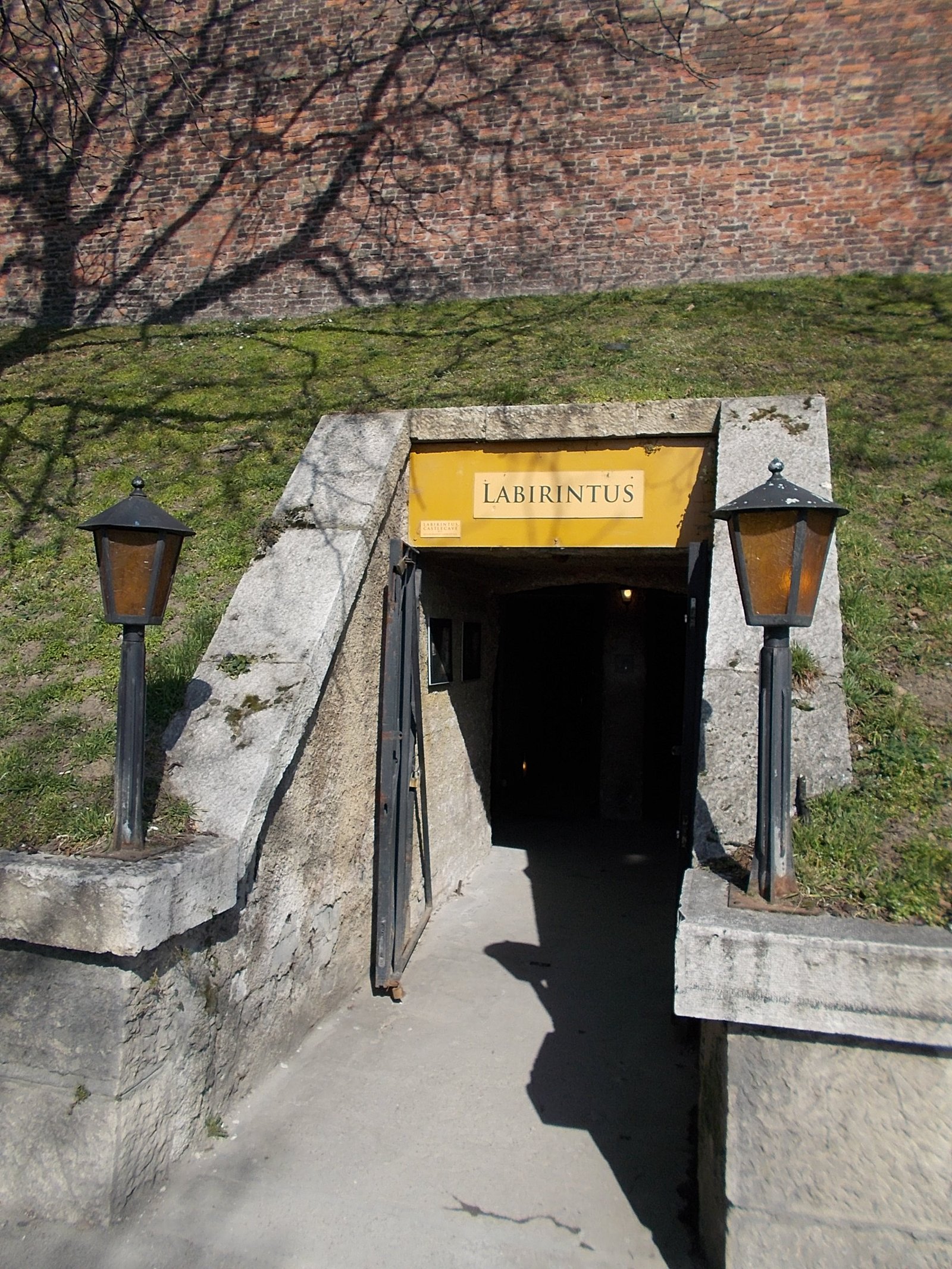
A network of wine cellars carved into the rock under Buda Castle became, in the space of a few months in 1944, a shelter for ten thousand people a night and the bunker from which both the German and Hungarian high command directed the defence of a besieged capital. It is marketed today mostly as a mystery tour.
At a glance
The caves and cellars under Castle Hill are natural, cut by thermal springs long before Budapest existed, and were used for centuries afterward by the citizens of Buda for exactly the purpose caves are good for: storing the wine that was one of the medieval town’s principal trades, and sheltering in during sieges and fires. In July 1944, with Allied bombing raids on Budapest well under way, part of the system was formally converted into a 2,000-person air-raid shelter reached from Lovas út, with a second access through the Big Labyrinth from Szentháromság utca.
Capacity was a formality the war ignored. Through the summer raids of 1944, as many as 10,000 people spent the night in the tunnels at once. Deeper inside the same system, reachable from its centre, both the German and the Hungarian high command ran their defence of Budapest from a bunker that outranked every shelter around it.
Key facts
- Origin: natural cave and cellar system cut by thermal springs, used since the medieval period for wine storage and as shelter during sieges and fires
- WWII shelter: 2,000-person capacity, entrance from Lovas út, completed by July 1944; access also via the Big Labyrinth from Szentháromság utca
- Peak wartime use: up to 10,000 people sheltering overnight during the summer 1944 air raids
- Command function: both German and Hungarian high commands operated from a bunker reachable from the centre of the tunnel during the Siege of Budapest (December 1944 – February 1945)
- Cold War: rebuilt in the 1950s with sewage, bathing and toilet facilities as a modern civil-defence shelter; sections later used as cells by the state security service
- Scale: roughly 1,200 metres of passages and chambers, up to 16 metres below the castle district
- Public access: the southern section open to visitors since 1983; the reconstructed central section (1997) accessible by guided tour only
- Coordinates: 47.4985° N, 19.0358° E (Palota út entrance)
How it was built
Nothing about the Labyrinth was purpose-built for war. It is a repurposed wine cellar, not an engineered bunker: the rock itself did the work a Regelbau casemate or an Árpád Line pillbox had to be poured and shaped to do. That made it fast to adapt and impossible to design for capacity — a hall cut for barrels holds as many people as will fit standing up, which in the summer of 1944 turned out to be five times the number the July shelter had been rated for.
The command bunker reachable from the tunnel’s centre was a different matter: a hardened position built into the existing cave system specifically to shelter the apparatus that was still trying, through December 1944 and into February 1945, to direct a defence that both armies knew by then was not going to hold. The choice to run a joint German-Hungarian command from a converted wine cellar says as much about how late and how improvised Budapest’s defences were as any casemate ever could.
What the walls still show
Chalk markings from the 1944 shelter survive on the rock in places — directions, capacities, the ordinary administrative marks of a space being run as emergency housing for thousands of people a night. They sit in the same tunnels that, a decade later, the Cold War civil-defence authorities rebuilt with running water and toilets for a different war that never came, and that, later still, state security used as detention cells for reasons that had nothing to do with any war at all. Three regimes used the same rock for three different kinds of control over people who had no choice about being there.
Who tells it, and where the accounts diverge
The institutional record of the Labyrinth — kept by the historians documenting Buda Castle’s history after 1686 — states plainly what the tunnels were for in the winter of 1944 and 1945: the joint command post of two armies fighting to hold a capital, reached from the same corridors that sheltered the civilians those armies were nominally defending. It is a sober, specific, well-sourced claim.
The Labyrinth’s public-facing identity today runs the other way. Visitor sites and tour operators market it chiefly as a place of mystery and legend, built around the tunnels’ age and their unsettling atmosphere rather than their documented military use. None of that is invented, exactly; it is simply a different selection from a very long history, one that finds a sense of mystery more marketable than the fact that this cellar once outranked every command post in the city above it. The chalk marks from 1944 are still there for whoever asks to see them, in a tour built mostly to show something else.
What you see today
- The southern cave sections, open to independent visitors, with information on the site’s geological and medieval history.
- The reconstructed central Labyrinth (1997), accessible by guided tour, where WWII-era chalk markings and Cold War civil-defence fittings are preserved alongside the older cellar structure.
- Low ceilings, uneven natural rock floors and constant cool temperature throughout — conditions largely unchanged since the tunnels were repurposed as a shelter.
Getting there
The Palota út entrance sits on Castle Hill, reachable on foot from the Castle Hill Funicular or the Castle Bus (Várbusz 16A) from Clark Ádám Square at the Buda end of the Chain Bridge, the same routes serving the other Castle Hill sites.
Nearby
- Hospital in the Rock, the wartime hospital and later nuclear shelter occupying another section of the same Castle Hill cave system, a short walk away
- Buda Castle and the National Gallery, directly above, part of the same UNESCO World Heritage district
Sources
- Budavár Történeti Archívum / MTA-BTK (budavar.abtk.hu), «The history of Buda Castle after 1686» — shelter capacity and opening date, the joint German-Hungarian command bunker.
- Institutional and heritage summaries of the Buda Castle cave system’s medieval and geological history, cross-checked across independent visitor-information sources for the 1983/1997 public-access dates and the Cold War rebuild.
Find it on the map
See this place and what’s around it →📷 Become a Cultural Heritage Online photographer
Share your photos of places: they stay published under your name as the author. The more they're seen, the more you get noticed — and soon a contest will reward the most appreciated photos.
Log in or sign up free to add a photo