
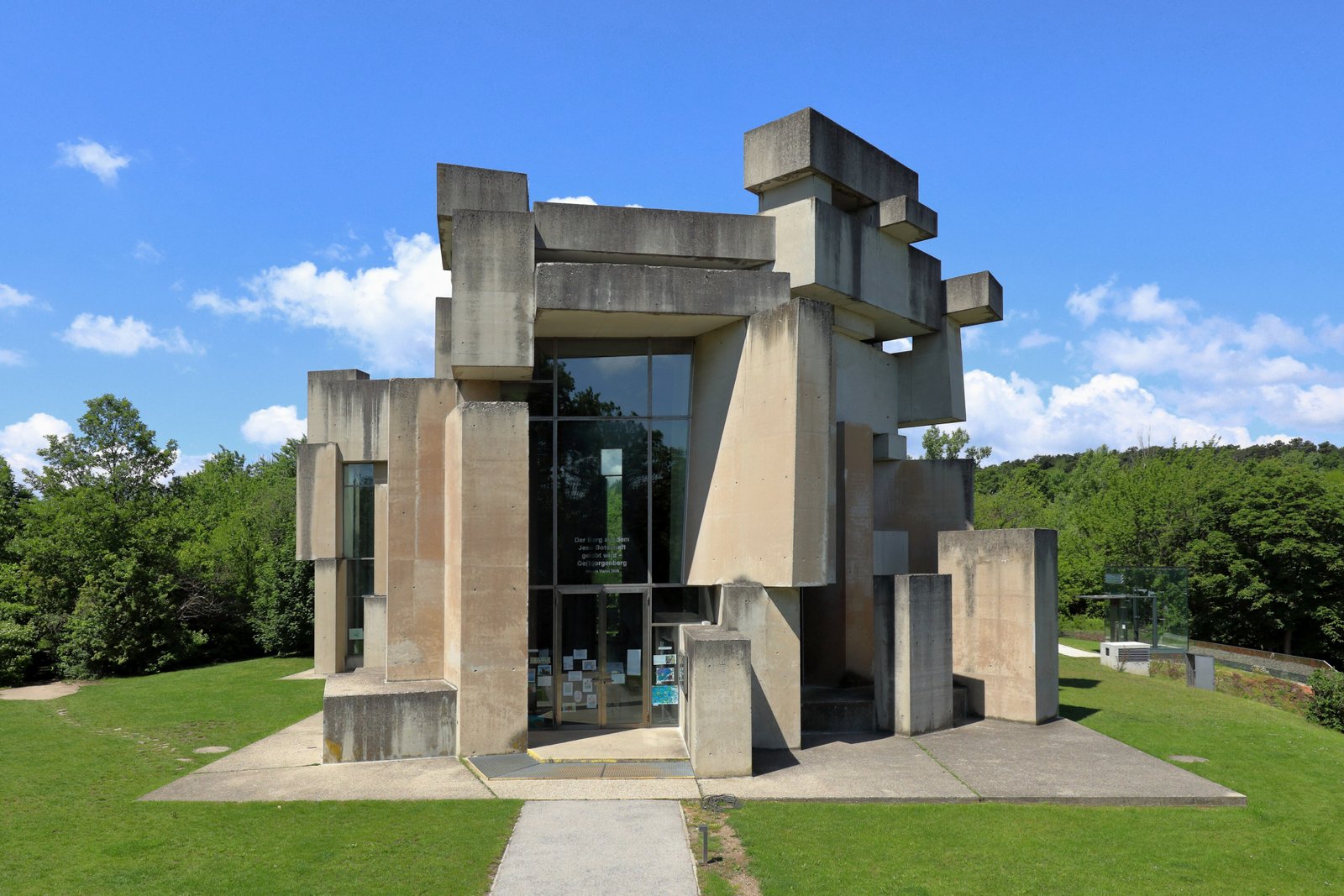
A Brutalist Catholic church in Vienna designed by sculptor Fritz Wotruba as a bold artistic and spiritual statement during an era of secularization.
At a glance
Built from 152 concrete blocks in the Liesing district, this chapel eschews symmetry and tradition in favour of dramatic sculptural form. Clear glass windows flood the interior with light, while an artificial-marble altar and bronze crucifix complete the spare, contemplative space. The church demonstrates Brutalism’s capacity for spiritual expression.
History
Margarethe Ottillinger conceived the church and selected a site on former Nazi barracks, seeking to plant a symbol of faith and artistic vision in post-war Vienna. She commissioned Austrian sculptor Fritz Wotruba, whose design drew inspiration from Chartres Cathedral. Planning architect Fritz Gerhard Mayr coordinated the technical execution. Construction began in August 1974 and proceeded over two years; Wotruba died before completion, leaving Mayr to oversee the final stages. The church was consecrated in 1976.
What you see
The building’s most striking feature is its composition of 152 stacked concrete blocks, arranged without apparent symmetry to create a dynamic, almost sculptural silhouette. Wotruba, a sculptor first, treated the structure as three-dimensional art rather than conventional architecture. Large expanses of clear glass dissolve barriers between interior and exterior, allowing daylight to become a design element. The altar, fashioned from artificial marble, anchors a serene interior. The bronze crucifix is a replica of Wotruba’s design for the Hofkirche in Bruchsal, Germany.
Cultural significance
The Wotruba Church represents a pivotal moment in post-war Austrian modernism, when the country sought new expressions of spirituality. Its uncompromising Brutalism challenged conservative religious architecture, asserting that faith need not retreat into historical style. The church also reclaimed contested ground, transforming a site of Nazi occupation into a space of contemplation and art. In 2021–2022, curator Gabriele Stöger-Spevak mounted the first major exhibition devoted exclusively to the church, reaffirming its place in twentieth-century cultural history.
Key facts
- Country: Austria
- City: Vienna (Liesing district)
- Built: August 1974 – October 1976
- Designed by: Fritz Wotruba (sculptor)
- Planning architect: Fritz Gerhard Mayr
- Constructed of 152 concrete blocks
- Coordinates: 48.14763889, 16.25343889
Practical information & getting there
The Wotruba Church is located in the Liesing district of Vienna’s southern suburbs. Visitors are advised to check opening hours and arrangements in advance, as the church operates as an active parish and may restrict access during services or special events.
Sources & resources
Find it on the map
See this place and what’s around it →📷 Become a Cultural Heritage Online photographer
Share your photos of places: they stay published under your name as the author. The more they're seen, the more you get noticed — and soon a contest will reward the most appreciated photos.
Log in or sign up free to add a photoIs this page about you?
This page is read by travellers and heritage enthusiasts who find it on Google. Tell us how you are connected to this place and we will take it from there.