
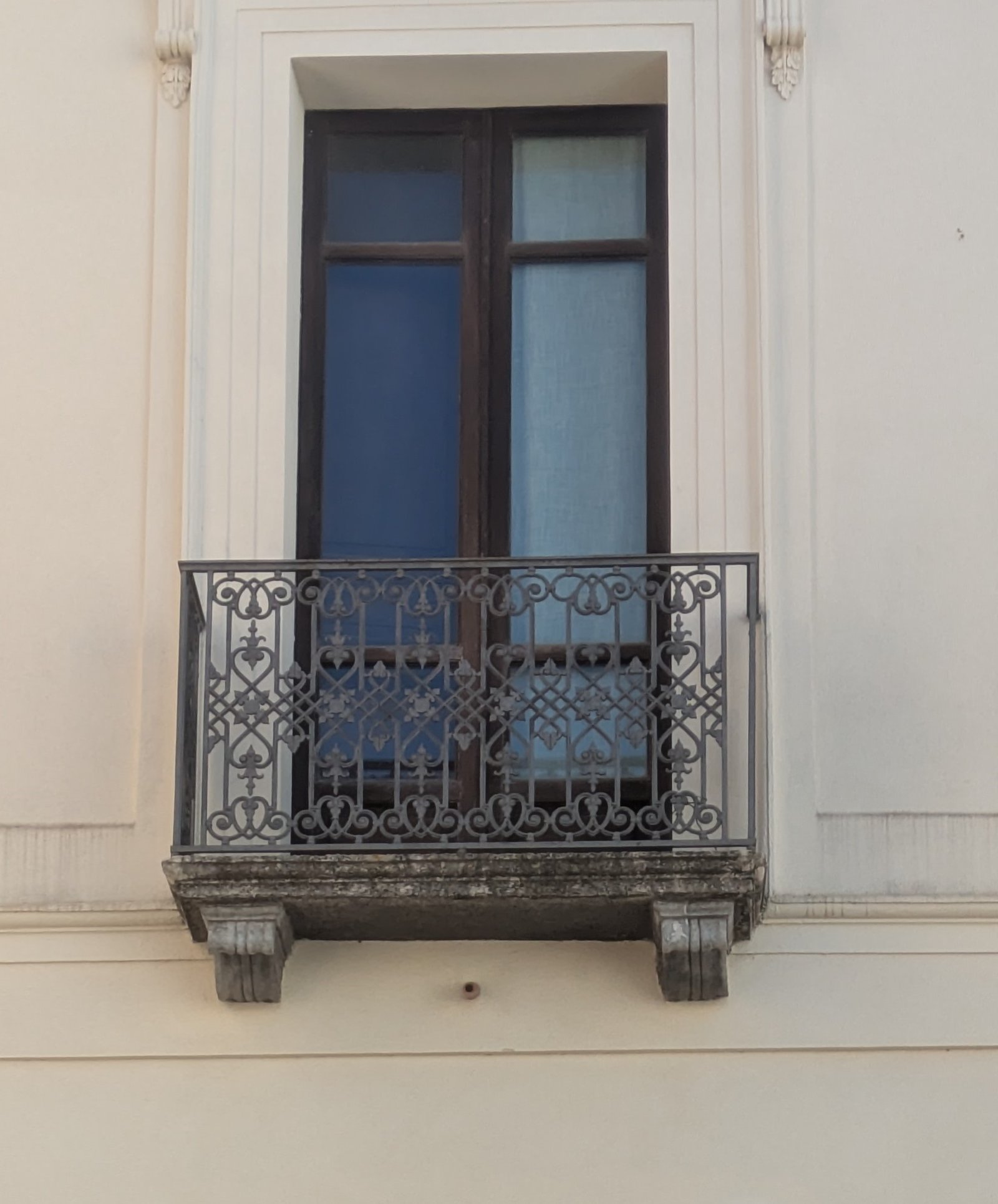
Everyone photographs the facade. The thing worth looking at hangs off it: a run of wrought-iron balconies whose pattern was drawn in a Neapolitan foundry, and which almost nobody has ever catalogued.
At a glance
Palazzo Alemanni stands on via Giuseppe Sensales — the old via Aranci — in the Montecorvino quarter of the historic centre of Catanzaro. It was built for the Alemanni, marquesses of Pianopoli and barons of Tiriolo, who commissioned Neapolitan architects; the main block went up at the end of the eighteenth century and the three wings that close it like a horseshoe were added in the first half of the nineteenth. It is one of the best-kept noble houses in the city, and since 2024 it has held a branch office of the state heritage authority for the provinces of Catanzaro and Crotone. What brings it onto this site is neither the family nor the office, but the ironwork of its balconies.
Key facts
- Built for: the Alemanni family, marquesses of Pianopoli and barons of Tiriolo
- Architects: commissioned from Naples — the palace belongs to the Neapolitan orbit, not a local one
- Two campaigns: main block, late 18th century; three horseshoe wings added during the 19th century for the marriage of Michele Alemanni to Princess Agata Ruffo della Scaletta — the sources place the enlargement in the first half of the century and also give the year 1870, so the date is not settled
- Storeys: three
- Ironwork: wrought-iron balcony railings; the pattern is referred by the Catanzaro iron catalogue to the Naples foundry of Enrico Treichler
- Today: owned by the Regione Calabria, granted for ten years to the Soprintendenza Archeologia Belle Arti e Paesaggio, which opened its Catanzaro branch here in June 2024
- Address: via Giuseppe Sensales 20, 88100 Catanzaro — 38.9072 N, 16.5932 E
History
The Alemanni were among the families that mattered in Catanzaro under the Bourbons: marquesses of Pianopoli, barons of Tiriolo, with the reach to hire architects from the capital rather than from the province. The main body of the house dates from the closing years of the eighteenth century. Two generations later a dynastic marriage — Michele Alemanni to Agata Ruffo della Scaletta, of one of the great families of the Kingdom — produced the money and the occasion for the enlargement, and the three wings that give the building its horseshoe plan were added in the course of the nineteenth century. The great hall built at that time carries both coats of arms, Ruffo and Alemanni, on its ceiling. (How late in the century the work fell is not settled: the same source that places it in the first half also gives the year 1870.)
That second campaign is the one that matters for the ironwork. It falls exactly in the decades when the trade changed: the blacksmith of the eighteenth century worked metal he had refined himself, while his nineteenth-century successor bought bar and plate already squared by industry and spent his skill on shaping and finishing. The balconies of Palazzo Alemanni are the product of that hybrid moment — hand-worked scrolls in industrially produced iron.
The house passed out of the family and into public hands. It is now owned by the regional government, which in 2024 granted it on a ten-year free loan to the state heritage authority; the offices that protect the monuments of Catanzaro and Crotone now sit inside one of them.
What you see
The front is plain and well kept: rendered wall, stone frames around tall two-light windows, a moulded string course. The balconies interrupt it. Each rests on two carved stone corbels shaped like scrolls, and carries a railing of iron about waist height. The railing is not the work of a single technique: the frame — the long flat bars of base and handrail, the square-section uprights — is forged, drawn and worked at the anvil, while the six ornamental panels set into the front were moulded, cast to a pattern and finished by engraving. The catalogue of Catanzaro ironwork records both operations on this one railing, and places it in the nineteenth century — contemporary, that is, with the horseshoe wings rather than with the eighteenth-century core of the house.
The pattern repeats along the run and is worth reading slowly. The uprights are plain bars; between them sit bands of interlaced work — opposed C-scrolls that meet in inverted heart shapes, and a lattice of lozenges filling the centre of the panel. The rhythm is symmetrical, three fields wide, with the densest ornament in the middle and simpler runs at the ends, which is how these railings were normally composed: the eye is meant to settle at the centre of the window, not at its edges. Seen from the street the whole thing reads as a dark lace stretched across the glass.
According to the catalogue of Catanzaro ironwork published by C. Riga and O. Mendicino, the design of this railing derives from the Naples foundry of Enrico Treichler. Treichler learned the trade at the De Lamorte foundry in Naples, where he designed the cast-iron lamp posts of the Risanamento — the great slum-clearance of the city — before opening a foundry of his own. That a Catanzaro palace should carry a Neapolitan pattern is not surprising: the family had already gone to Naples for its architects.
Cultural significance
Wrought iron sits awkwardly in the history of art. It is decorative but useful, made by craftsmen rather than artists, and it is fixed to buildings that get catalogued for other reasons; so it tends to fall through the gaps of protection. Railings are replaced during renovations, gates are sold, and nobody records what was there. The centre of Catanzaro holds an unusual concentration of this material, from the late sixteenth century to the twentieth, and much of it has only recently been surveyed — by researchers working privately rather than by any public programme.
The balconies of Palazzo Alemanni are a good argument for why that survey matters. They are neither signed nor dated, they are not mentioned in the guidebooks, and they carry a piece of information — a Neapolitan design in a Calabrian town — that exists nowhere except in the metal itself.
Practical information
- The palace is a working public office, not a museum: the interior is not open to casual visitors.
- The railings are on the street front and can be seen at any hour from via Sensales.
- Best light is in the morning, when the sun crosses the front and the ironwork throws its pattern onto the rendered wall.
- Occasional openings are organised for heritage weekends: worth checking around the European Heritage Days in September.
Getting there
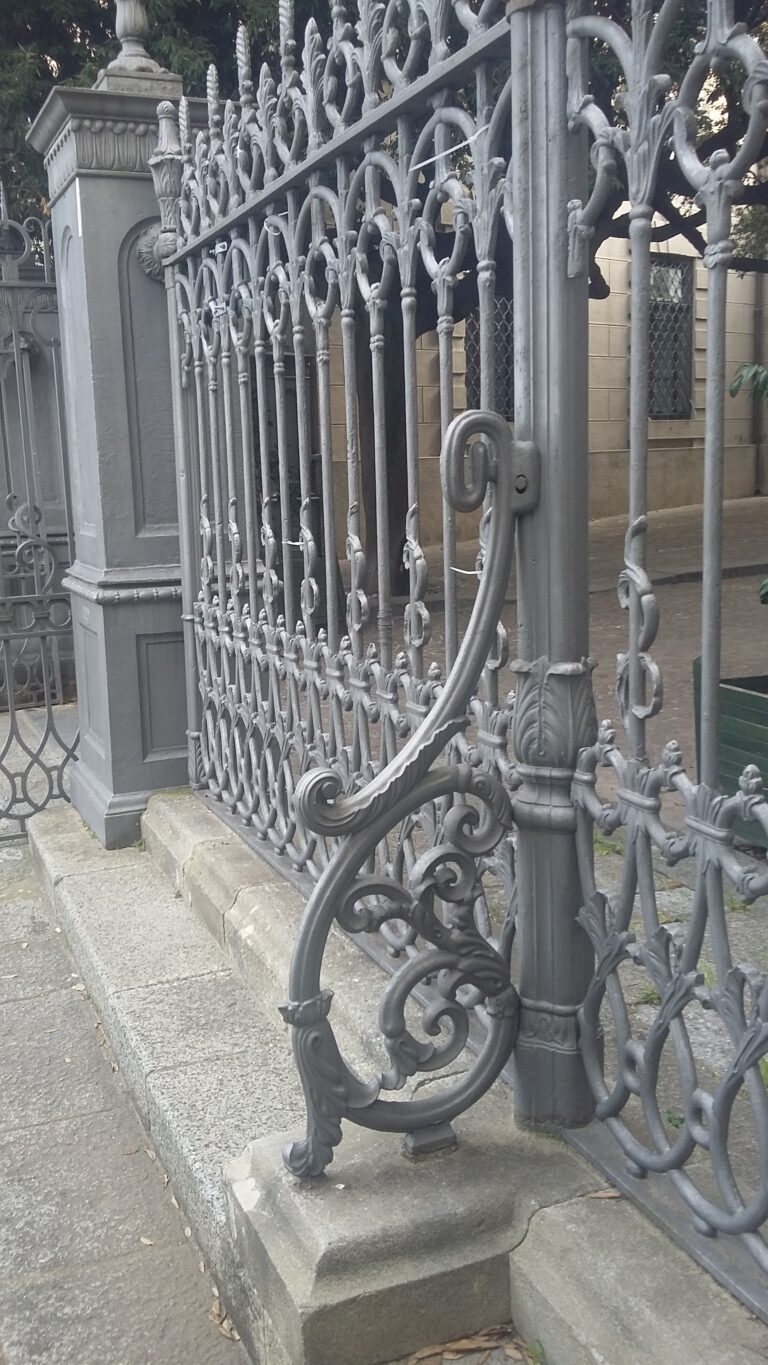
Catanzaro sits on a ridge above the Ionian coast. Via Sensales is in the historic centre, a few minutes on foot from the main axis of corso Mazzini and from the public garden of Villa Margherita, whose moulded-iron enclosure, signed by the Archimede works of Messina, makes the obvious second stop on any walk built around this material. The city is served by Lamezia Terme airport, about forty minutes away, and by the coastal railway at Catanzaro Lido, connected to the upper town by the local line.
Sources
- Palazzo Alemanni-Gallelli — the Montecorvino quarter, via Sensales 20 (the old via Aranci), the two building campaigns and the Ruffo marriage
- Soprintendenza ABAP per le province di Catanzaro e Crotone — the Palazzo Alemanni branch office (2024)
- The noble houses of Catanzaro — context for the palace within the historic centre
- On Enrico Treichler, the De Lamorte foundry and the cast-iron lamp posts of the Naples Risanamento
- O. Mendicino, Manifatture in ferro a Pisa e fuori Pisa, 2006 (2nd ed. 2007); C. Riga and O. Mendicino, Iconografia dei manufatti in ferro dal tardo XVI al XX secolo nel centro storico di Catanzaro, 2025, CROM — the survey from which the attribution of the railing pattern is taken
- The description of the railing is our own, made from photographs taken on site by Ortensio Mendicino in 2026
Find it on the map
See this place and what’s around it →Record researched and written by Ortensio Mendicino for Cultural Heritage Online, 2026.
📷 Become a Cultural Heritage Online photographer
Share your photos of places: they stay published under your name as the author. The more they're seen, the more you get noticed — and soon a contest will reward the most appreciated photos.
Log in or sign up free to add a photoIs this page about you?
This page is read by travellers and heritage enthusiasts who find it on Google. Tell us how you are connected to this place and we will take it from there.