
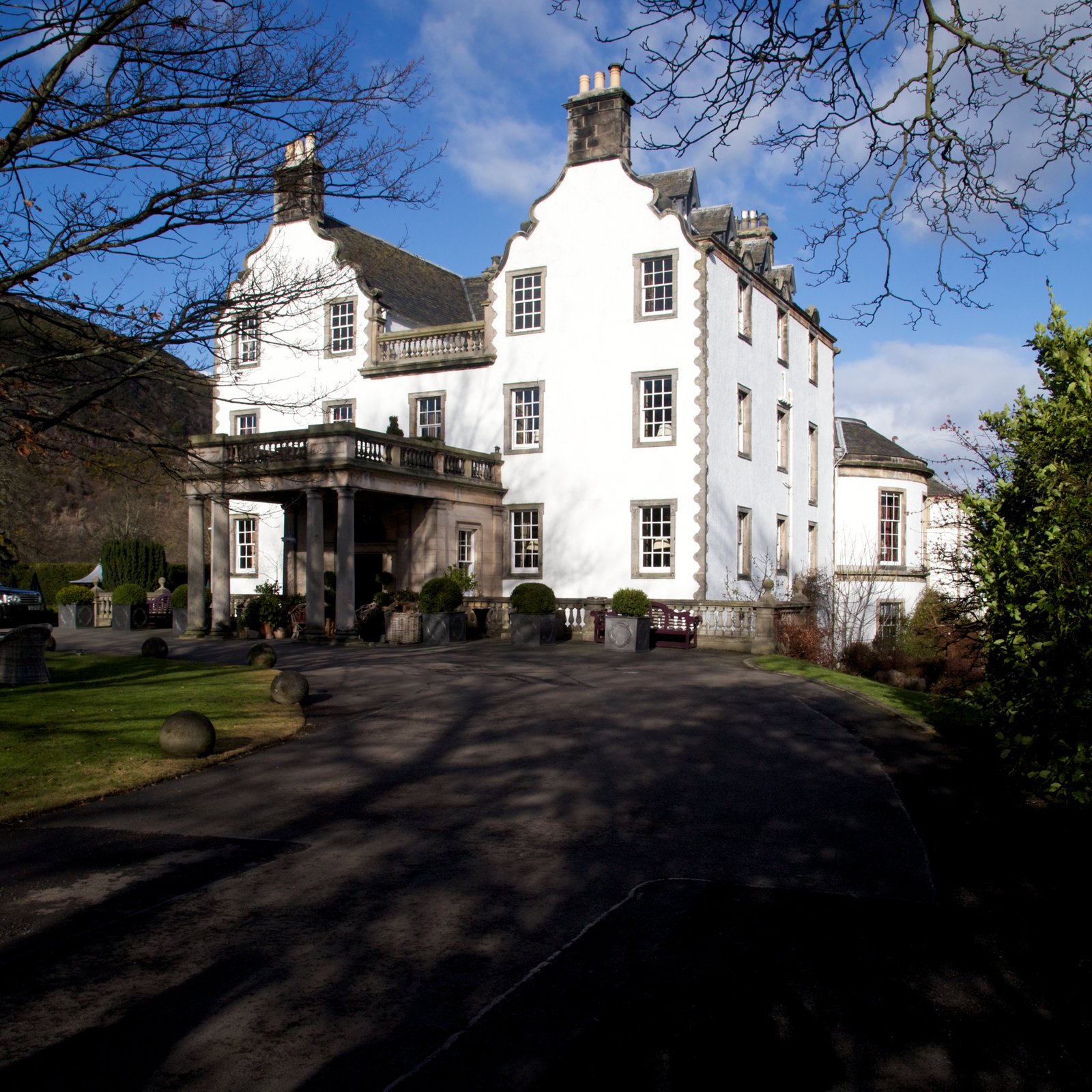
A crowd burned the first house down in 1681. Its replacement still stands below Arthur’s Seat, harled white, and the grand carriage porch arrived only a century and a half later.
At a glance
Prestonfield House sits at the foot of Arthur’s Seat, on the southern edge of Edinburgh. Sir James Dick, Lord Provost of the city, began it in 1687 to replace a house a crowd had burned six years earlier; the Gazetteer for Scotland records it as completed in 1689. The same source gives the design to Sir William Bruce, the King’s Architect, then just finished at the Palace of Holyroodhouse. The designed-landscape record adds a caution worth keeping: it names Robert Mylne as a possible hand in 1687. What is not in doubt is the fabric — white-harled rubble with sandstone dressings, and gables that look Dutch. One family held the house until 1957. It has taken guests since 1958.
Key facts
- Built: begun 1687, completed 1689
- Patron: Sir James Dick, Lord Provost of Edinburgh. His initials, SJD, and those of his wife Dame Anne Paterson, DAP, are carved above the upper windows
- Architect: Sir William Bruce (1630–1710). Robert Mylne is named as a possible designer in the gardens inventory record — the attribution is not settled
- Protection: Category A listed, Historic Environment Scotland ref. LB28107, listed 14 July 1966. The grounds are on the Inventory of Gardens and Designed Landscapes in Scotland
- Fabric: white-harled rubble with sandstone ashlar dressings, Dutch-influenced gables, and a Roman Doric porte-cochère added later
- Grounds: about 8 hectares of garden and parkland. The circular stable block, attributed to James Gillespie Graham and dated between about 1816 and 1819 depending on the source, is listed B, as is the eighteenth-century sundial
- Today: a hotel since 1958, run as a country-house hotel since 2003
History
The house that stood here before this one did not fall to war or neglect. In 1681 a crowd burned it, in the episode the Gazetteer for Scotland records as the No Popery Riot. Sir James Dick, a merchant who had risen to Lord Provost of Edinburgh, rebuilt on the same ground six years later, and the building that went up was deliberately of its moment: a wealthy merchant’s house, four storeys and a garret, harled and gabled rather than fortified.
Sir William Bruce had just completed the rebuilding of Holyroodhouse for the Crown, and the Gazetteer names him as the designer here. The house that resulted drew the century that followed through its doors. Benjamin Franklin came in 1759 and Samuel Johnson in 1773; David Hume and the painter Allan Ramsay were among the Scottish Enlightenment figures who knew the place as a private house rather than an address.
The grounds changed more than the walls. Sir Alexander Dick, who succeeded in 1748, laid out the long grassed walks and planted them with snowdrops, crocuses and daffodils; William Walker set out a formal design in 1764. An eighteenth-century Dutch Garden held fountains, carved stone seats, dials, statues and clipped evergreen hedges, until Sir Robert Dick turned that ground over to stables in the early nineteenth century and moved the kitchen garden south of the house. An obelisk went up in 1839 for Sir Robert’s children. Part of the parkland has been a golf course since 1920. The Dick-Cunyngham family sold in 1957, and the house opened as a hotel the following year.
What you see
The walls are the first thing: rubble finished in white harling, with sandstone ashlar at the openings, so the building reads as a pale block against the hill behind it. The gables carry a Dutch accent that was fashionable in Scottish building of the 1680s. Look up at the top windows and the initials are still there, SJD and DAP, cut for the man who paid for the house and the woman he was married to. The Roman Doric carriage porch below them is a later arrival and does not pretend otherwise: it is a nineteenth-century idea of arriving somewhere, bolted onto a seventeenth-century front.
The grounds keep the fragments of the vanished Dutch Garden. A lead Bacchus fountain survives from it, as do a sphinx and stone seats dated 1687 — the year the house was begun. The 1839 obelisk stands in parkland planted with specimen beech and sycamore. Highland cattle and peacocks are kept on the grass, which sounds like an invention of the hotel era and is recorded by the Gazetteer as part of the place.
Practical information
- The house operates as a hotel and restaurant and is open to the public; the interiors are seen as a guest or a diner, not on a ticketed tour
- The grounds and parkland surround the house on all sides; allow time to walk them, and expect peacocks
- The circular stable block now serves as a function suite — worth a look from outside even if you are not attending anything in it
- Best light on the harled west front is late in the day
Getting there
Prestonfield stands at 71 Priestfield Road, in the Prestonfield district south-east of the Old Town, at the foot of Arthur’s Seat and just off Dalkeith Road, which carries frequent city buses from the centre. Coordinates: 55.936642, -3.157087 (Google Maps). Holyrood Park lies immediately north, so the house can also be reached on foot across the park from the Royal Mile end in about half an hour.
Nearby
- St Mary’s Cathedral, Edinburgh (Episcopal)
- St Mary’s Cathedral, Edinburgh (Catholic)
- Rosslyn Chapel, a short drive south of the city
Sources
- The Gazetteer for Scotland, University of Edinburgh — dates, architect, the 1681 riot, visitors, ownership and grounds
- Parks & Gardens UK — the designed landscape, the Dutch Garden, the stables and the listing grades
- Historic Environment Scotland, listed building ref. LB28107, Category A, listed 14 July 1966
- Coordinates verified against OpenStreetMap Nominatim for 71 Priestfield Road, Edinburgh
Find it on the map
See this place and what’s around it →Record researched and written by Luigi De Marchi for Cultural Heritage Online, 2026.
📷 Become a Cultural Heritage Online photographer
Share your photos of places: they stay published under your name as the author. The more they're seen, the more you get noticed — and soon a contest will reward the most appreciated photos.
Log in or sign up free to add a photoIs this page about you?
This page is read by travellers and heritage enthusiasts who find it on Google. Tell us how you are connected to this place and we will take it from there.