
The standard dictionary of Venetian, published in 1856, contains none of them in the sense you will hear tonight. Yet the osteria at the sign of the two swords is documented from 1414. A walk through five counters where Venice still eats standing up.
Ask anyone in Venice what an ombra is and you will be told a story. Wine sellers on the Piazzetta, the story goes, moved their benches through the day to keep their barrels in the shadow of the campanile, and going for a glass became going for a shadow. It is a good story. It is told on wine lists, in guidebooks, on the walls of the bars themselves.
There is no evidence for it.
The place to check is Giuseppe Boerio’s Dizionario del dialetto veneziano, the standard nineteenth-century record of the language, compiled when the Republic was within living memory. Its entry for ombra gives shade, the shadow thrown by opaque bodies; the figurative sense of suspicion; the card game; and a fish. There is no wine in it. There is no entry for bacaro. There is no entry for cicheto.
The three words that every visitor now learns in their first hour in Venice are not attested, in these meanings, in the dictionary of Venetian. They are twentieth-century usages. Cicchetto reached the Italian standard so recently that it can be dated: the Venetian sense — a small plate eaten with a glass of wine at the counter — was admitted to the Zingarelli dictionary only in the 2026 edition, announced at the end of September 2025. The word you were told is ancient entered the national dictionary the year before last.
What linguists give instead of the campanile is duller and more convincing. Manlio Cortelazzo and Carla Marcato’s etymological dictionary of Italian dialects reads un’ombra de vin as simply a small quantity of wine, the same figure of speech as a shadow of salt or a shadow of butter in a recipe. A little. A trace. No bell tower required.
What Boerio does have
The dictionary is not silent on the subject, and what it contains is better than the legend.
It has bàcara, a noun: a rowdy gathering, a knot of people making a racket. And it has the expression far bàcara, glossed as carousing, taking one’s pleasure — literally, pigliar diletto mangiando in brigata, taking delight in eating as a company. The venue took its name from the verb, not from Bacchus. What was documented first was the behaviour.
And it has magazen. A magazen da vin, Boerio writes, was a tavern of poor people, a shop selling wine by the measure — and, in the time of the Republic, a place that took goods in pawn. The pledge was paid out two-thirds in cash and one-third in wine, and the wine was terrible. It had its own name: vin da pegni, pledge wine. That is the real ancestor of the modern wine counter: a pawnshop that paid you partly in drink.
The places, on the other hand, are old
Here is the reversal. The vocabulary is recent; the addresses are not.
Behind the Rialto market, on the rio de le Beccarie, the canal of the butchers, a sign with two swords has named a corner of Venice for more than five hundred years. Giuseppe Tassini, whose Curiosità veneziane remains the reference work on the city’s street names, records that in 1488 a certain Carlo de Zuane, host at the sign of the Spade, was steward of the innkeepers’ confraternity, which met in the nearby church of San Matteo. Tassini adds that the osteria was by then already molto antica. An earlier document, a Venetian sentence of 1414, mentions the benefice of the osteria delle Spade outright.
The property survey of 1566 records the rest of the arrangement: the osteria delle do spade at San Matteo, with two shops beneath it, belonged to the Foscari and was let to an innkeeper named Battista. And on a carnival night in 1745, according to Casanova’s own memoirs as reported by Tassini, a gentleman of the Balbi family and Casanova, passing themselves off as officers of the Council of Ten, carried a woman off from San Giobbe and brought her here for supper. One night, well documented — not the lifetime of patronage that gets advertised.
Today the premises trade as Cantina Do Spade. The company cannot be shown to descend in unbroken line from the fifteenth-century house, and it should not claim to. The sign is old. The calle, the sotoportego and the bridge all still carry its name. That is enough.
Fire, oranges and an arcade
A few minutes away, at the water’s edge, is a name that is pure market inventory. Rialto was never one market but several, each with its own street and its own goods: Erbaria for greens, Beccaria for meat, Casaria for cheese, Pescaria for fish, Ruga dei Oresi for goldsmiths, Ruga dei Spezieri for spice merchants — and Naranzeria for the citrus that came in by sea from the Mediterranean.
On 10 January 1514 fire took the whole of it. The only building left standing was the little church of San Giacometto. What went up in place of the ruins is the block that stands there now: the Fabbriche Vecchie, designed by Antonio Abbondi, called lo Scarpagnino, and built between 1520 and 1522, its ground floor divided among the Erbaria, the Pescaria, the Bancogiro and the Drapperia. Tassini notes that the Sotoportego del Bancogiro runs beneath them, named after the public merchant bank that once had its seat there.
Naranzaria occupies that arcade, with tables on the Grand Canal where the boats still unload before dawn. The business itself is recent — the earliest trace of it is from 2004 — and the distinction matters. The building is of 1520. The osteria is of our century. Both facts are worth knowing, and neither should be allowed to borrow the other’s age.
Where the counter became an institution
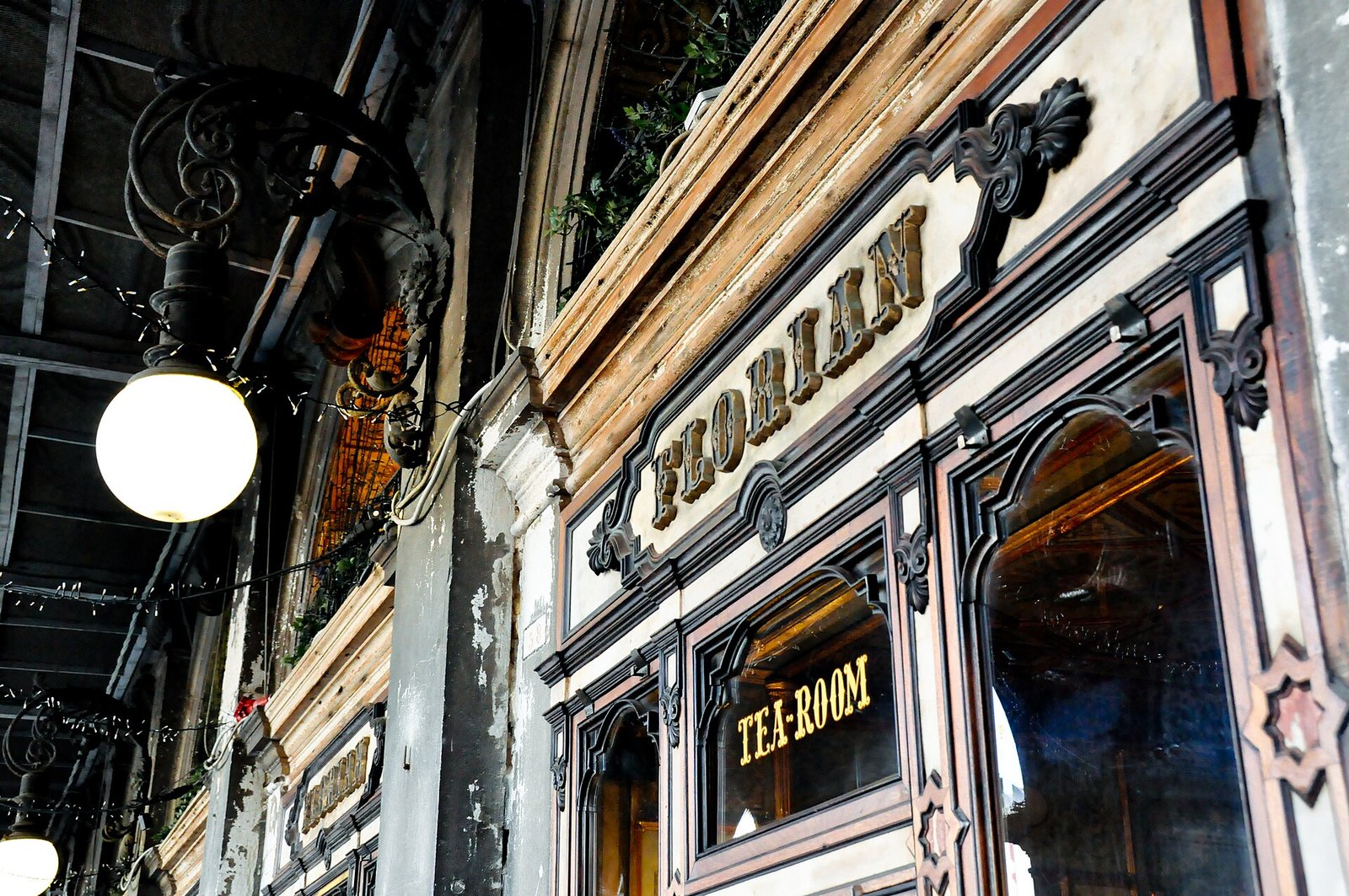
Coffee was a different business, and it left better records. Caffè Florian opened in Piazza San Marco on 29 December 1720 under the sign Alla Venezia Trionfante. Custom replaced the sign with the man: people said they were going da Florian, after the founder Floriano Francesconi, and the name stuck. The Regione Veneto’s register of historic places of commerce carries the entry with a start date of 1720 — a government document, not a house legend.
It is the oldest café in Italy; the Antico Caffè Greco in Rome, its nearest rival, is of 1760. It is also one of the very few anywhere still working in the rooms where it began. Older houses exist — the Procope in Paris of 1686, the Oxford coffee houses of the 1650s — but they moved, or their trade was interrupted. Florian did neither. That is the honest claim, and it is a strong one; the version you will sometimes read, that it is the oldest café in the world, is not even made by the café itself.
The interiors are not those of 1720. From 1858 the new owners had Lodovico Cadorin remake them, and the work went on for a generation: the Sala del Senato by Giacomo Casa, the Chinese and Oriental rooms by Antonio Pascuti, the Sala delle Stagioni by Cesare Rota in 1872, the Sala degli Uomini Illustri by Giulio Carlini in 1891, with medallion portraits of ten Venetians from Marco Polo to Palladio.
A counter of 1978, and why that is fine
Not everything worth a stop is old, and pretending otherwise is how archives fill with fiction. All’Aciugheta, off Campo Santi Filippo e Giacomo in Castello, has been run by Gianni Bonaccorsi since 1978. The house tells an older story about itself — a bacaro of the early twentieth century, famous in the 1950s for anchovy rolls — and that story is its own, unattested elsewhere. What is documented is 1978, and the anchovy: the roll became a small anchovy pizza, and the pizza became the reason people cross the campo.
A bacaro that is fifty years old is a real thing in a city where almost nothing new survives at all. It does not need a false fifteenth century to justify a visit.
The garden where Venice ate outdoors
The walk ends away from the counters, at the northern edge of the city, where the houses stopped and the lagoon began. In 1531 Titian rented a house at Biri Grande from the nobleman Leonardo Molin, with a patch of empty ground beside it that he made into a garden. He stayed forty-five years, until he died there on 27 August 1576.
On the feast of the Assumption in 1540, Francesco Priscianese described a supper in that garden, in a letter he published with his Latin grammar. The guests were Jacopo Sansovino, Pietro Aretino and Jacopo Nardi. The tables were laid outdoors, gondolas crossed the water in the dusk, and the company waited for the sun to go down before eating. It is the earliest good description we have of Venetians eating outside for pleasure, in a garden that then looked north over open water towards Murano — the Fondamente Nove, which closed that view, were not built until 1589.
The house still stands, on the campo that now carries his name. It is not a museum and nothing marks it from the square. Part of it is occupied by the last workshop in Venice where gold is still beaten into leaf by hand, which can be visited by appointment. That is the only way inside the building where the Danae and the late Pietà were painted.
Walking it
The five places are within a couple of kilometres of each other, and the order that works is geographical rather than chronological: the two Rialto counters first, then across to the piazza, then east into Castello, then north to Cannaregio and the campo del Tiziano. We have laid it out as a route, with each stop timed, in Ombre and cichéti: a Venice walk from the Rialto counters to Titian’s house.
One last word about the words. That bacaro and cichéto turn out to be young does not make them fake, and it does not make the practice recent. Boerio’s far bàcara is the same behaviour under an older name, and his pledge-wine shops were doing in 1856 roughly what the counters do now, minus the pawnbroking. What changed was the vocabulary, and the vocabulary changed late. A city that has been drinking standing up for six centuries only got round to naming the practice in the twentieth — and only got the word into the national dictionary in 2026.