
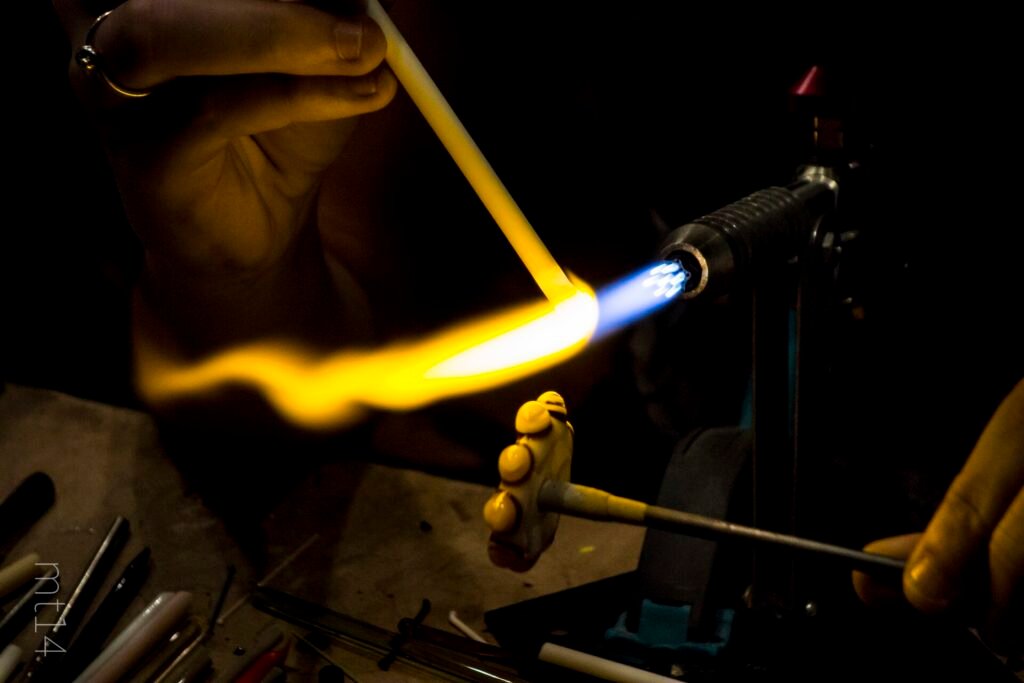
For millennia, artisans have shaped molten glass into luminous beads—objects of trade, adornment, and cultural exchange. This ancient craft persists as a living art form, passed through generations of makers across Europe.
At a glance
Glass bead making is a centuries-old craft in which artisans heat, shape, and finish glass into decorative and functional beads. The practice encompasses techniques for forming, annealing, and embellishing beads of varied colours, sizes, and designs. Contemporary practitioners work in small workshops, often combining traditional methods with modern tools to sustain this heritage.
Origins & history
The oldest known glass beads date back more than 3,000 years. Egyptian faience beads—clay with a self-forming vitreous coating—represent perhaps the earliest glass-like beads. Around 1,500 BC, in Egypt and Mesopotamia, glass beads became prized decorative items, symbolizing wealth, artistry, and the expanding trade networks of ancient civilizations.
People have been making beads from glass since at least Ancient Roman times. The presence of glass beads in archaeological contexts often signals trade routes and the spread of bead-making technology across distant regions, making them valuable markers of cultural contact and exchange.
The practice
Glass bead makers work with coloured glass rods heated over a flame or in a furnace. Using hand tools and gravity, they wind, shape, and cool the molten glass around a mandrel (a thin rod), creating the characteristic hollow bead. Makers may add trails of contrasting glass, etch patterns into the surface, or apply metallic foil and enamels to achieve varied decorative effects.
Each bead requires skill in temperature control, timing, and hand movement. The finished bead must cool slowly—a process called annealing—to prevent cracking. Colours range from deep blues and rich reds to translucent ambers and opaque whites, reflecting both historic recipes and contemporary innovation.
Cultural significance
Glass beads embody human creativity and the desire to adorn, trade, and connect. Their presence in archaeological deposits has allowed researchers to trace ancient commerce, understand sources of raw materials, and document the movement of peoples and ideas across continents.
Today, the art of glass bead making represents continuity—a tangible link to the hands and minds of ancient artisans. For makers and wearers alike, each bead carries the weight of three millennia of human craftsmanship and exchange.
Key facts
- Practice spans more than 3,000 years of documented history
- Anchor community and heartland: Paris, France
- Shared across France and Italy
- UNESCO Intangible Cultural Heritage inscription: 2020 (Reference 01591)
Where to experience it
Paris and the surrounding Île-de-France region remain centres of glass bead artistry in France. Contemporary makers work in small ateliers and studios throughout the city; some offer demonstrations or workshops. Italy, particularly Venice, also maintains a strong glass bead-making tradition. Seek out local craft fairs, heritage centres, and artisan networks to connect with active practitioners.
Sources & resources
- Glass bead making — Wikipedia
- The Art of Glass Beads — UNESCO Intangible Cultural Heritage
- Cultural Heritage Online
Find it on the map
See this place and what’s around it →📷 Become a Cultural Heritage Online photographer
Share your photos of places: they stay published under your name as the author. The more they're seen, the more you get noticed — and soon a contest will reward the most appreciated photos.
Log in or sign up free to add a photo