
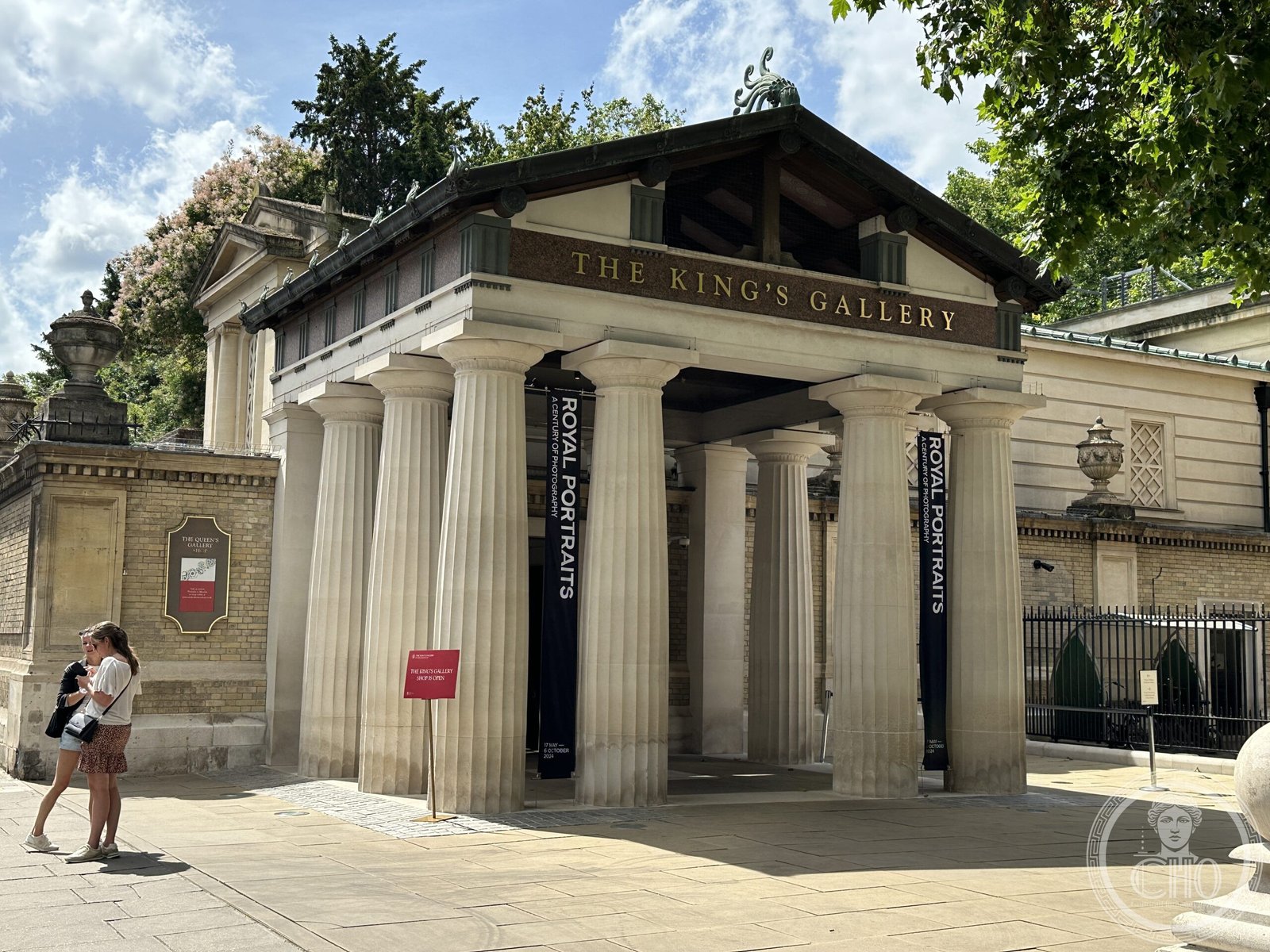
The Queen’s Gallery — now officially The King’s Gallery — is a public art gallery at Buckingham Palace displaying rotating exhibitions drawn from the Royal Collection, one of the largest and most important art collections in the world. First opened to the public in 1962 under Queen Elizabeth II on the site of a bombed private chapel, the gallery was substantially enlarged in 2002 and today exhibits approximately 450 works at a time, including paintings, drawings, manuscripts, and decorative arts spanning five centuries of royal patronage.
At a glance
- Type
- Royal art gallery (public access wing of Buckingham Palace)
- Period
- Opened 1962; rebuilt and enlarged 2002
- Style
- Neoclassical; entrance portico in “new classical” style (John Simpson, 2002)
- Location
- Buckingham Gate, London SW1A 1AA, England
- Coordinates
- 51.4998° N, 0.1426° W
- Managed by
- Royal Collection Trust
- Collection source
- Royal Collection (held in trust for the nation by the monarch)
Overview
The King’s Gallery, previously known as the Queen’s Gallery, is a public art gallery at Buckingham Palace, the official residence of the British monarch, in London. First opened to the public in the reign of Elizabeth II in 1962, it exhibits works of art from the Royal Collection on a rotating basis. Enlarged in the early 21st century, the gallery has its own separate public access entrance built in a “new” classical style and typically displays about 450 works, mainly paintings and drawings. The Royal Collection encompasses over one million objects accumulated by successive monarchs since the Tudor period.
History
The gallery occupies the site of the private chapel of Buckingham Palace, which was destroyed by German bombing in September 1940 during the Blitz. Queen Elizabeth II opened the converted space to the public in 1962, marking the first time members of the public could view works from the Royal Collection in a purpose-designed gallery setting. The original facility was modest; a major redevelopment in 2002, timed to mark the Golden Jubilee, enlarged the gallery substantially and provided it with a new classical entrance on Buckingham Gate designed by architect John Simpson.
What you see
Exhibitions change regularly and draw on the extraordinary breadth of the Royal Collection, which includes major works by Leonardo da Vinci, Raphael, Vermeer, Rembrandt, Canaletto, and Gainsborough, alongside royal portraits, armour, furniture, silver, and Fabergé objects. The entrance portico features carved friezes and columns in a new classical idiom that references the Palace’s 19th-century facade while signalling the gallery’s public, civic role. Approximately 450 works are on display at any one time.
Cultural significance
The Queen’s/King’s Gallery is one of very few points at which the British public can engage directly with the Royal Collection, a body of works held constitutionally in trust for the nation. It democratises access to one of the world’s great collections — assembled over 500 years through purchase, commission, and gift — without the need to visit the private royal residences themselves.
Practical information
- Address
- Buckingham Gate, London SW1A 1AA
- Opening hours
- Check the Royal Collection Trust website for current opening times; closed on certain public holidays and during royal events
- Admission
- Paid entry; check rct.uk for current prices
- Website
- rct.uk/visit/the-kings-gallery-buckingham-palace
Getting there
The gallery entrance is on Buckingham Gate, near the south-west corner of Buckingham Palace. The nearest London Underground stations are Victoria (District, Circle, and Victoria lines, approximately 5 minutes’ walk) and St James’s Park (District and Circle lines, approximately 8 minutes’ walk). Numerous bus routes serve Victoria. By car, the area is within the central London Congestion Charge Zone; no public parking is available at the palace.
Sources & resources
See the place
Find it on the map
See this place and what’s around it →📷 Become a Cultural Heritage Online photographer
Share your photos of places: they stay published under your name as the author. The more they're seen, the more you get noticed — and soon a contest will reward the most appreciated photos.
Log in or sign up free to add a photoIs this page about you?
This page is read by travellers and heritage enthusiasts who find it on Google. Tell us how you are connected to this place and we will take it from there.