
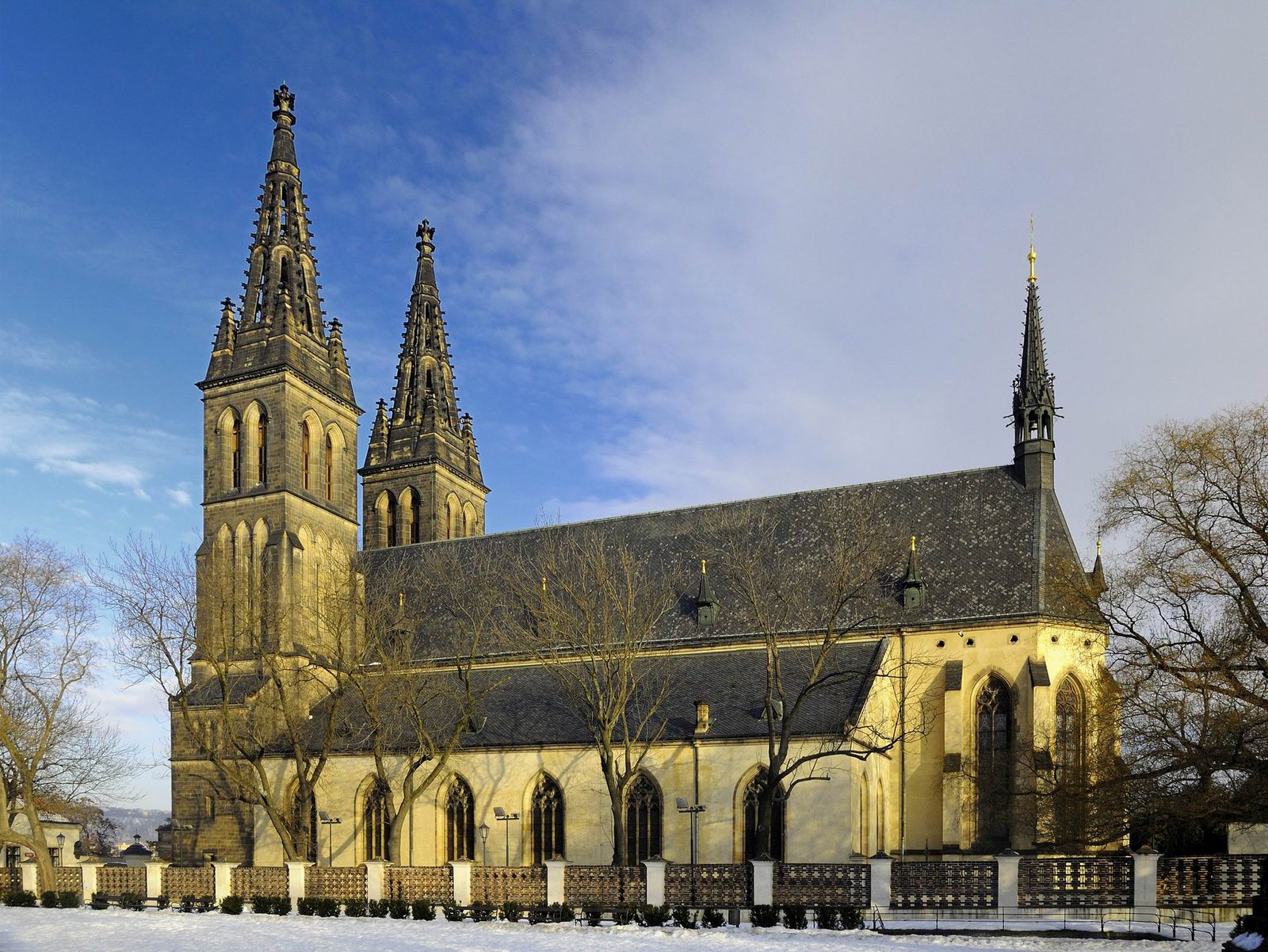
A twin-towered neo-Gothic church anchoring the Vyšehrad fortress, Prague’s twin-towered basilica crowns a hill above the Vltava River, commanding views across the city’s southern reach.
At a glance
Founded in 1070–1080 by King Vratislaus II of Bohemia, this church has been rebuilt and reimagined across centuries. Its 58-meter twin towers rise prominently above the fortress. Elevated to basilica status by Pope John Paul II in 2003, it remains one of Prague’s most recognizable monuments.
History
King Vratislaus II commissioned the original Romanesque basilica during the late 11th century at Vyšehrad fortress, the first seat of Czech kings. A devastating fire in 1249 destroyed much of the structure, prompting reconstruction. Over subsequent centuries, the church was rebuilt in Gothic style, then again in neo-Gothic fashion, reflecting the architectural tastes and spiritual aspirations of its era.
What you see
The basilica’s defining features are its pair of soaring stone towers, each reaching 58 meters. An impressive stone mosaic adorns the entry. The neo-Gothic design—with its pointed arches, ribbed vaults, and ornamental stonework—demonstrates 19th-century interpretations of medieval forms. The twin towers are visible from the Vltava riverbank, creating a dramatic silhouette against Prague’s skyline.
Cultural significance
Beyond its architectural presence, the basilica anchors Vyšehrad as a site of national memory. The adjacent cemetery holds many of Czech culture’s luminaries—composer Antonín Dvořák and author Karel Čapek among them. The church thus serves as both spiritual monument and pantheon for the Czech nation.
Key facts
- Country: Czech Republic
- City: Vyšehrad, Prague
- Founded: 1070–1080 by King Vratislaus II
- Major fire: 1249
- Twin tower height: 58 meters
- Elevated to basilica: 2003 by Pope John Paul II
- Coordinates: 50.06436, 14.41779
Practical information & getting there
The basilica stands within Vyšehrad fortress in Prague’s Vyšehrad district. You can reach it by metro (Line C to Vyšehrad station) or tram. The site includes the church, a large park, and Vyšehrad cemetery, all open to visitors. Check locally for current visiting hours and any admission fees.
Sources & resources
Find it on the map
See this place and what’s around it →📷 Become a Cultural Heritage Online photographer
Share your photos of places: they stay published under your name as the author. The more they're seen, the more you get noticed — and soon a contest will reward the most appreciated photos.
Log in or sign up free to add a photoIs this page about you?
This page is read by travellers and heritage enthusiasts who find it on Google. Tell us how you are connected to this place and we will take it from there.