
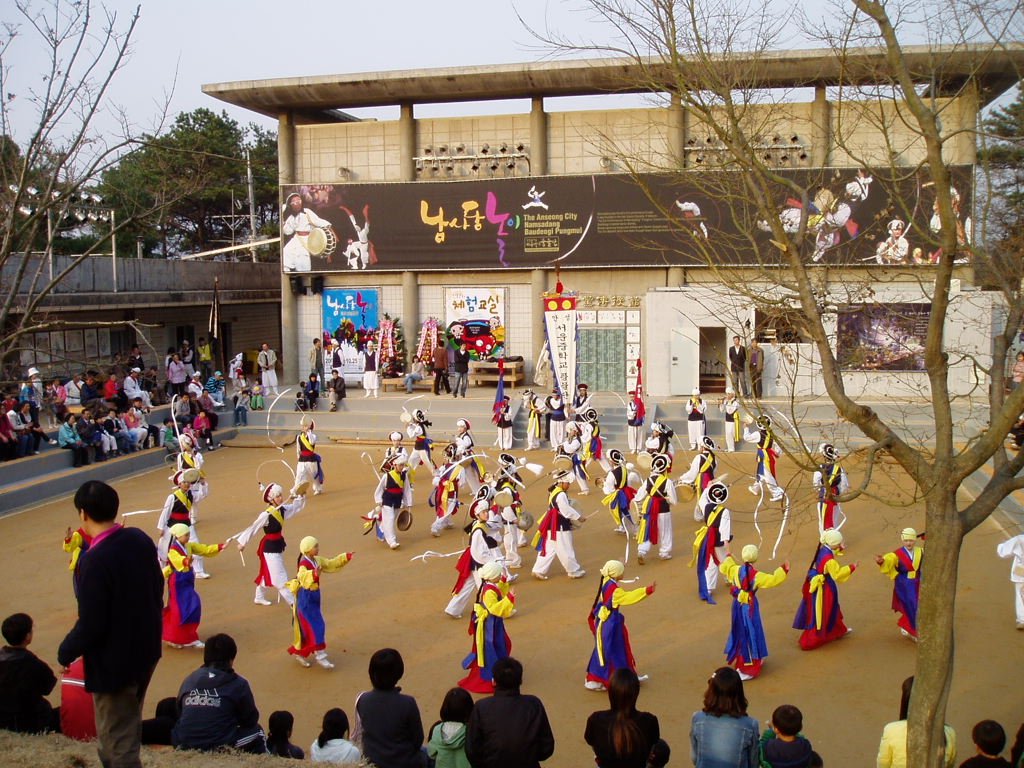
An all-male itinerant troupe that has wandered Korea’s marketplaces and villages for centuries, performing a virtuosic blend of acrobatics, mask drama, puppet theater, and music.
At a glance
Namsadang nori comprises six interconnected performance disciplines: pungmul nori (spinning hat dance), beona nori (spinning hoops and dishes), salpan (tumbling), eoreum (tightrope walking), deotboegi (mask dance drama), and deolmi (puppet play). Originally ten performances, only these six have survived into the modern era. The troupe integrates music, acrobatics, stunts, dance, and theatrical narrative into a single flowing performance.
Origins & history
Namsadang is thought to have formed spontaneously before 1900 during the Joseon period, though puppet shows were documented as far back as the Silla period (57 BCE–935 CE), suggesting that similar itinerant companies may have existed for millennia in Korean history. The name derives from “nam” (남, 男), meaning male—the troupe was originally composed exclusively of men, though women were eventually admitted. During the late Joseon Dynasty, the most celebrated namsadang was based at Cheongryongsa temple in Anseong, Gyeonggi Province. Because troupe members belonged to cheonmin (vulgar commoners) or equivalent social underclasses, few historical records survived their long history.
The practice
A namsadang performance unfolds as a sequence of six integrated disciplines, each demanding distinct physical and musical skill. Pungmul nori opens with rapid spinning of hats and percussion; beona nori follows with acrobatic manipulation of hoops and dishes. Salpan showcases tumbling and hand-balancing feats, while eoreum demands precise balance and agility on a rope strung between two points. Deotboegi introduces masked dancers who perform satirical or comedic dramas, often mocking authority or social pretense. Deolmi closes the spectacle with puppet theater—wooden figures manipulated by concealed performers enacting stories for the crowd. Throughout, live musicians provide rhythmic and melodic accompaniment, binding each section into a cohesive whole.
Cultural significance
For centuries, namsadang occupied a vital but precarious role in Korean popular culture, bringing entertainment and spectacle to villages and markets when other amusements were scarce. The troupe’s members were simultaneously beloved performers and members of despised castes—their art was consumed while their social status remained stigmatized. This contradiction has made namsadang nori a uniquely valuable record of lower-class Korean life and the resilience of performance traditions even under social marginalization. The practice embodies Korean ingenuity in adapting multiple art forms into a single mobile entertainment.
Key facts
- Anchor community: Anseong, Gyeonggi Province, South Korea (37.00299, 127.28288)
- Six core performances: pungmul nori, beona nori, salpan, eoreum, deotboegi, deolmi
- Deolmi designated Important Intangible Cultural Property: December 7, 1964
- All six namsadang nori performances designated Important Intangible Cultural Property: August 1, 1988
- UNESCO ICH inscription: 2008 (reference 00184)
Where to experience it
Anseong, the historical heartland of namsadang tradition, remains the primary center for encountering this practice. Performances occur at cultural venues and festivals throughout South Korea, particularly in regions with strong connections to the troupe’s wandering routes. Contact local cultural centers in Anseong or the national intangible cultural heritage authorities for current performance schedules and venues.
Sources & resources
- Namsadang – Wikipedia
- Namsadang nori – UNESCO Intangible Cultural Heritage
- Cultural Heritage Online
Find it on the map
See this place and what’s around it →📷 Become a Cultural Heritage Online photographer
Share your photos of places: they stay published under your name as the author. The more they're seen, the more you get noticed — and soon a contest will reward the most appreciated photos.
Log in or sign up free to add a photo