
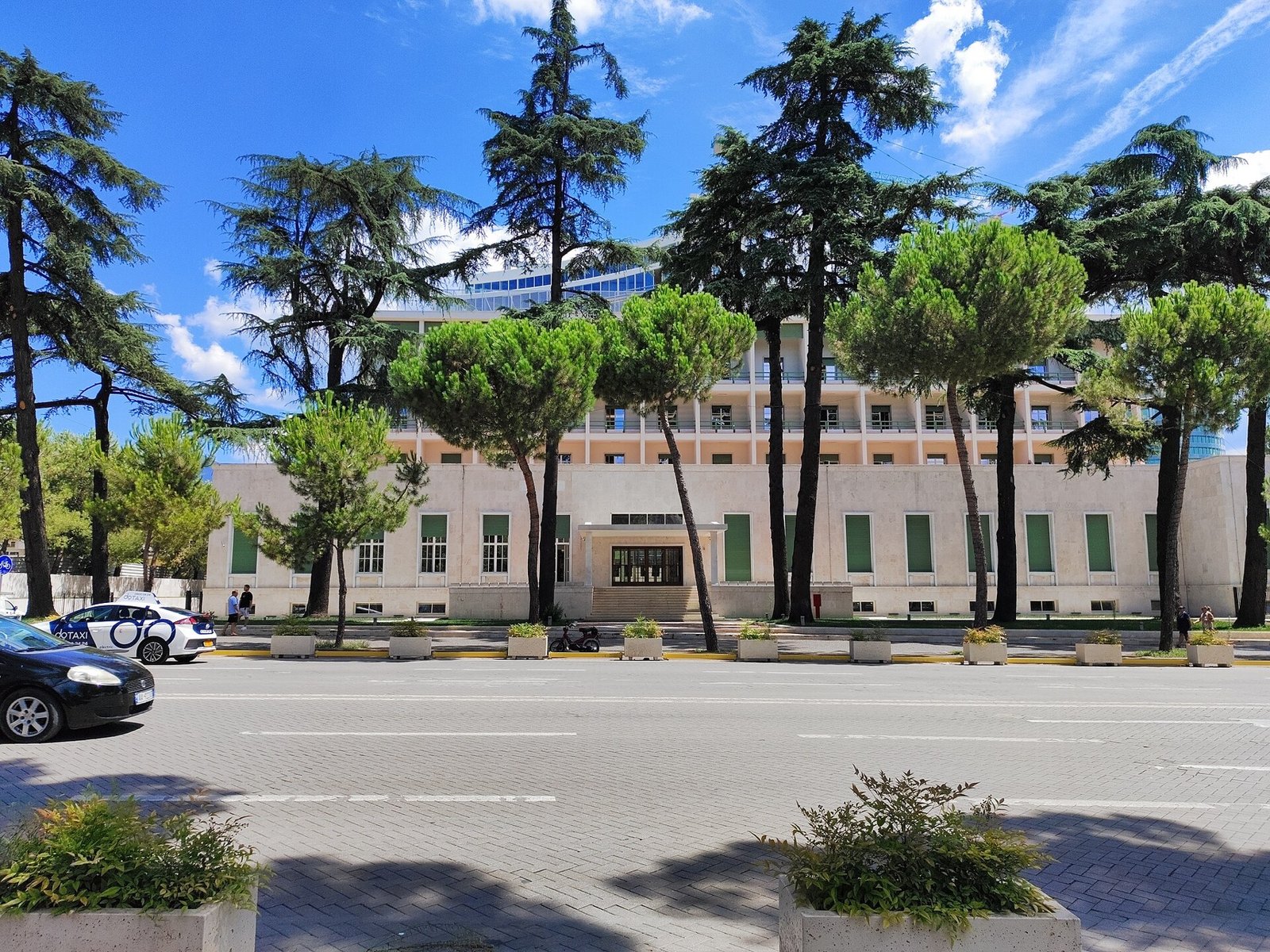
Tirana (1939–1942): the grand hotel Gherardo Bosio built on the new boulevard during the Italian occupation, with furnishings by Gio Ponti — later the bugged hotel of the socialist state, now the Bank of Albania.
At a glance
The Hotel Dajti stands on Tirana’s great boulevard, a long, low block of white stone facing Rinia Park. It was designed by the Italian architect Gherardo Bosio at the end of the 1930s, when Italy had occupied Albania and set about turning its capital into a monumental axis. Furnished in part by the designer Gio Ponti, it opened in 1942 as the finest hotel in the country. Under the socialist state it became the guarded home of every visiting diplomat — and, it later emerged, of the microphones in their rooms. Today the building belongs to the Bank of Albania.
Key facts
- Architect: Gherardo Bosio (1903–1941), head of Tirana’s central planning bureau
- Interiors: furnishings in part by Gio Ponti
- Built: 1939–1942, during the Italian occupation of Albania
- Style: among the first functionalist buildings in Albania
- Setting: Dëshmorët e Kombit Boulevard, beside Rinia Park, central Tirana
- Protected: listed as a cultural monument in 2002
- Today: owned by the Bank of Albania (bought 2010 for €30 million)
History
Italy invaded Albania in April 1939 and, as it had in Rhodes and Tirana’s own centre, moved quickly to rebuild the capital in its own image. Gherardo Bosio, a Florence-trained architect who ran the central bureau of construction and urban planning, was given the boulevard that runs south from Skanderbeg Square and asked to line it with the institutions of a modern capital. The Hotel Dajti was the boulevard’s showpiece: a state hotel to house the officials, engineers and guests the new order expected.
Work ran from 1939 into 1942. Bosio did not see it finished — he died in April 1941, aged thirty-eight, with the building still on site. It opened the following year under the name of the mountain that rises east of the city, and it was, at once, the grandest hotel Albania had.
What you see
The Dajti is read along its length rather than up its height. A ground floor faced in pale travertine runs the full width of the block, pierced by tall shuttered windows and centred on a low, flat-canopied portico reached by a broad flight of steps. Above it the upper floors step back behind a continuous screen of slender pillars, a shaded loggia of balconies that gives the front its calm, horizontal rhythm. There is no tower, no pediment; the monumentality is in the proportion and the stone.
The functionalist manner was new to Albania in 1940, and the Dajti introduced it at the scale of a boulevard. Inside, Gio Ponti’s hand shaped part of the furnishing, carrying the clean Italian design of the day into the guest rooms and public spaces.
Diplomats, microphones, a bank
After 1945 the communist government kept the Dajti as its window on the outside world. For decades it was the one hotel where foreign diplomats and visitors were lodged — and watched. The guest rooms were fitted with microphones, and a sub-basement floor housed the staff who listened. The building’s comfort and its surveillance were the same fact.
The hotel closed after the fall of the regime and stood empty and overgrown for years; in 2009 its derelict halls hosted the Tirana International Contemporary Art Biennale. In 2010 the Bank of Albania bought it for thirty million euros and restored it, using it while its headquarters on Skanderbeg Square were rebuilt. The purchase was not without controversy: Albanian media reported claims that the central bank had printed money to fund the deal, which the bank’s critics raised as a question of oversight.
Visiting
- The building is a bank office and is not open to the public inside; the boulevard facade is what you come to see.
- It is best viewed from Rinia Park across the street, where the full length of the front is clear of traffic.
- Late-afternoon light rakes the travertine and the loggia; that is the hour to photograph it.
Getting there
The Dajti sits on the Dëshmorët e Kombit Boulevard, a few minutes’ walk south of Skanderbeg Square and the cluster of Italian-era ministries at the heart of Tirana. The whole boulevard is walkable; Rinia Park lies directly opposite.
Nearby
Sources
- Wikipedia, Hotel Dajti and Gherardo Bosio — architect and designer, location, functionalist style, socialist-era use and microphones, 2002 listing, 2009 Biennale, 2010 Bank of Albania purchase.
- Architectuul and Tirana Times — construction 1939–1942, Bosio’s planning role, Gio Ponti furnishings, central-bank conversion.
- Cultural Heritage Online, Italian-Era Albania: the Tirana Axis, from Brasini’s Plan to Bosio’s Square — the boulevard and its context.
Find it on the map
See this place and what’s around it →Record researched and written by Luigi De Marchi for Cultural Heritage Online, 2026.
📷 Become a Cultural Heritage Online photographer
Share your photos of places: they stay published under your name as the author. The more they're seen, the more you get noticed — and soon a contest will reward the most appreciated photos.
Log in or sign up free to add a photoIs this page about you?
This page is read by travellers and heritage enthusiasts who find it on Google. Tell us how you are connected to this place and we will take it from there.