
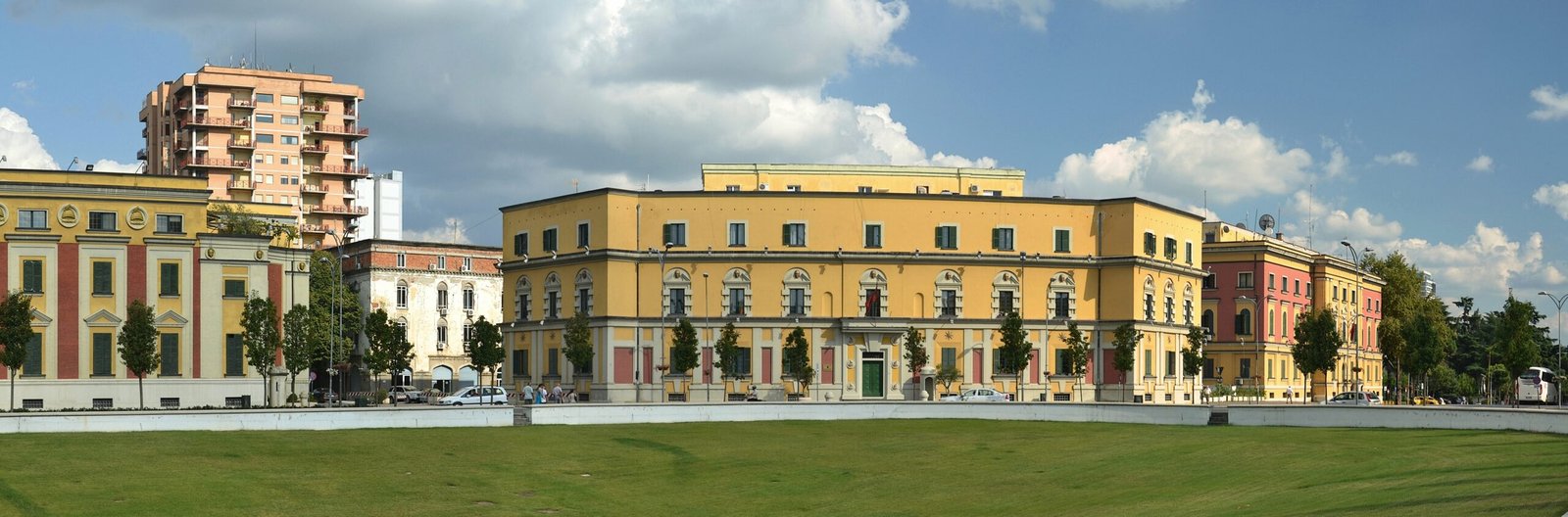
The centre of Albanian public life is framed by ochre neo-Renaissance fronts drawn by Italian architects for King Zog’s new capital. Redesigned in 2017, the square won the European Prize for Urban Public Space.
At a glance
Skanderbeg Square is Tirana’s centre and its most legible palimpsest. A public square first laid out here under Austrian administration in 1917 became, after Tirana was made capital in 1920, the pivot of a city plan drawn by Armando Brasini in 1925 and carried forward by Florestano Di Fausto — the same architect then reshaping Tripoli and Rhodes. The ministries they framed around the square, ochre and neo-Renaissance, still house the Albanian state. Under the monarchy the square itself was a roundabout with a central fountain; Gherardo Bosio updated the master plan in 1939, after the Italian invasion. Some 40,000 square metres today, pedestrianised in a 2017 redesign by 51N4E with artist Anri Sala, it won the European Prize for Urban Public Space in 2018.
Key facts
- Origins: public square laid out in 1917; Tirana capital of Albania from 1920
- Plan: Armando Brasini, 1925; continued by Florestano Di Fausto (1890–1965) in neo-Renaissance manner; master plan updated by Gherardo Bosio, 1939
- The ministries: the ochre government fronts framing the square, built under the monarchy of King Zog (1928–1939)
- On the square: the Et’hem Bey Mosque and the Clock Tower, the National Historical Museum, the Bank of Albania, and the equestrian monument to Skanderbeg
- Under communism: a statue of Stalin stood where the Skanderbeg Monument now stands; it was removed after 1991
- Today: about 40,000 m², pedestrianised 2017 (51N4E with Anri Sala); European Prize for Urban Public Space 2018
History
The context, stated plainly: the Italian hand in Tirana came in two distinct phases. In the 1920s and 1930s, Italian architects worked for the independent Albanian state of King Zog, financed by Italian loans that were themselves instruments of influence; in April 1939 Italy invaded and annexed the country, and the planning continued under occupation. The square’s fabric belongs mostly to the first phase, its final Italian plan to the second. Both are documented here as heritage, not endorsed.
Brasini, a Roman master of theatrical classicism, set the axis and the government centre; Di Fausto carried the work forward, and through the 1930s the ministries went up around the square in the composed, ochre-toned neo-Renaissance the two had established, while the square itself functioned as a fountain roundabout at the meeting of the old Ottoman town — mosque, clock tower, bazaar — and the new administrative capital. Bosio’s 1939 revision, made for the occupation regime, extended the axis south into the boulevard and the complex now anchored by Mother Teresa Square.
The square has been re-centred by every regime since: Stalin’s statue rose under communism and fell to the student demonstrations of 1991; the equestrian Skanderbeg took his place as the national symbol. The 2017 redesign by the Brussels studio 51N4E with Anri Sala tilted the whole surface into a shallow pyramid of local stone, banned the car, and returned the space to pedestrians — a transformation recognised with the European Prize for Urban Public Space in 2018.
What you see
Stand at the centre and turn: the ochre ministries hold the southern arc in matched neo-Renaissance fronts — pilasters, pedimented windows, deep cornices — while the Et’hem Bey Mosque and the Ottoman Clock Tower hold the eastern corner, and the communist-era National Historical Museum closes the north with its mosaic front. The monument to Skanderbeg rides between them. No single building dominates; the square is the exhibit, four regimes of architecture around one open floor.
The 2017 surface is the subtlest piece: a barely perceptible slope of stone quarried across Albania, with fountains flush to the paving and new trees around the perimeter. In summer the stone radiates the day’s heat well into the evening, and the square fills as the light goes — the rare case of an interwar governmental setpiece that has become, without irony, a beloved public living room.
Practical information
- The square is open, pedestrian and free at all hours; the ministries are working government buildings, viewed from outside.
- The Et’hem Bey Mosque and the Clock Tower can be visited; the National Historical Museum faces the square.
- Allow an hour for the square and its edges, more if you continue south along the boulevard to Mother Teresa Square.
Getting there
The square is the geographic and civic centre of Tirana, within walking distance of most of the city’s hotels. GPS: 41.32847, 19.81769 · Open in Google Maps.
Related places and reading
- Italian-Era Albania: the Tirana Axis, from Brasini’s Plan to Bosio’s Square — the wider frame
- Mother Teresa Square and the former Casa del Fascio — Bosio’s end of the axis
Sources
- English Wikipedia, “Skanderbeg Square” (1917 origins, Brasini 1925 plan continued by Di Fausto, Bosio’s 1939 update, Stalin statue and 1991, size, 2017 redesign by 51N4E with Anri Sala, European Prize for Urban Public Space 2018).
- Our article “Italian-Era Albania” (the Brasini–Di Fausto–Bosio sequence and the ministries ensemble), fact-checked separately.
- OpenStreetMap Nominatim (coordinates, “Sheshi Skënderbej”).
Find it on the map
See this place and what’s around it →Record researched and written by Luigi De Marchi for Cultural Heritage Online, 2026.
📷 Become a Cultural Heritage Online photographer
Share your photos of places: they stay published under your name as the author. The more they're seen, the more you get noticed — and soon a contest will reward the most appreciated photos.
Log in or sign up free to add a photoIs this page about you?
This page is read by travellers and heritage enthusiasts who find it on Google. Tell us how you are connected to this place and we will take it from there.