
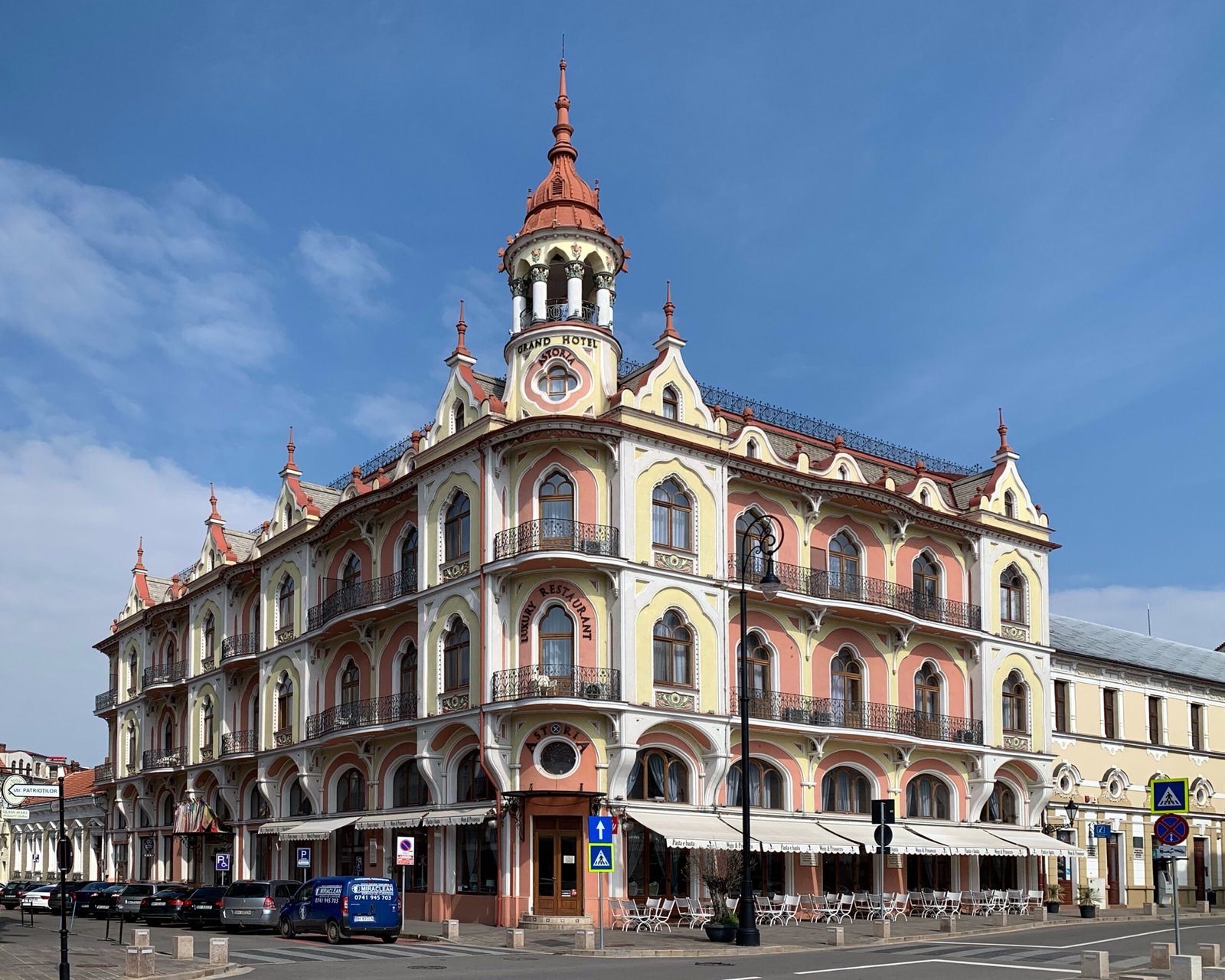
Ferenc Sztarill built his own apartment palace on Theatre Street between 1902 and 1906, folding Secession ornament into a neo-Gothic frame and giving Oradea one of its earliest statements in the new style.
At a glance
The Sztarill Palace stands at the corner of Strada Teatrului and Piața Regele Ferdinand I, in the historic core of Oradea, near Romania’s western border. The architect Ferenc Sztarill (1859–1943) designed and built it for himself between 1902 and 1906, combining Secession ornament with a neo-Gothic frame of steep pediments and curving gable lines. Rental apartments filled the upper floors; the ground floor held the EMKE café, one of the city’s celebrated literary meeting places. Since 1930 the building has served as a hotel, the Astoria, and today it operates as the Grand Hotel Astoria. It is a listed historic monument and an early landmark on Oradea’s Art Nouveau route.
Key facts
- Architect: Ferenc Sztarill (1859–1943)
- Built: 1902–1906, as an apartment palace for the architect himself
- Style: Secession (Art Nouveau) with neo-Gothic elements
- Original use: rental apartments above, the EMKE café at street level
- Became a hotel: the Astoria, from around 1930–1931
- Heritage status: listed Romanian historic monument, LMI code BH-II-m-B-01082
- Location: Strada Teatrului 1, at the corner of Piața Regele Ferdinand I
History
Ferenc Sztarill (1859–1943) was among the busiest architects and builders working in turn-of-the-century Oradea, then the Hungarian city of Nagyvárad. He began the palace in 1902 as both an income property and a personal statement, completing the work around 1906. It is widely regarded as Sztarill’s first building in the Secession idiom and, by some accounts, the first of its scale in the city — a claim local historians make with caution rather than certainty.
The ground-floor EMKE café opened in 1902 and soon became the address for the town’s writers and journalists. The literary circle known as A Holnap (“Tomorrow”), formed in 1908, gathered here, and the poet Endre Ady counted the café among his haunts during his Nagyvárad years. Mirrors, murals and a mezzanine of curtained booths gave the room its Secession character.
Sztarill converted the palace into a hotel around 1930, and the Astoria name has stayed with it since. The building closed after the Second World War and reopened in 1975, though the original Secession furnishings were lost in the intervening decades. It carries the Romanian heritage listing code BH-II-m-B-01082.
What you see
The facade is the building’s argument. Sztarill broke the long street front into a shifting rhythm of bays, then crowned it with tall pediments and undulating gable contours that carry the eye up and along. Secession detailing — floral and geometric motifs, wrought-iron balcony rails, framed window surrounds — softens the underlying Gothic verticality without hiding it.
The corner turning onto Piața Regele Ferdinand I is where the design concentrates, marking the palace as a hinge between square and street. At street level, the former EMKE café space keeps the building tied to daily life; the ornament that survives rewards a slow look upward, where the interplay of stone, iron and glass reads most clearly in raking afternoon light.
Practical information
- Central Oradea, a five-minute walk from Union Square (Piața Unirii) across the Crișul Repede.
- Still a working hotel: the lobby and ground-floor spaces are publicly accessible, but the building is not a museum.
- Allow 15–20 minutes for the facade and corner, longer if you pair it with the wider Art Nouveau route.
Getting there
Oradea sits in Bihor County, close to the Hungarian border and roughly 13 km from the crossing at Borș. The city is reached by rail and road from Cluj-Napoca and from Budapest; Oradea railway station lies about 2 km north of the centre, a short taxi or bus ride away. From the central squares, the palace is an easy walk along Strada Teatrului.
Nearby
- Black Eagle Palace (Palatul Vulturul Negru) — Marcell Komor and Dezső Jakab, 1907–1908; Oradea’s Secession showpiece, with its glazed arcade and stained-glass eagle.
- Stern Palace (Palatul Stern), Strada Republicii — by the same architects.
- Moskovits palaces, on Strada Republicii — further stops on the city’s Art Nouveau route.
- Piața Unirii (Union Square) and the Oradea State Theatre, both within a short walk.
Sources
- https://www.oradeaheritage.ro/astoria-hotel-the-sztarill-palace/?lang=en
- https://ro.wikipedia.org/wiki/Hotelul_Astoria_din_Oradea
- https://www.wikidata.org/wiki/Q18540772
- https://www.oradeaheritage.ro/black-eagle-palace/?lang=en
Find it on the map
See this place and what’s around it →📷 Become a Cultural Heritage Online photographer
Share your photos of places: they stay published under your name as the author. The more they're seen, the more you get noticed — and soon a contest will reward the most appreciated photos.
Log in or sign up free to add a photoIs this page about you?
This page is read by travellers and heritage enthusiasts who find it on Google. Tell us how you are connected to this place and we will take it from there.