
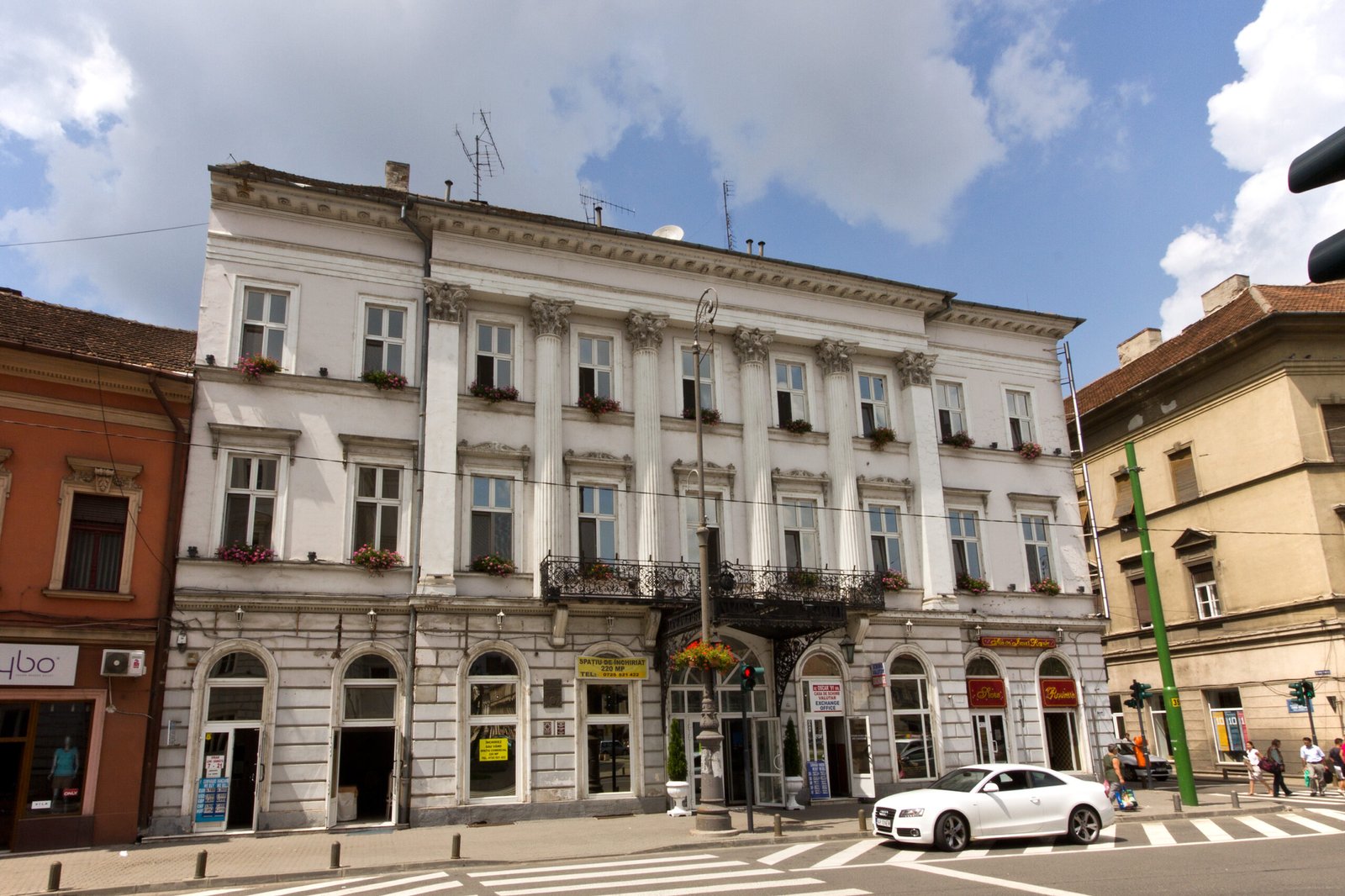
Behind a sober neo-classical front on Arad’s main boulevard lies a festive hall where Franz Liszt, Johann Strauss the Younger and Pablo Casals once played.
At a glance
Hotel Ardealul stands on Bulevardul Revoluției, the broad ceremonial boulevard that has served as Arad’s corso since the nineteenth century. Raised in 1840–1841 to designs by the architect Franz Mahler, it opened as the White Cross Hotel — Crucea Albă in Romanian, Fehér Kereszt in Hungarian — in what was then the Kingdom of Hungary, on the site of an earlier postal station. Its upper-floor festive hall became one of the most important concert rooms in the region: Franz Liszt played here in 1846, Johann Strauss the Younger in 1847, and the cellist Pablo Casals in 1912. The building is a listed Romanian historic monument and still operates as a hotel, with 146 rooms in the city centre.
Key facts
- Opened: 1841, as the White Cross Hotel (Crucea Albă / Fehér Kereszt)
- Architect & style: Franz Mahler; neo-classical
- Location: Bulevardul Revoluției 98, central Arad
- Concert-hall performers: Franz Liszt (1846), Johann Strauss the Younger (1847), Pablo Casals (1912)
- Heritage status: Romanian historic monument, code AR-II-m-B-00558
- Rooms today: 146
- Liszt’s piano: said to be preserved in the Arad museum collection
History
A postal station occupied this corner from the eighteenth century, at the meeting point of the routes linking Vienna, Arad and Sibiu. When the Arad–Alba Iulia railway opened in 1868 and the coaching traffic fell away, the premises were given over fully to hospitality and took the name of the White Cross. The festive hall on the upper floor, generously proportioned and valued for its acoustics, was used for balls, banquets and public concerts.
The list of musicians who appeared in that hall is unusually distinguished. Franz Liszt gave a recital there in 1846, during his last great concert tour; the piano he is said to have used survives in the collection of the Arad museum. Johann Strauss the Younger followed in 1847, and in 1912 the young Pablo Casals brought his cello to the same room. Johannes Brahms appeared in Arad in 1879 alongside the violinist Joseph Joachim, a concert that heritage records place in this hall.
The hotel also lodged a roll-call of writers and public figures, among them George Coșbuc, Ion Luca Caragiale, Octavian Goga, George Enescu and the French composer Jules Massenet, and in 1872 it hosted a large gathering of Romanians from western Transylvania. In the twentieth century the concert hall was converted first into the Mureșul cinema, then a dance club, and it later became a church venue. The building changed ownership in 2023 and continues to operate as a hotel.
What you see
The exterior is restrained neo-classical: a long, symmetrical facade of rendered masonry facing the boulevard, its window bays ordered by simple pilasters and cornice lines rather than ornament. The scale is urban and civic rather than showy, matching the row of institutional buildings along the corso; the Ioan Slavici Classical Theatre stands immediately alongside. A restoration in 1974 kept the street front broadly as it appears today.
Inside, the former festive hall remains the building’s historic core. It was built as a tall room able to seat a substantial audience — the quality that first recommended it for orchestral and solo concerts. Its later lives as cinema, dance floor and place of worship have altered the interior, but the volume that once held Liszt’s piano and Casals’s cello is still legible in the plan.
Practical information
- Location: central Arad, on Bulevardul Revoluției beside the Ioan Slavici Classical Theatre.
- Time needed: 15–20 minutes for the facade and its setting; longer if combined with a walk along the boulevard.
- Access: the interior is a working hotel; the historic hall is not a public exhibition space.
Getting there
Arad lies in western Romania, close to the Hungarian border and about 50 kilometres north of Timișoara. It is a significant rail junction: Arad railway station sits on the main line between Budapest and Bucharest, and the hotel is a walk of roughly fifteen minutes from the platforms through the city centre. The nearest large airport is Traian Vuia International near Timișoara. By road, the A1 motorway links Arad with Timișoara and the border crossings.
Nearby
- Ioan Slavici Classical Theatre — Arad’s principal theatre, immediately next door on the boulevard.
- Administrative Palace of Arad — the nineteenth-century city hall with its landmark clock tower.
- Reconciliation Park — a central green space with monuments marking the city’s layered history.
- Cultural Palace of Arad — home to the Arad Philharmonic and the city’s museum collections.
Sources

Find it on the map
See this place and what’s around it →📷 Become a Cultural Heritage Online photographer
Share your photos of places: they stay published under your name as the author. The more they're seen, the more you get noticed — and soon a contest will reward the most appreciated photos.
Log in or sign up free to add a photoIs this page about you?
This page is read by travellers and heritage enthusiasts who find it on Google. Tell us how you are connected to this place and we will take it from there.