
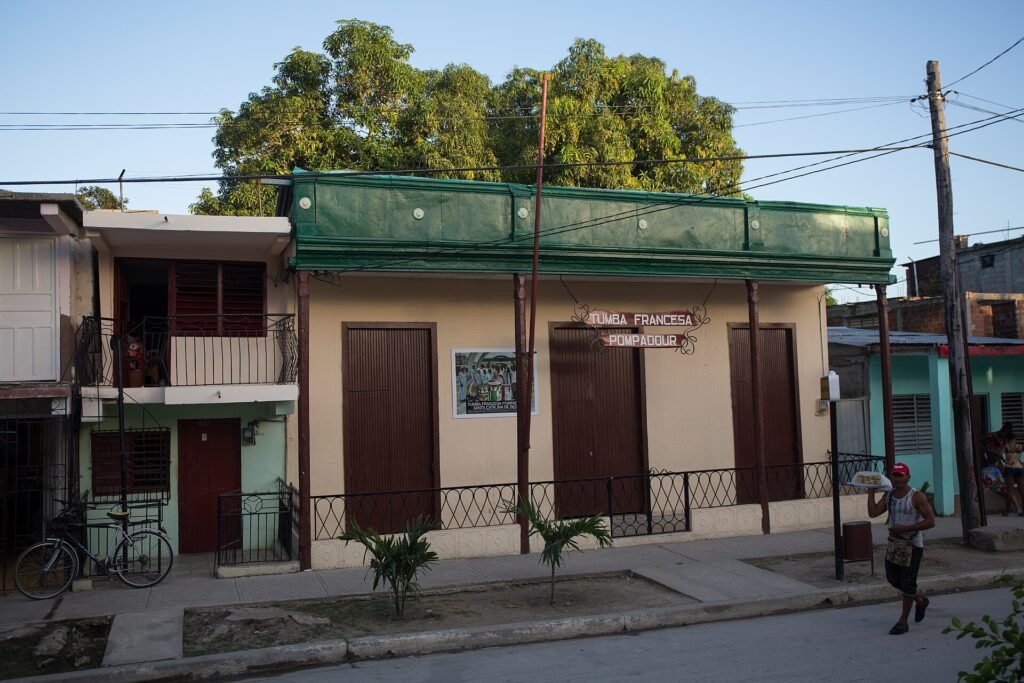
A secular Afro-Cuban genre of dance, song, and drumming born from the cultural memory of enslaved people brought to eastern Cuba from Saint-Domingue in the 1790s, kept alive by three surviving societies.
At a glance
Tumba francesa emerges at the intersection of African rhythm, Caribbean migration, and Creole identity. The practice combines percussion, song, and choreography performed by members of historic societies that have preserved this living tradition across generations. It represents the cultural legacy of enslaved people whose owners fled Haiti’s slave rebellion and resettled in Cuba’s eastern provinces.
Origins & history
Tumba francesa arose in Oriente following waves of forced migration from Saint-Domingue (later Haiti) in the 1790s. Enslaved and formerly enslaved people carried their musical and spiritual traditions into Cuba’s eastern regions, where these practices merged with local Creole culture. The genre flourished in the late 19th century with the formation of sociedades de tumba francesa—formal societies dedicated to maintaining the music, dance, and ritual of the tradition. Of these organized communities, only three persist today, serving as custodians of repertoire and technique.
The practice
Tumba francesa is performed by drummers, singers, and dancers moving in coordinated patterns that reflect both African and Cuban sensibilities. The soundscape is anchored by complex polyrhythmic drumming patterns, layered voices, and call-and-response vocal exchanges. Movement is fluid yet deliberate, with performers responding to the rhythmic conversation between drums. The societies that maintain the practice function as both performance ensembles and social organizations, gathering members for ceremonies and public occasions that celebrate Afro-Cuban heritage.
Cultural significance
Tumba francesa embodies the resilience and creative memory of Black diaspora communities in the Caribbean. It preserves knowledge of African musical systems, spiritual practices, and social structures within a Cuban context. The surviving societies represent rare institutional continuity—spaces where culture passes across generations through direct teaching and collective participation. The practice affirms dignity and identity rooted in shared history.
Key facts
- Practice originates in Oriente, Cuba, following migration from Saint-Domingue (Haiti) in the 1790s
- Three societies preserve tumba francesa today
- UNESCO Intangible Cultural Heritage, reference 00052
- Anchor community: Santiago de Cuba (20.02287°N, 75.82782°W)
Where to experience it
Santiago de Cuba remains the heartland of tumba francesa practice. The surviving societies continue to perform and teach within their communities, though access and performance schedules are best confirmed through local cultural organizations in the city. Visitors should seek connections through Santiago’s cultural institutions.
Sources & resources
- Tumba francesa — Wikipedia
- La Tumba francesa — UNESCO Intangible Cultural Heritage
- Cultural Heritage Online
Find it on the map
See this place and what’s around it →📷 Become a Cultural Heritage Online photographer
Share your photos of places: they stay published under your name as the author. The more they're seen, the more you get noticed — and soon a contest will reward the most appreciated photos.
Log in or sign up free to add a photo