
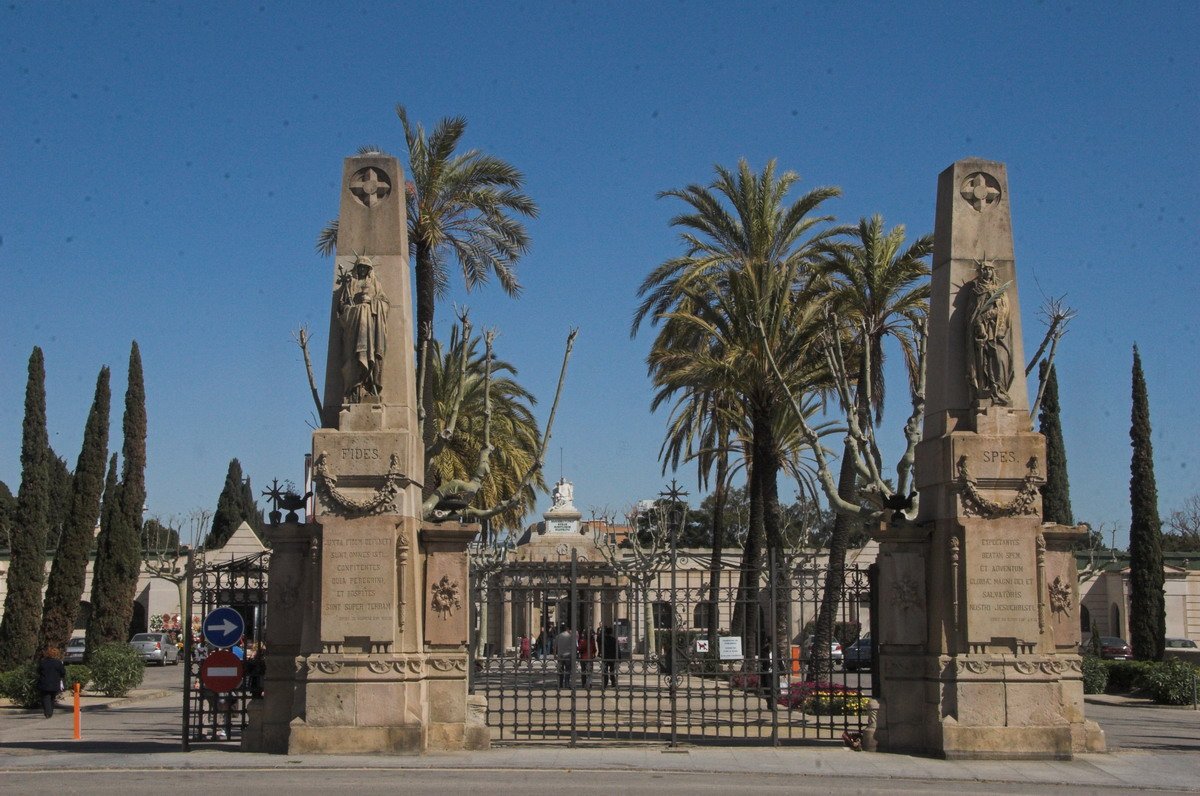
Barcelona’s East Cemetery reveals the city’s social geography through stone—egalitarian burial niches at its front, monuments of wealthy merchants at its rear, and a haunting sculpture of death and youth at its heart.
At a glance
Poblenou Cemetery, also known as the East Cemetery or General Cemetery, anchors the Poblenou neighbourhood in Barcelona’s eastern expansion. Its address on Calle de Taulat, main entrance at Avenida Icària, marks a site consecrated to the dead since the 18th century.
History
The first cemetery opened here in 1775, built outside the city’s medieval walls when churchyard burials within Barcelona became a sanitary concern. Napoleon’s troops destroyed this site in 1813. Italian architect Antonio Ginesi was commissioned to rebuild it; the new cemetery was reconsecrated by Bishop Pau de Sitjar i Ruata on 15 April 1819. The cemetery formally opened to the public in 1898 under Bishop Josep Climent i Avinent’s benediction.
What you see
Ginesi’s design divides the cemetery into three distinct social spaces. The front terraces hold egalitarian burial niches in neat rows—democratic even in death. Behind them rises a landscape of private mausolea and monuments, extravagant memorials to the city’s bourgeoisie, merchants and manufacturers. A narrow third section along the southern wall mingles niches, monuments and common graves in pragmatic combination.
Cultural significance
Poblenou Cemetery is a map of 19th-century Barcelona’s class divisions rendered in stone and bronze. Its architecture reflects the city’s industrial expansion and the anxieties of a rising merchant class about memory and permanence. The cemetery remains a working burial ground and a vital archive of Catalan sculpture and memorial practice.
Key facts
- Country: Spain
- City: Barcelona (Poblenou neighbourhood)
- Coordinates: 41.39611111, 2.20305556
- First cemetery established: 1775
- Rebuilt and reconsecrated: 15 April 1819
- Formally opened: 1898
- Architect (rebuild): Antonio Ginesi
- Most famous monument: The Kiss of Death (1930), carved by Jaume Barba
Practical information & getting there
The cemetery is located in the Poblenou neighbourhood of Barcelona, with its main entrance at Avenida Icària. Exact opening hours and visiting regulations are best confirmed in advance with Barcelona’s municipal authorities or the cemetery office.
Sources & resources
Find it on the map
See this place and what’s around it →📷 Become a Cultural Heritage Online photographer
Share your photos of places: they stay published under your name as the author. The more they're seen, the more you get noticed — and soon a contest will reward the most appreciated photos.
Log in or sign up free to add a photoIs this page about you?
This page is read by travellers and heritage enthusiasts who find it on Google. Tell us how you are connected to this place and we will take it from there.