
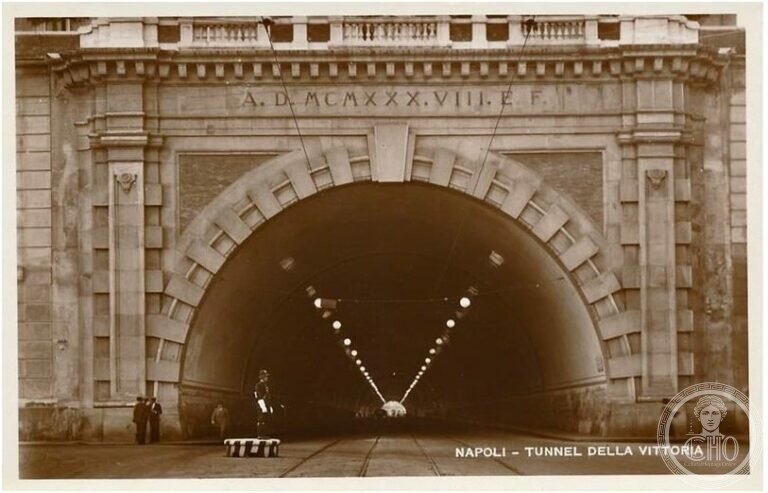
Six hundred metres of roadway driven beneath the tufa of Monte Echia and opened to traffic in 1929. In this 1930s postcard the portal is new: two tram tracks, one white-gloved policeman, a string of lamps running to a point of daylight.
- Location
- Between via Acton at the Molosiglio and the junction of via Chiatamone, via Morelli and via Arcoleo, Napoli
- Period
- Opened to traffic in 1929; western front completed 1933
- Designers
- Executive project and works directed by ing. Michele Guadagno; via Acton retaining wall by Giuseppe Madonna; western front by Roberto Pane (1897–1987)
- Length
- 609 m, as reported by Neapolitan historiography
- Current use
- Urban road tunnel, in service
- Coordinates
- 40.8322° N, 14.2438° E (western portal)
- Notes
- The attic in the postcard reads A.D. MCMXXX · VIII E.F. — 1930, year eight of the Fascist calendar
Then and now
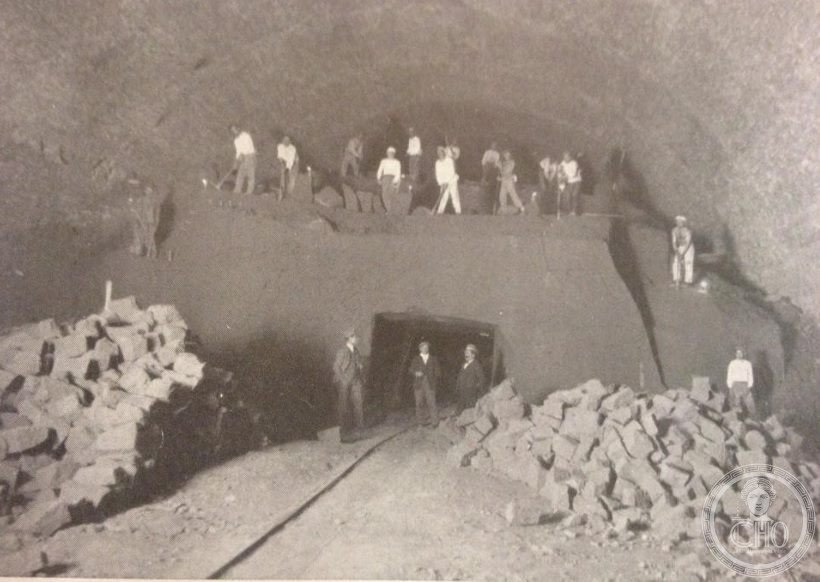
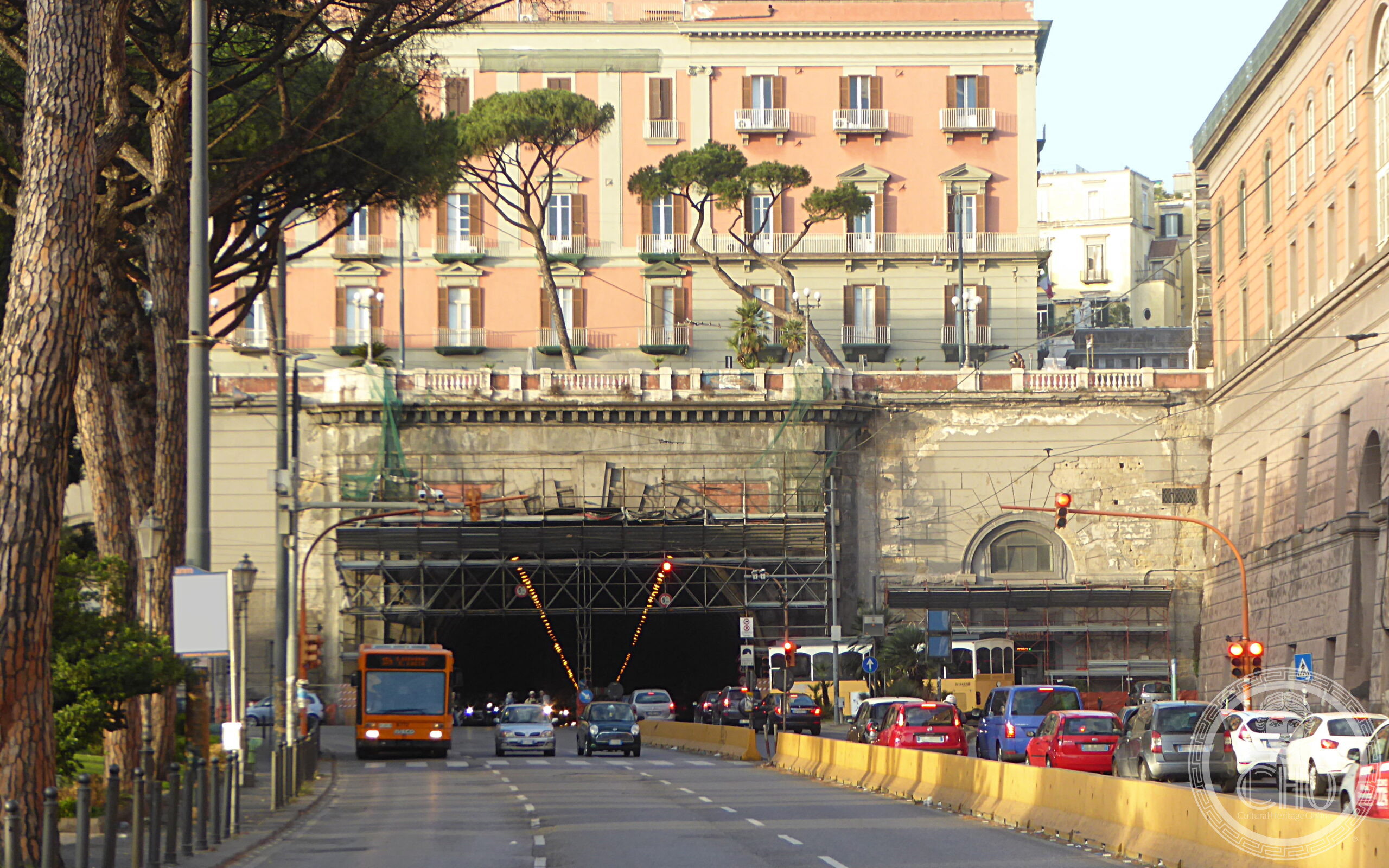
The tunnel under construction, and the eastern portal as it stands today.
Visit on the map
Via Chiatamone / Galleria della Vittoria, Napoli · 40.8322° N, 14.2438° E
Download for your navigator
A single waypoint, ready for GPS apps, navigators, and contacts.
The photographer stood in the middle of the roadway, and the postcard keeps that nerve. The arch fills the frame: a broad rusticated archivolt springing between panelled piers, a moulded attic carrying the date, and inside the bore two files of globe lamps converging on a far point of daylight. Tram rails curve in under the vault beneath their overhead wire. A traffic policeman holds the centre of the carriageway from a small striped island; a knot of men in overcoats watches from the left kerb. The inscription above them reads A.D. MCMXXX · VIII E.F. — the year 1930 of the common era, year eight of the Fascist one.
The tunnel itself had opened to traffic the year before. Naples had run a public competition to link the port road of via Acton with the Chiaia seafront without climbing over the Pizzofalcone spur; the winning scheme, by an engineer named Monticelli, put its western mouth at via Serapide and was discarded when the approaches proved unworkable. The revision and the works fell to engineer Michele Guadagno. Cutting the bore meant clearing what stood in the way: remains of the Bourbon arsenal, the seventeenth-century ramps that climbed toward Piazza del Plebiscito, the old Spanish bastion. Giuseppe Madonna designed the great retaining wall on the via Acton side. In 1927 the competition for the western front was won by a thirty-year-old Roberto Pane (1897–1987), who closed the Chiatamone end with a semicircular exedra finished in 1933 — a Fascist-era commission from the man who would become Italy’s leading theorist of architectural conservation. The name echoes the neighbouring Piazza della Vittoria, which commemorates the victory of Lepanto in 1571.
Local historiography ranks the Galleria della Vittoria among the largest urban works built in Europe in those years: a bore of 609 metres, wide enough for two carriageways, driven under a hill that already carried centuries of the city on its back. It still earns its keep. The tunnel remains the east–west spine of the seafront, and the same tufa spur is threaded by an older sibling — the escape tunnel the Bourbons cut in the mid-nineteenth century, now visitable as the Galleria Borbonica. The postcard preserves what daily traffic no longer notices: how consciously this piece of infrastructure was dressed as architecture.
Resources & References
Editorial picks across local historiography and architectural study.
Postcard from the collection of Stefano Vigolo, published by permission. Archive photographs via Wikimedia Commons, credited in captions. Editorial text Cultural Heritage Online, OASIS Tech LLC USA.
Find it on the map
See this place and what’s around it →Record researched and written by Oasis Tech for Cultural Heritage Online, 2026.
📷 Become a Cultural Heritage Online photographer
Share your photos of places: they stay published under your name as the author. The more they're seen, the more you get noticed — and soon a contest will reward the most appreciated photos.
Log in or sign up free to add a photo