
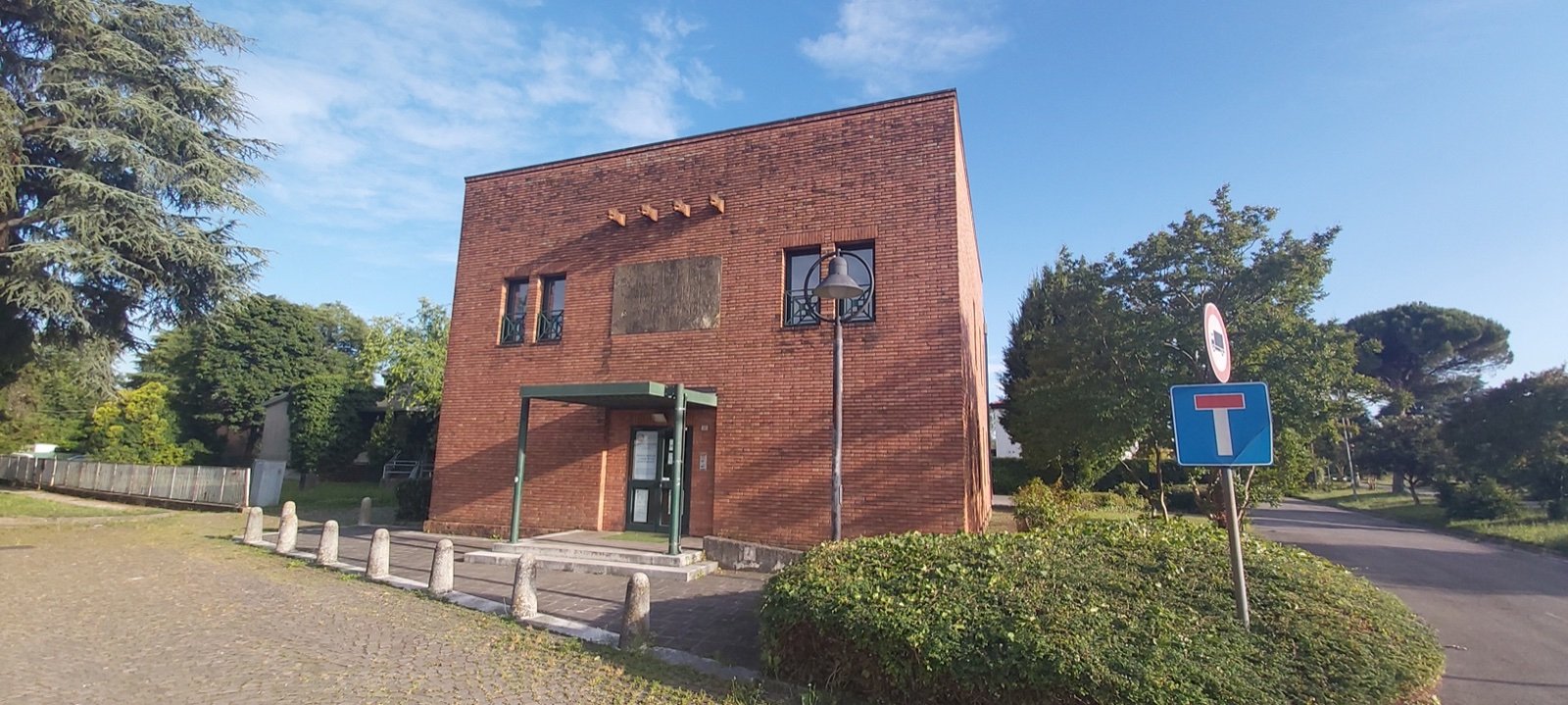
Rubano (1937–1939): one of the rural party houses Quirino De Giorgio built across the Padua countryside, a brick block that still carries its stone slogan and four fasces consoles.
At a glance
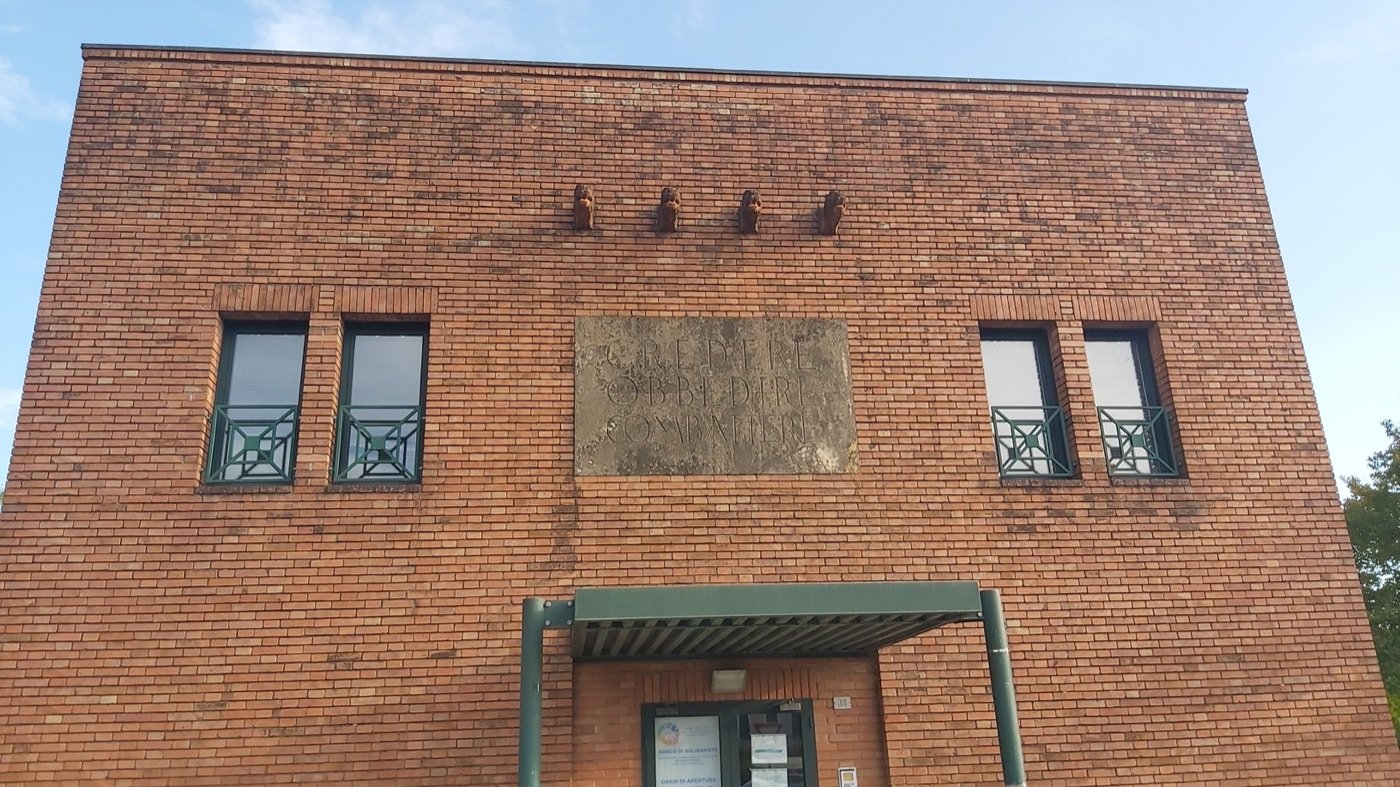
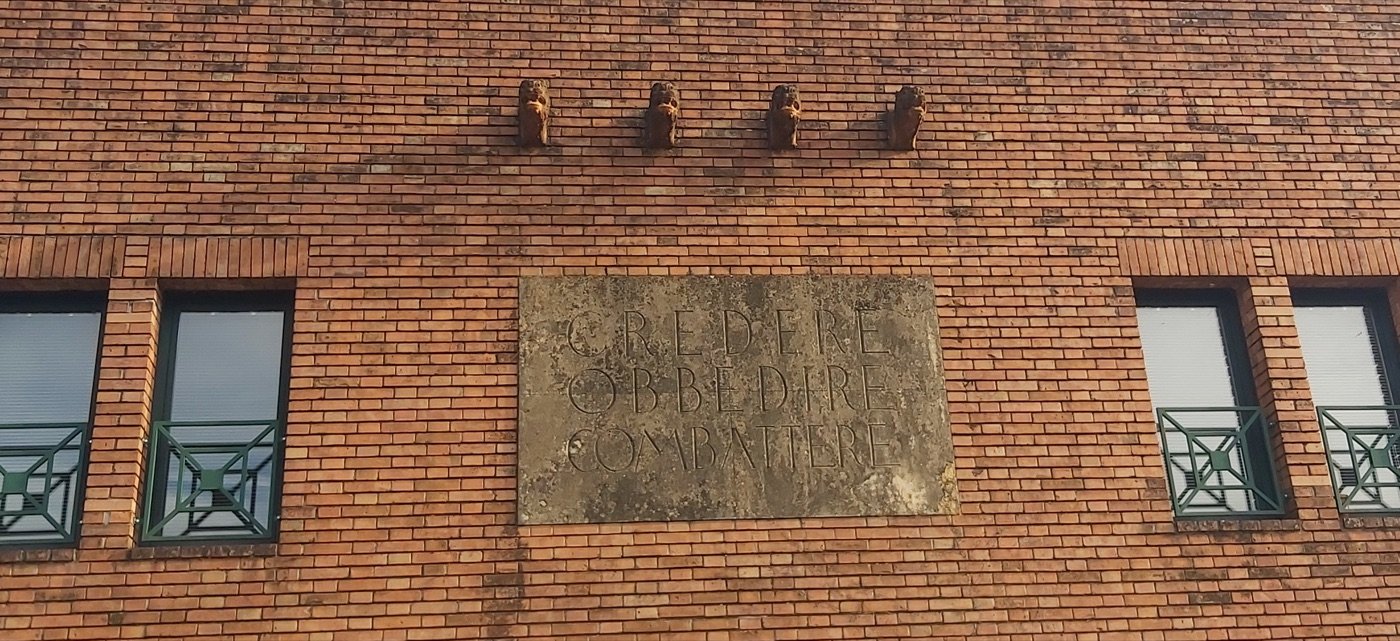
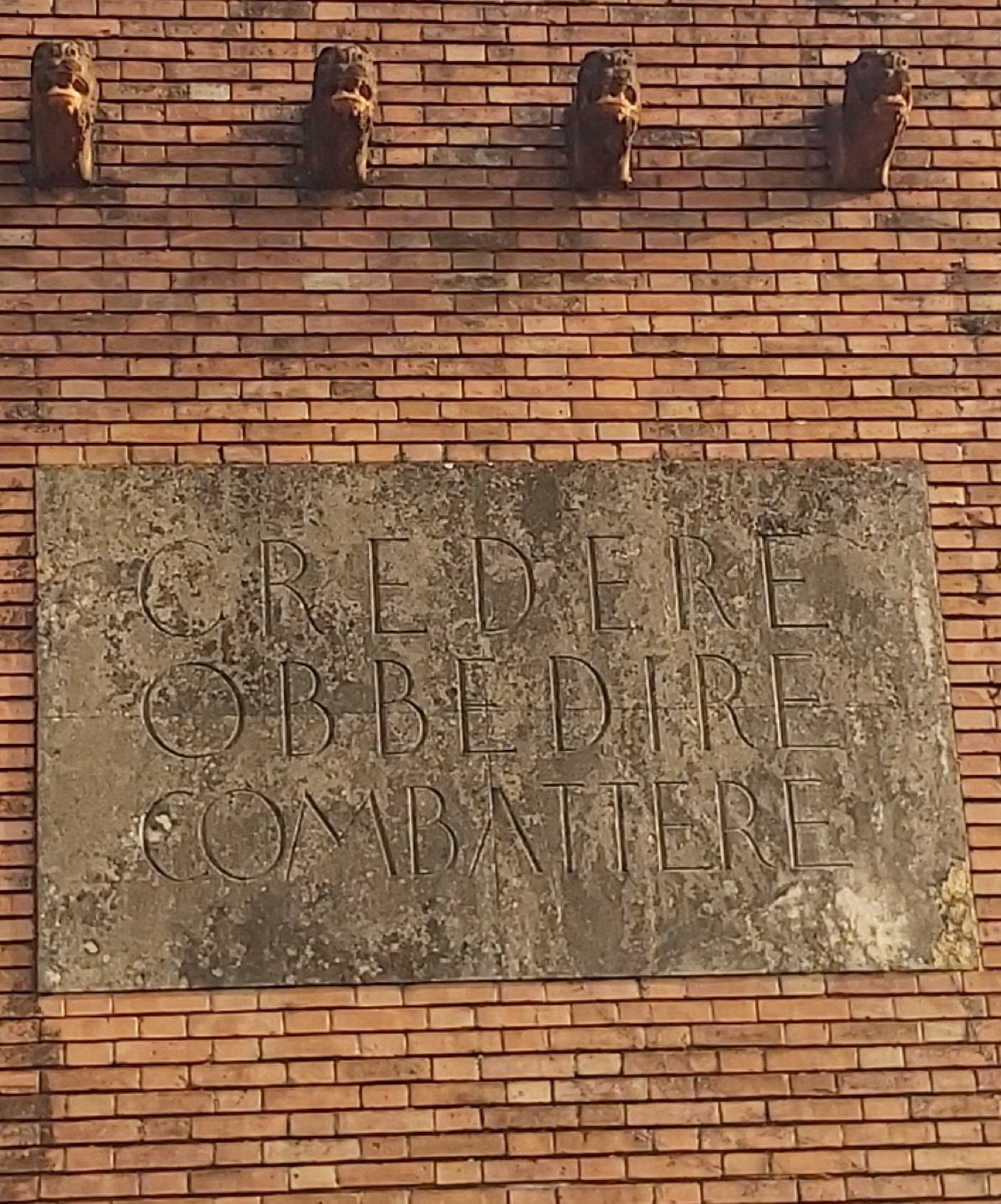
On a small paved square in Rubano, west of Padua, stands a compact two-storey block in bare brick. It was built at the end of the 1930s as the local Casa del Fascio, the house of the Fascist party, to a design by Quirino De Giorgio. The party is long gone; the building has served the town council for decades. What has not been removed is the evidence of what it was: four stone consoles carved as fasces, and a slab that still reads Credere, Obbedire, Combattere.
Key facts
- Architect: Quirino De Giorgio (1907–1997)
- Built: late 1930s, within his 1937–1939 series of rural party houses
- Material: load-bearing brick, exposed inside and out
- Original use: Casa del Fascio (local Fascist party house)
- Today: municipal building; renovated and extended in the 1990s
- Address: Via Enrico Medi 11, Bettanella di Rubano (Padua)
History
Quirino De Giorgio was young, local, and prolific. Trained in the orbit of Futurism and drawn to the imported language of Rationalism, he became the busiest interpreter of Fascist building in the province of Padua once the party started funding houses for its rallies and youth groups. Between 1937 and 1939 he produced a run of rural Case del Fascio across the countryside around Padua — at Vigonza, Sant’Urbano, Noventa Padovana, Pontelongo, Piazzola sul Brenta and here at Rubano.
These were small commissions with a fixed programme: a hall for meetings, offices for the local branch, a balcony or forecourt for speeches. De Giorgio met the brief with an economy of means that reads today as almost austere. After 1945 the network of party houses lost its purpose overnight. Rubano’s, like many, was absorbed into civic use, renovated and enlarged in the 1990s, and it now houses council services with access limited to staff.
What you see
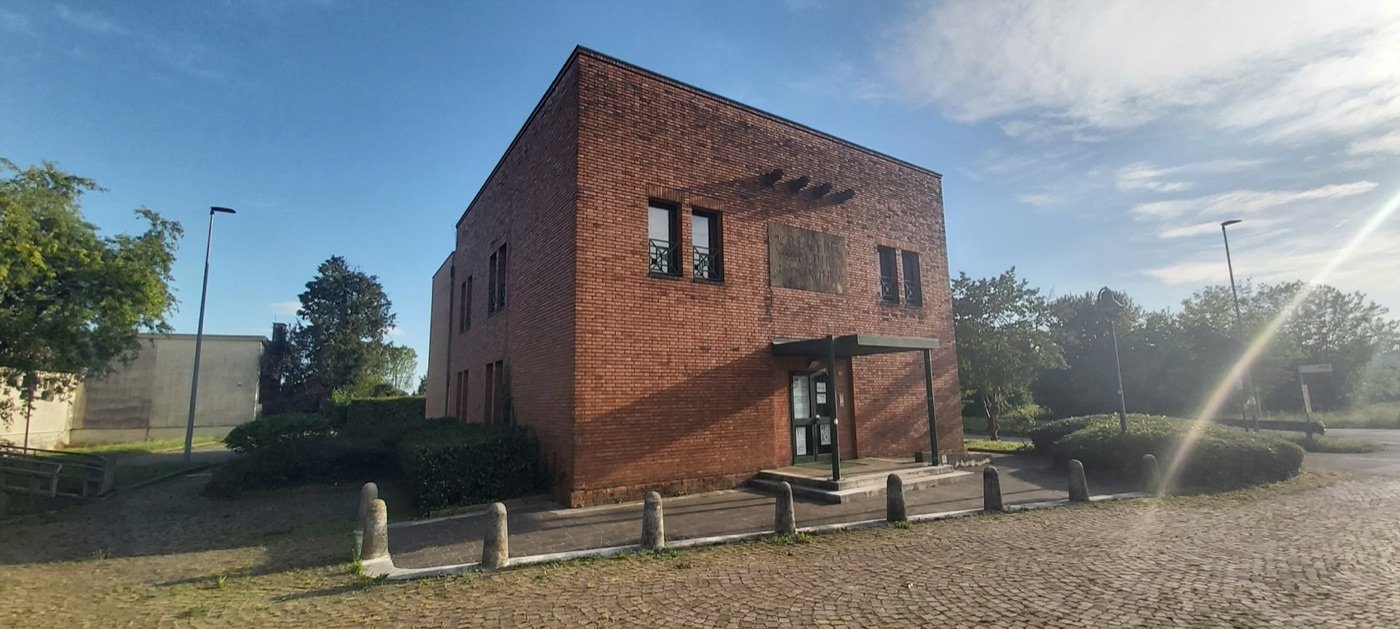
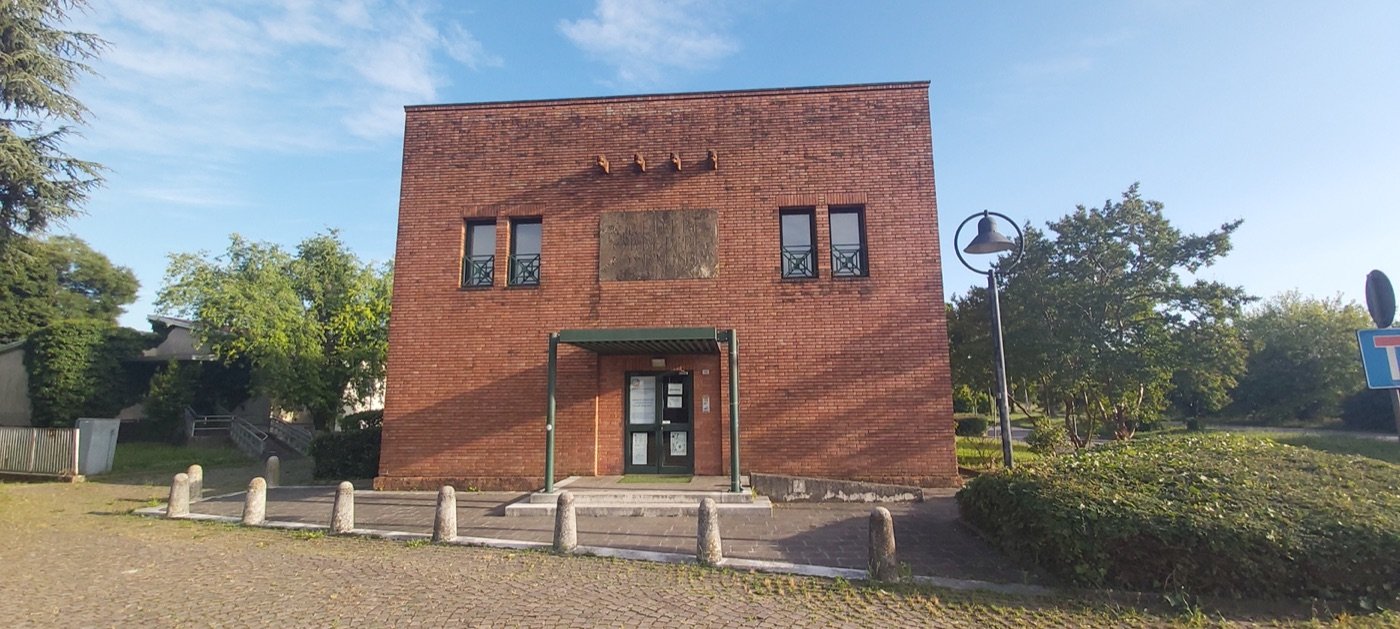
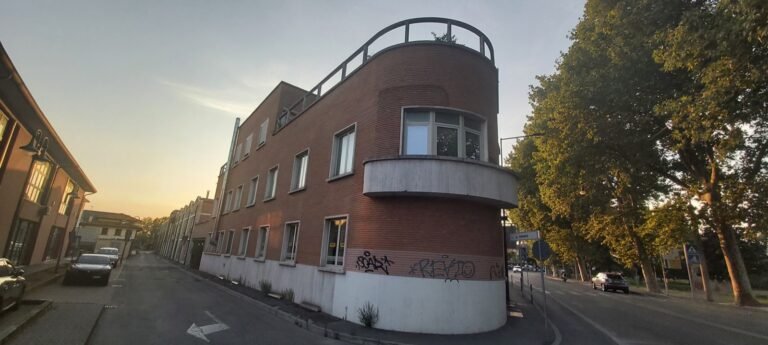
The block is a plain brick prism, its two long facades organised by a shallow rhythm of brick pilasters that rise into the wall without base or capital — a De Giorgio signature, the structure folded into an elementary geometry rather than dressed with ornament. A slim entrance canopy on green steel shelters the door; a single small bell hangs high on the flank.
The charged detail sits at the top of the facade. Four terracotta consoles are carved as fasci littori, the bundled rods that gave Fascism its name and emblem. Below them a weathered stone slab carries the party’s three-word command in incised Roman capitals: Credere, Obbedire, Combattere — Believe, Obey, Fight. The stone is worn but fully legible.
Reading the building
Cultural Heritage Online documents this building as a historical source. The terracotta fasces and the incised slogan are recorded here as part of its fabric — a rural party house of the late 1930s, built with real skill and preserved intact. We present it as a document of its years, describing what stands rather than judging the period.
Getting there
Rubano sits about eight kilometres west of Padua, along the old road to Vicenza. It is a short drive or bus ride from Padua’s centre; the nearest railway hub is Padova. The building faces a public square and can be seen from the street at any time, though the interior is a council office and is not open to visitors.
Sources
- Comune di Rubano — Ex Casa del Fascio, official building record (address, dating, current use).
- Catalogo generale dei Beni Culturali (ICCD), entry Casa del Fascio, Rubano, no. 0500349932.
- Biographical and architectural literature on Quirino De Giorgio and the rural Case del Fascio of the Padua province (1937–1939).
Gallery
More views — photographs by Stefano Vigolo, 2026.
Find it on the map
See this place and what’s around it →Record researched and written by Stefano Vigolo for Cultural Heritage Online, 2026.
📷 Become a Cultural Heritage Online photographer
Share your photos of places: they stay published under your name as the author. The more they're seen, the more you get noticed — and soon a contest will reward the most appreciated photos.
Log in or sign up free to add a photoRequest to use these images
Each photograph is offered by the person who took it — the seller is the photographer named on the image; Cultural Heritage Online runs the payment and delivers the file on their behalf. Buying gives you the right to use the image in your own project — a website, an article, a presentation — with the file and a written licence. Read the Terms of Sale.
What you receive. The file as it is held in our archive: the photographer's own original, without the Cultural Heritage Online watermark, unretouched and not enlarged. This is a working archive built over many years by many people, so the files differ — some were taken recently, others years ago with the equipment of their time. Older pictures are usually smaller: a camera from fifteen or twenty years ago simply recorded fewer pixels than a phone does today, so the resolution is lower and the print comes out smaller. We say so rather than hide it. The size, weight, format and year of each one are printed below it, and the print size is given at 300 dpi. Nothing is upscaled to make a number look better. Where the picture on this page has been cropped for the layout, the file you receive is the full frame, which may be wider or taller than what you see here.
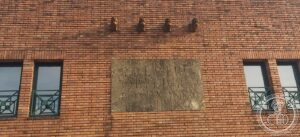
Ex Casa del Fascio — Rubano (Quirino De Giorgio, 1937–1939) — The four fasces consoles and the slogan slab, set between the upper windows.
Sold by Stefano Vigolo
€3.00
1400 × 641 px · JPG · 423.2 KB
prints 12 × 5 cm at 300 dpi · taken 2026
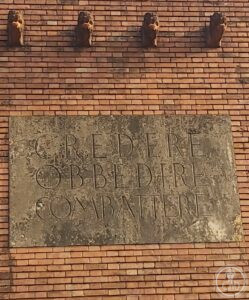
Ex Casa del Fascio — Rubano (Quirino De Giorgio, 1937–1939) — The stone slab in close-up: CREDERE OBBEDIRE COMBATTERE, incised in Roman capitals.
Sold by Stefano Vigolo
€3.00
1164 × 1400 px · JPG · 518.0 KB
prints 10 × 12 cm at 300 dpi · taken 2026
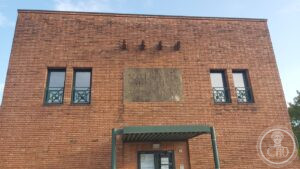
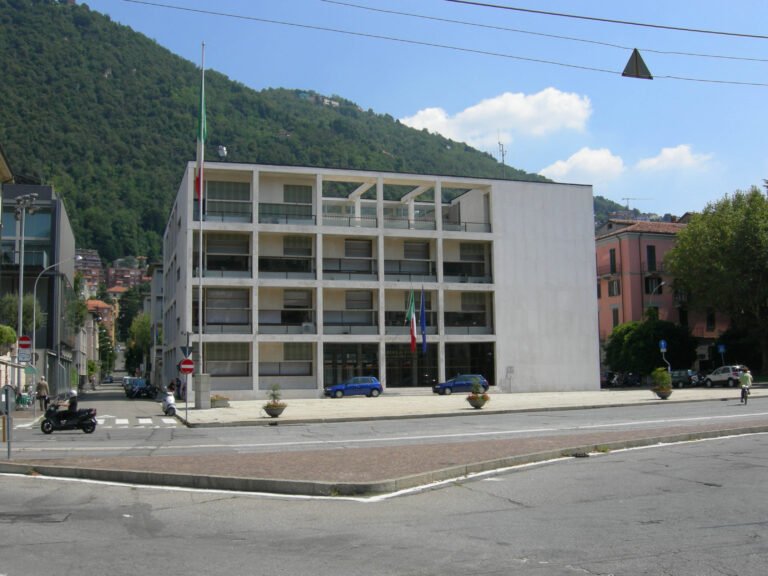
Ex Casa del Fascio — Rubano (Quirino De Giorgio, 1937–1939) — The main facade, with the entrance canopy below the inscription.
Sold by Stefano Vigolo
€3.00
1400 × 787 px · JPG · 441.7 KB
prints 12 × 7 cm at 300 dpi · taken 2026
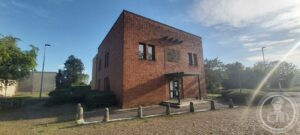
Ex Casa del Fascio — Rubano (Quirino De Giorgio, 1937–1939) — The block from the side, its brick pilasters rising without base or capital.
Sold by Stefano Vigolo
€3.00
1400 × 629 px · JPG · 255.4 KB
prints 12 × 5 cm at 300 dpi · taken 2026
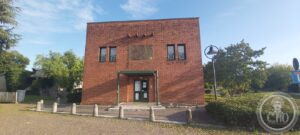
Ex Casa del Fascio — Rubano (Quirino De Giorgio, 1937–1939) — The two-storey volume seen from the square.
Sold by Stefano Vigolo
€3.00
1400 × 629 px · JPG · 301.3 KB
prints 12 × 5 cm at 300 dpi · taken 2026
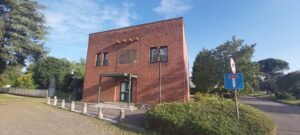
The ex Casa del Fascio of Rubano, seen from the piazza. Photo: Stefano Vigolo, 2026.
Sold by Stefano Vigolo
€3.00
1600 × 719 px · JPG · 467.1 KB
prints 14 × 6 cm at 300 dpi · taken 2026
Is this page about you?
This page is read by travellers and heritage enthusiasts who find it on Google. Tell us how you are connected to this place and we will take it from there.