
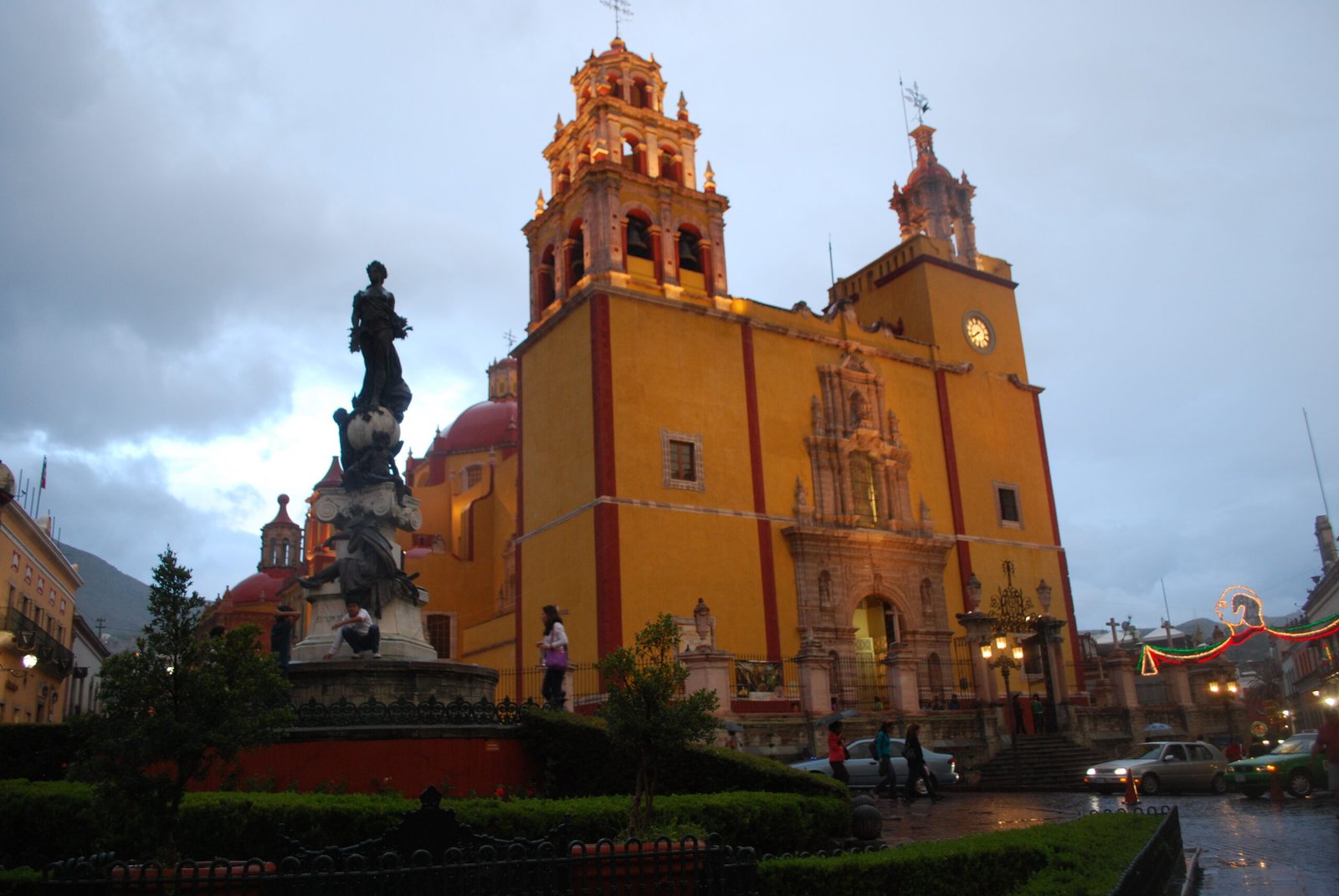
The Basílica Colegiata of Our Lady of Guanajuato looks onto the Plaza de la Paz, and is recognisable from afar by its ochre yellow, edged in red. It was built between 1671 and 1696, twenty-five years of work according to the INAH, in Mannerist Baroque style, financed by the silver miners who made the city’s fortune. It has been a basilica since 1957. Its treasure is the image of Our Lady of Guanajuato: a polychrome, gilded cedar-wood sculpture, 1.15 metres tall, wood, not paste, as is sometimes claimed, mounted on a base of embossed silver. On its origin the sources agree: it was donated in 1557 by Philip II, traditionally together with his father Charles I of Spain (Emperor Charles V), and brought from Granada. It entered the basilica in 1696. A devotional tradition, reported by every source always as such, holds it to be extremely ancient, «the oldest Christian image in Mexico», with a legend tracing it to the 7th century and hidden for eight centuries after the Moorish conquest: here it is recorded as tradition, not as an established fact. The interior is in the form of a Latin cross, with a dome and a gilded altar that holds the image. An adjoining chapel holds a gilded eighteenth-century retablo, and the 1777 sacristy is the work of the architect Felipe de Ureña. Two towers of different styles, one of them Churrigueresque, frame the Baroque portal. A clarification on colour and stone: the yellow is a paint finish, while the celebrated pink cantera Churrigueresque facades belong to other Guanajuato churches, San Diego and San Francisco, not to this basilica. The basilica is not individually inscribed on the UNESCO list: it stands on the Plaza de la Paz, within the core of the Historic Town of Guanajuato and Adjacent Mines, which in the eighteenth century was the world’s leading silver-extraction centre, inscribed in 1988 under criteria (i), (ii), (iv) and (vi).
About the Basilica
The Basilica of Our Lady of Guanajuato, on the Plaza de la Paz, is the yellow-painted Baroque heart of Mexico’s great silver city. Built between 1671 and 1696 with the miners’ wealth, and a basilica since 1957, it shelters the image of Our Lady of Guanajuato — a 1.15-metre carved cedar Madonna on an embossed silver base, gifted in 1557 by Philip II and brought from Granada. Its twin asymmetric towers and gilded interior rise over the Plaza de la Paz, within the Historic Town of Guanajuato and Adjacent Mines, a UNESCO World Heritage Site since 1988.
Key facts
- 1557: the cedar image of Our Lady gifted by Philip II (traditionally credited jointly to his father Charles I / Charles V), brought from Granada.
- 1671–1696: the basilica built over 25 years, financed by Guanajuato’s silver miners.
- 1696: the venerated image installed in the new church.
- 1777: the sacristy added by architect Felipe de Ureña.
- 1957: the church raised to the rank of minor basilica.
- 1988: Historic Town of Guanajuato and Adjacent Mines inscribed by UNESCO, criteria (i)(ii)(iv)(vi).
History
Guanajuato was one of the richest silver towns on earth, and its parish church was built to match: raised between 1671 and 1696, a sober Mexican Baroque financed by the mine owners, and elevated to a minor basilica in 1957. At its heart is an image older than the city itself — a polychrome cedar Madonna, 1.15 metres tall, that tradition says was given to Guanajuato in 1557 by Philip II, jointly with his father Charles I, and carried from Granada. Devotional accounts push its age much further, calling it the oldest Christian image in Mexico and telling of a hidden origin in the 7th century; those claims belong to tradition, not to the documentary record.
Whatever its true age, the image was enthroned in the finished basilica in 1696 and set on a base of embossed silver — the metal that paid for everything here. The building gathered its ornament over the following century: a golden main altar around the venerated figure, an 18th-century gilded retablo in an annexed chapel, and, in 1777, the sacristy of the architect Felipe de Ureña.
What you see
From the triangular Plaza de la Paz, the basilica is unmistakable: an ochre-yellow front trimmed in wine-red, two towers of different heights and styles — one Churrigueresque — framing a carved Baroque portal, with a red-tiled dome behind. Inside, a Latin-cross plan leads under the dome to the golden altar and the cedar image of Our Lady on her silver base. (The pink cantera Churrigueresque facades that Guanajuato is famous for belong to San Diego and San Francisco nearby, not to the yellow basilica.)
Practical information
- Opening hours: open daily outside services; check current times before visiting.
- Location: Plaza de la Paz, Centro Histórico, Guanajuato, Mexico.
- Status: active parish and basilica, Archdiocese of León; the image of Our Lady venerated here since 1696.
Getting there
The basilica stands on the Plaza de la Paz in the middle of Guanajuato’s historic centre, a short walk from the Juárez Theatre and the funicular to the Pípila monument; the city’s tangle of underground streets runs beneath it. GPS: 21.0165°N, 101.2534°W.
Nearby
- Historic Town of Guanajuato and Adjacent Mines — the UNESCO-listed silver city folded into its ravines.
- Templo de la Compañía and Templo de San Diego — the great Churrigueresque churches of pink cantera nearby.
- Juárez Theatre and Plaza de la Paz — the civic and cultural core around the basilica.
Sources
- Instituto Nacional de Antropología e Historia (INAH) — national heritage catalogue and Lugares INAH records.
- UNESCO World Heritage Centre — “Historic Town of Guanajuato and Adjacent Mines” (ref. 482).
- Gobierno de Guanajuato and Ciudades Patrimonio de México — official records on the image, its donor and the silver base.
- GCatholic — basilica title; El Informador — cross-check on the image and its history.
- Wikipedia (English and Spanish) — “Basílica colegiata de Nuestra Señora de Guanajuato”, used as a map and cross-checked.
Find it on the map
See this place and what’s around it →📷 Become a Cultural Heritage Online photographer
Share your photos of places: they stay published under your name as the author. The more they're seen, the more you get noticed — and soon a contest will reward the most appreciated photos.
Log in or sign up free to add a photo