
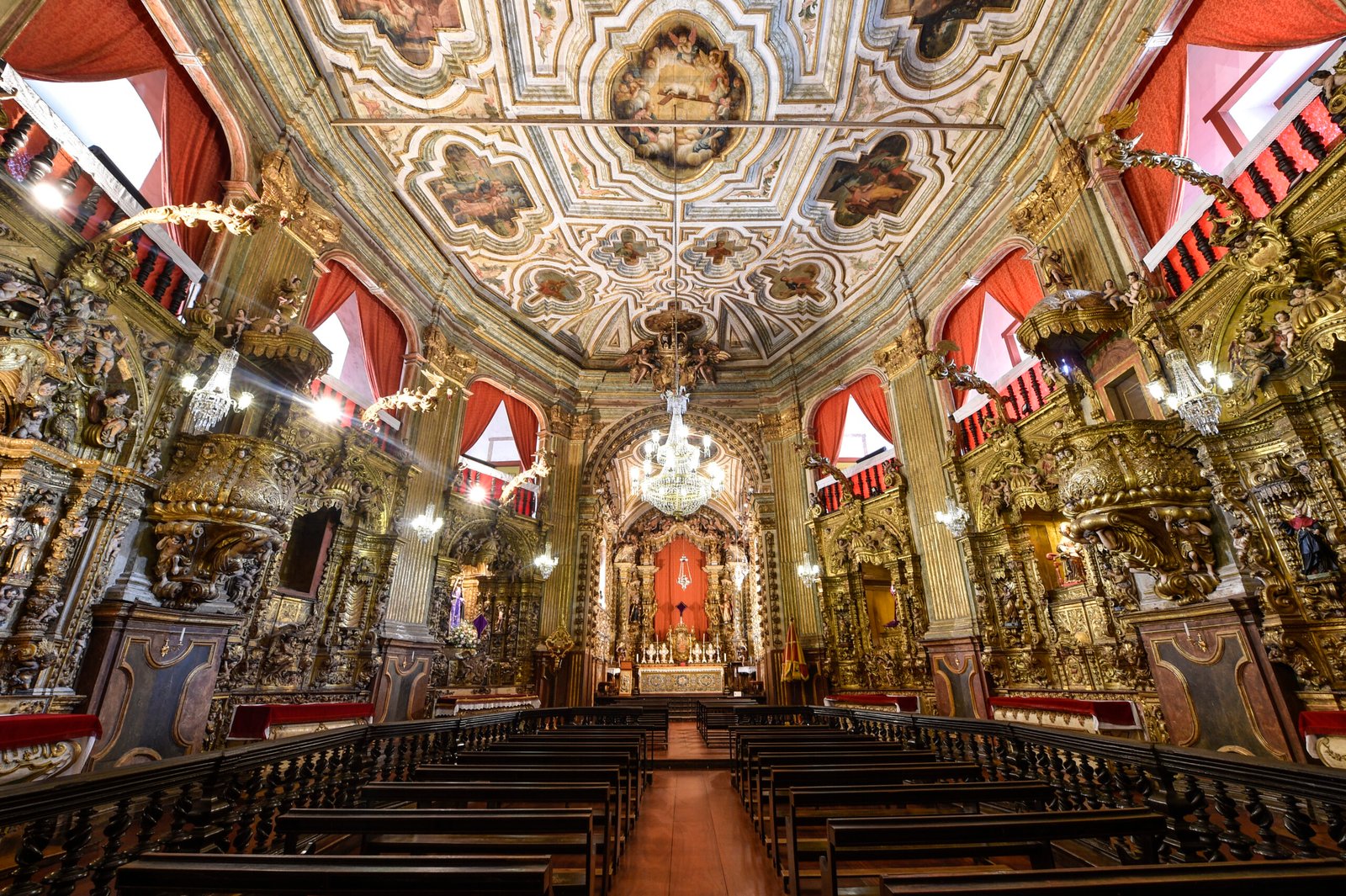
The Basílica of Our Lady do Pilar, the mother church of the Pilar quarter of Ouro Preto, is one of the two churches richest in gold in Brazil — so the town’s official source puts it, cautiously, quantifying the interior ornament at «more than 400 kg of gold» and noting that this is gold leaf, not solid gold. Many guides call it the second most gilded in the country, after the church and convent of San Francisco in Salvador; that is reported here as a widely held judgement, not as official fact. The present fabric was begun between 1728 and 1730 and the body completed by 1733, over an early chapel of wood and adobe from the start of the century; the gilding and decoration went on into the 1770s, and the facade and tower were rebuilt in stone between 1828 and 1848. The nave is polygonal — not decagonal, as one sometimes reads — a form attributed to Antônio Francisco Pombal. The talha dourada, the gilded woodcarving, was the work of several hands at different times: the best documented attribution is that of the main chapel to Francisco Xavier de Brito, between 1746 and his death in 1751 — he did not gild the whole church, as is sometimes simplified. Six side altars, two pulpits, a ceiling of fifteen panels painted by João de Carvalhais in 1768, and in the basement the Museu de Arte Sacra. The church was protected by IPHAN in 1939 and raised to a minor basilica on 1 December 2012. It is not inscribed by UNESCO in its own right: it is one of the monuments of the Historic Town of Ouro Preto, the first Brazilian site inscribed on the World Heritage List, in 1980, under criteria (i) and (iii) — the Baroque capital of eighteenth-century gold.
About the Basilica
The Basilica of Our Lady of Pilar is the parish church of the Pilar district of Ouro Preto, and one of the two most gold-laden church interiors in Brazil. Behind a plain colonial facade — rebuilt in stone in the 19th century — the polygonal nave is sheathed in gilded woodwork holding, by the city’s official reckoning, more than 400 kilos of gold leaf. Built between 1728 and 1733 and decorated into the 1770s, it was made a minor basilica in 2012. It stands within the Historic Town of Ouro Preto, the first Brazilian UNESCO World Heritage Site (1980).
Key facts
- Early 1700s: a primitive wood-and-adobe chapel serves as the parish church
- 1728–1733: the present masonry church built; its polygonal nave attributed to Antônio Francisco Pombal
- 1746–1751: Francisco Xavier de Brito carves the gilded chancel (capela-mor)
- 1768: the ceiling of fifteen painted panels by João de Carvalhais
- Over 400 kg: of gold leaf in the interior, by the city’s official figure
- 2012: raised to the rank of minor basilica (1 December)
- 1980: Historic Town of Ouro Preto inscribed by UNESCO, criteria (i)(iii) — Brazil’s first World Heritage Site
History
Ouro Preto — “black gold” — was the capital of the 18th-century Brazilian gold rush, and its parish churches turned that wealth into gilded wood. The Pilar church replaced an early wood-and-adobe chapel: the masonry building rose between 1728 and 1733, its polygonal nave attributed to Antônio Francisco Pombal, and its decoration continued for decades. The finest carving, in the chancel, was the work of Francisco Xavier de Brito between 1746 and his death in 1751; the gilding was finished only in the 1770s. The stone facade and tower came later still, rebuilt between 1828 and 1848.
The result is one of the two richest gold interiors in Brazil, holding more than 400 kilos of gold leaf by the municipality’s own count — often ranked second only to the Church and Convent of São Francisco in Salvador. Listed by Brazil’s heritage institute IPHAN in 1939 and raised to a minor basilica in 2012, it keeps a Museu de Arte Sacra in its basement and remains the working matriz of the Pilar parish.
What you see
From the square the church is almost austere — a plain twin-towered colonial front of white and stone. Inside, everything changes: a polygonal nave lined floor to cornice in carved, gilded wood, six lateral altars, two pulpits, and the gilded chancel of Francisco Xavier de Brito, all under a ceiling of fifteen painted Old Testament panels. The gold is leaf, not solid, but there is enough of it — more than 400 kilos — to make the interior glow against the white-and-blue colonial town outside. A Museu de Arte Sacra occupies the basement.
Practical information
- Opening hours: generally Tuesday–Sunday, mornings and afternoons, closed Mondays — check current times before visiting
- Admission: ticketed; one ticket covers the church and the Museu de Arte Sacra
- Location: Praça Monsenhor Castilho Barbosa 17, Bairro Pilar, Ouro Preto, Minas Gerais, Brazil
- Status: active parish church and minor basilica, Archdiocese of Mariana
Getting there
The basilica stands in the Pilar district, one of the hills of Ouro Preto’s historic centre, a walk from the central Praça Tiradentes; the town is about two hours from Belo Horizonte. GPS: 20.3868°S, 43.5075°W.
Nearby
- Historic Town of Ouro Preto — the UNESCO-listed Baroque gold-rush capital, Brazil’s first World Heritage Site
- Church of São Francisco de Assis — the Aleijadinho masterpiece with its soapstone portal, deliberately un-gilded, across town
- Praça Tiradentes and the Museu da Inconfidência — the civic heart of Ouro Preto
Sources
- Prefeitura de Ouro Preto — official tourism record (gold figure, dates, hours)
- Arquidiocese de Mariana and Paróquia de Nossa Senhora do Pilar — basilica status and church history
- IPHAN / iPatrimônio — national heritage record (tombamento 1939, attributions)
- UNESCO World Heritage Centre — “Historic Town of Ouro Preto” (ref. 124)
- Wikipedia (English and Portuguese) — “Basílica Menor de Nossa Senhora do Pilar (Ouro Preto)”, used as a map and cross-checked
Find it on the map
See this place and what’s around it →📷 Become a Cultural Heritage Online photographer
Share your photos of places: they stay published under your name as the author. The more they're seen, the more you get noticed — and soon a contest will reward the most appreciated photos.
Log in or sign up free to add a photo