
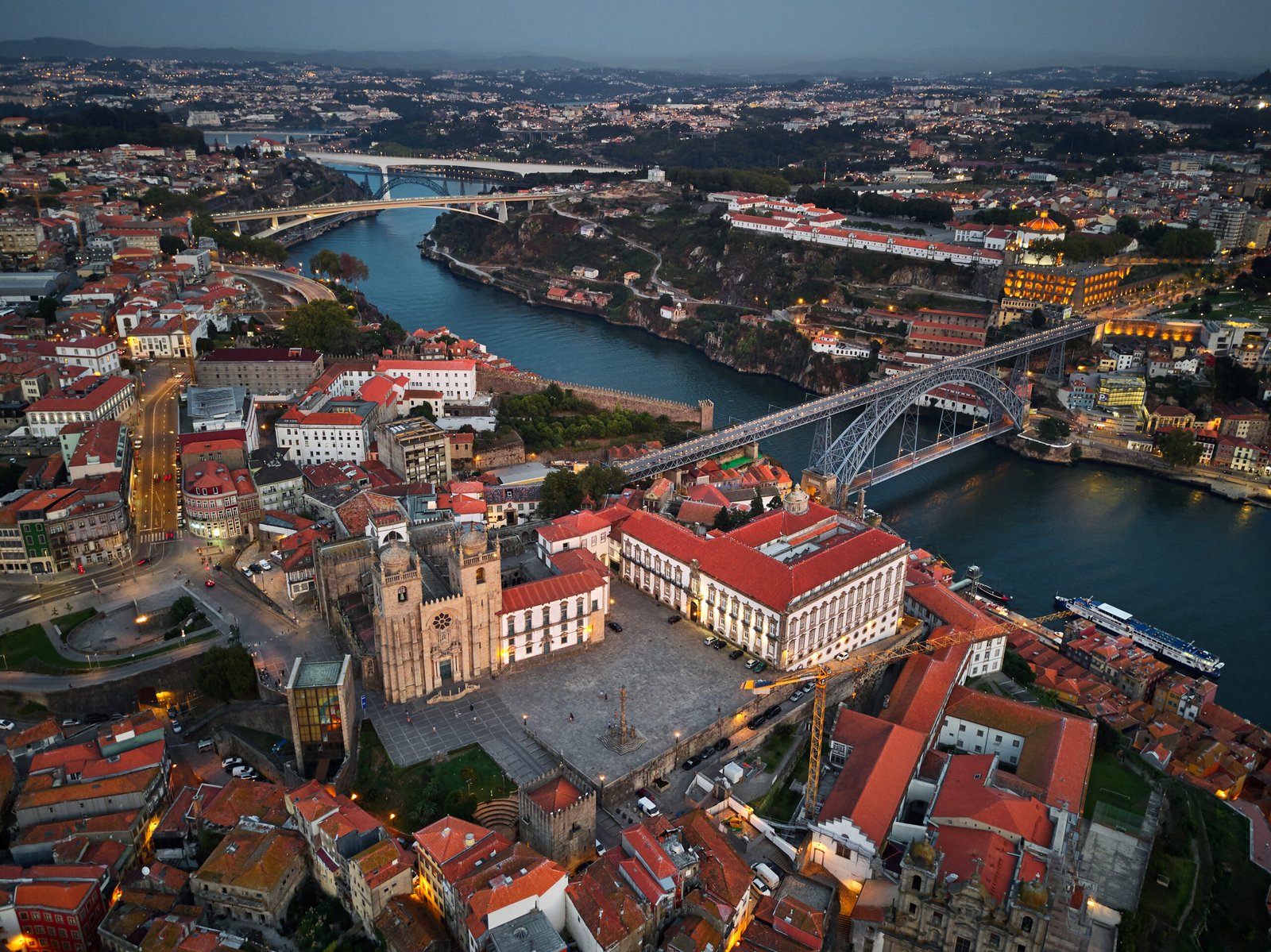
Porto Cathedral, the Sé, dedicated to Our Lady of the Assumption, dominates the city from its terrace at the top of the Terreiro da Sé. It rose where Henry of Burgundy had founded a chapel around 1108, and that, not the cathedral, is the starting point. The present building was begun in the second half of the 12th century in Romanesque forms, reaching its present size in the thirteenth century. The look is that of a fortress-church: two square towers crowned by domes, battlements, and a Romanesque rose window under a crenellated arch. It was among the first buildings in Portugal to use flying buttresses. Between the seventeenth and the eighteenth centuries came a Baroque transformation, with the work closing around 1737, and in 1736 the Italian architect Nicolau Nasoni added the loggia, or galilé, on the north side front. The Gothic cloister, of the 14th and 15th centuries, under the reign of John I, was clad in 1729-1731 with azulejos by Valentim de Almeida: the stories of the Song of Songs, a work not to be attributed, as is sometimes read, to Nasoni. In the Chapel of the Blessed Sacrament stands a silver altar begun in 1632. A popular tradition, reported here as legend because that is what it is in the sources, holds that during the Napoleonic invasion a sacristan covered it with plaster to keep it from the French troops, and died without revealing the secret. Within the walls of the Sé a marriage was celebrated that bound two crowns: in February 1387 John I of Portugal married Philippa of Lancaster, sealing the Anglo-Portuguese alliance. And here, by tradition, although the document of 1394 says only «baptised in the city», the infante Henry the Navigator is said to have been baptised. The cathedral is not inscribed on the UNESCO list on its own: the official description names it expressly, «the cathedral with its Romanesque choir», among the monuments of the Historic Centre of Oporto, Luís I bridge and Monastery of Serra do Pilar, inscribed in 1996 under criterion (iv).
About the Cathedral
Porto Cathedral, the Sé do Porto, dedicated to Our Lady of the Assumption, crowns the highest terrace of the old city. Begun in the second half of the 12th century in Romanesque style and completed to its present size in the 13th, it keeps the look of a fortress-church — two cupola-topped towers, battlements and a rose window — with Baroque additions of the 17th and 18th centuries, including Nicolau Nasoni’s 1736 loggia. It was here that John I of Portugal married Philippa of Lancaster in 1387. The cathedral is a named monument of the Historic Centre of Oporto, a UNESCO World Heritage Site since 1996.
Key facts
- c. 1108: Henry of Burgundy founds an earlier chapel on the site.
- Second half of the 12th century: the present Romanesque cathedral begun; it reaches its full size in the 13th century.
- February 1387: John I of Portugal marries Philippa of Lancaster in the cathedral, sealing the Anglo-Portuguese alliance.
- 1729–1731: the Gothic cloister lined with Song-of-Songs azulejos by Valentim de Almeida.
- 1736: Nicolau Nasoni adds the Baroque loggia to the north facade; the Baroque works are completed around 1737.
- 1996: Historic Centre of Oporto, Luís I Bridge and Monastery of Serra do Pilar inscribed by UNESCO, criterion (iv).
History
Porto’s cathedral began as a Romanesque stronghold of faith on the city’s highest ground, raised from the second half of the 12th century where Henry of Burgundy had founded a chapel around 1108. Its fortress silhouette — battlements, two square towers, a rose window under a crenellated arch — belongs to that first century; it was among the earliest buildings in Portugal to use flying buttresses. In 1387 the cathedral hosted the marriage of John I of Portugal and Philippa of Lancaster, daughter of John of Gaunt, an alliance between the two crowns that has never formally lapsed. Tradition, though not the surviving 1394 record, also places the baptism of their famous descendant Henry the Navigator here.
The Baroque age softened the fortress. Through the 17th and 18th centuries the interior filled with gilt and silver — the Chapel of the Blessed Sacrament keeps a silver altar begun in 1632, which legend says a sacristan plastered over to hide from Napoleon’s troops — and around 1736 the Italian architect Nicolau Nasoni added the elegant loggia to the north flank. The Gothic cloister, from the reign of John I, was lined between 1729 and 1731 with blue-and-white azulejos by Valentim de Almeida, telling the Song of Songs.
What you see
From the Terreiro da Sé the cathedral reads as granite armour: two heavy towers under cupolas, a battlemented parapet, and the Romanesque rose window at the centre of the west front. Nasoni’s Baroque loggia breaks the severity on the north side. Inside are the Romanesque nave and choir, the silver altar of the Blessed Sacrament, and the Gothic cloister with its Song-of-Songs tiles; a staircase by Nasoni climbs to the upper level. The terrace itself is the other great sight, opening over the tiled roofs of the Ribeira to the Douro, the two-tier Dom Luís I Bridge and the port-wine lodges of Vila Nova de Gaia opposite.
Practical information
- Opening hours: open daily outside services; check current times before visiting.
- Admission: the church is generally free; the Gothic cloister and upper areas are ticketed.
- Location: Terreiro da Sé, 4050 Porto, Portugal.
- Status: active seat of the Diocese of Porto.
Getting there
The cathedral stands on the hilltop above the Ribeira, a short climb from the São Bento station and the riverfront; the Sé metro station and the Funicular dos Guindais are close by. GPS: 41.1428°N, 8.6112°W.
Nearby
- Historic Centre of Oporto — the UNESCO-listed old city that looks out to the Atlantic, wrapped around the Douro gorge.
- Dom Luís I Bridge — the double-deck iron bridge in the same UNESCO listing, a few minutes downhill.
- Church of São Francisco — the Gothic church with a gold-drenched Baroque interior, down by the river.
Sources
- Visit Portugal — official tourism record for the Sé do Porto.
- UNESCO World Heritage Centre — “Historic Centre of Oporto, Luís I Bridge and Monastery of Serra do Pilar” (ref. 755).
- SIPA / monumentos.gov.pt — Portuguese national heritage database.
- Wikipedia (English and Portuguese) — “Porto Cathedral” / “Sé do Porto”, used as a map and cross-checked.
Find it on the map
See this place and what’s around it →📷 Become a Cultural Heritage Online photographer
Share your photos of places: they stay published under your name as the author. The more they're seen, the more you get noticed — and soon a contest will reward the most appreciated photos.
Log in or sign up free to add a photo