
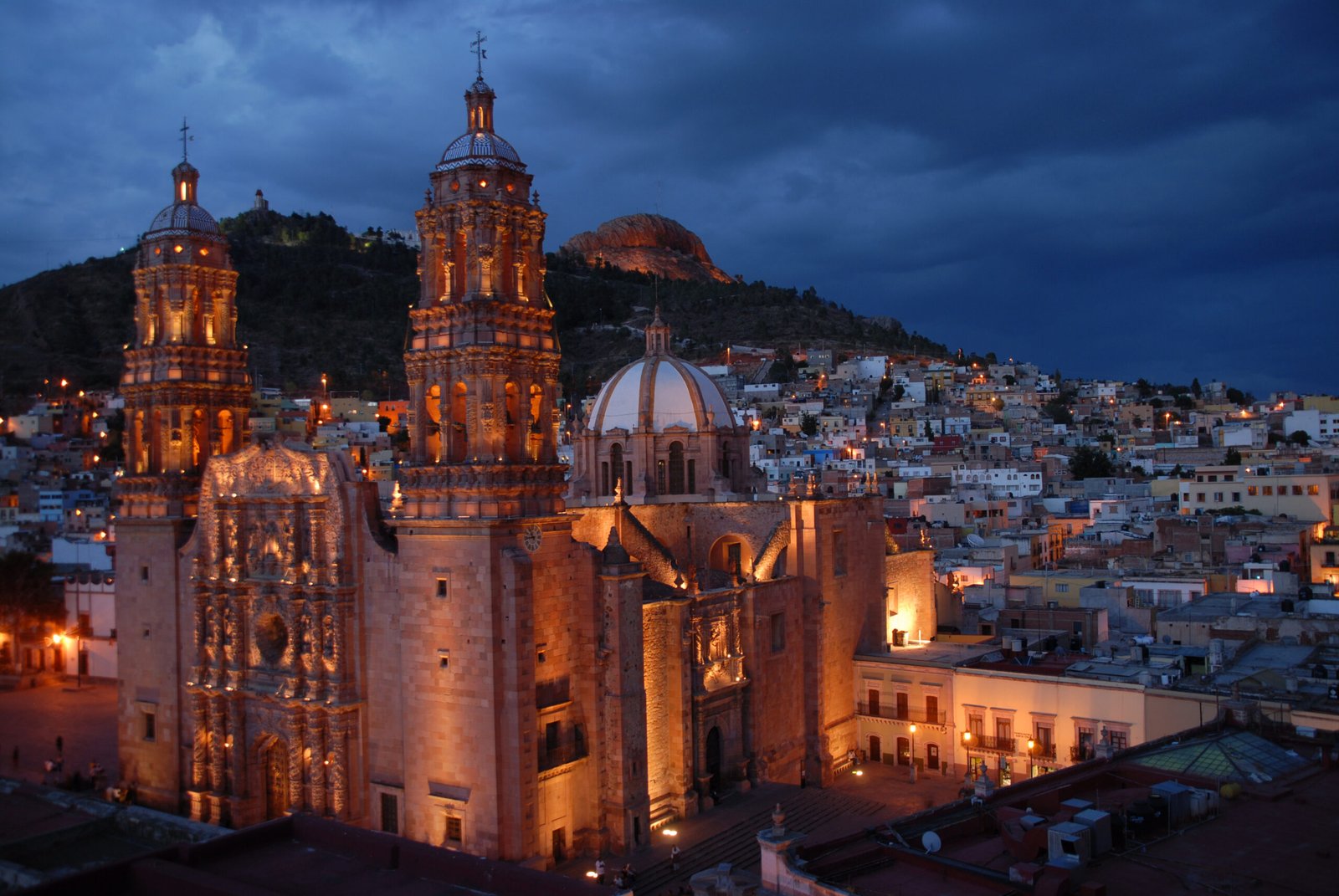
La cattedrale basilica dell’Assunzione di Maria è la terza chiesa sorta sullo stesso sito lungo l’attuale Avenida Hidalgo: una parrocchiale iniziata nel 1568, una seconda chiesa del 1625 e infine l’edificio attuale, la cui dedicazione solenne cadde il 15 agosto 1752, festa dell’Assunta. Sull’avvio del cantiere le fonti divergono — 1718 per il catalogo federale dei monumenti, 1729 o 1731 per altre — e qui si adotta la cornice della descrizione ufficiale UNESCO, «costruita tra il 1730 e il 1760»; il nome dell’architetto che avrebbe diretto i lavori, Domingo Ximénez Hernández, circola solo in fonti di livello enciclopedico non ufficiale e va quindi inteso come attribuzione. La celebre facciata principale, completata negli anni Quaranta del Settecento — anche qui le fonti oscillano tra il 1745 e il 1748 — è scolpita nella cantera rosa locale in quello stile churrigueresco, o ultrabarocco, che le schede ufficiali di SIC e INAH le riconoscono espressamente: tredici statue — Cristo e i dodici apostoli — ne popolano i registri, con il Padre Eterno al coronamento, e l’intero prospetto è dedicato all’Eucaristia, mentre le due facciate laterali onorano rispettivamente la Virgen del Patrocinio, patrona della città, e il Cristo. La descrizione UNESCO la dice «notevole per il disegno armonioso e la profusione barocca delle facciate, dove elementi decorativi europei e indigeni convivono fianco a fianco» — un giudizio che qui si preferisce ai superlativi turistici correnti, non confermati dalle fonti autorevoli. Le torri gemelle arrivarono a distanza di oltre un secolo l’una dall’altra: quella sud fu terminata il 5 gennaio 1782, quella nord solo ai primi del Novecento — il 1904 per più fonti, l’8 dicembre 1906 con il nome di «Torre de la Inmaculada» per il catalogo federale — per mano del capomastro Dámaso Muñetón di Jerez. Divenuta cattedrale con l’erezione della diocesi di Zacatecas da parte di Pio IX nei primi anni Sessanta dell’Ottocento — le fonti indicano variamente 1862, 1863 e 1864 — fu elevata a basilica minore da Giovanni XXIII il 17 luglio 1959. Del fastoso arredo coloniale resta poco: come ricorda la Britannica, dipinti europei, argenti e ori furono in gran parte confiscati dai riformisti negli anni 1850-60, e gli altari odierni sono neoclassici; dal 2010 il presbiterio ospita però il monumentale retablo contemporaneo dello scultore Javier Marín, circa venti tonnellate di betulla olandese e foglia d’oro a 24 carati. Con i suoi circa 45 metri, secondo il catalogo federale l’edificio resta ancora oggi il più alto dell’intera città incassata nel canyon; l’INAH la riassume con un epiteto che vale una guida: «rostro de cantera y corazón de plata», volto di cantera e cuore d’argento. Non è iscritta singolarmente all’UNESCO: è il monumento simbolo del Centro storico di Zacatecas, iscritto nel 1993 con i criteri (ii) e (iv).
About the Cathedral
The Cathedral Basilica of the Assumption of Mary rises on Avenida Hidalgo in the heart of Zacatecas, the great silver city of New Spain. Built, in UNESCO’s own framing, between 1730 and 1760 and solemnly dedicated on 15 August 1752, it is the third church on the site. Its pink cantera Churrigueresque facade carries Christ and the twelve apostles beneath God the Father; its twin towers were finished more than a century apart, in 1782 and the early 1900s. It is the flagship monument of the Historic Centre of Zacatecas, a UNESCO World Heritage Site since 1993.
Key facts
- 1568 / 1625: the two earlier churches on the site — a parish church and its successor
- 1730–1760: construction of the present building in UNESCO’s official framing; other sources place the start between 1718 and 1731
- 15 August 1752: solemn dedication, on the feast of the Assumption
- 5 January 1782: south tower completed; the north tower followed only in the early 1900s, built by master mason Dámaso Muñetón of Jerez
- Early 1860s: raised to cathedral rank when Pius IX created the Diocese of Zacatecas (sources give 1862–1864)
- 17 July 1959: declared a minor basilica by Pope John XXIII
- 2010: the contemporary main altarpiece by sculptor Javier Marín installed — some 20 tons of Dutch birch and 24-karat gold leaf
- 1993: Historic Centre of Zacatecas inscribed by UNESCO, criteria (ii) and (iv)
History
Zacatecas was silver: the mines of its metalliferous mountains financed one of the richest cities of New Spain, and the cathedral is where that wealth was carved in stone. The present building replaced two earlier churches, rising through the mid-18th century and receiving its solemn dedication on the feast of the Assumption in 1752. The facade was completed in the 1740s; the south tower in 1782; the north tower waited until the early 20th century, when Dámaso Muñetón of Jerez finally matched its twin.
The interior tells a harsher story. As Britannica records, the cathedral kept its European paintings and elaborate silver and gold work only until the 1850s and 1860s, when most of it was confiscated during the Reform era; the Baroque altarpieces disappeared, replaced by Neoclassical ones. Since 2010 the sanctuary has answered that loss with Javier Marín’s monumental contemporary retablo in gilded Dutch birch — a modern work in deliberate dialogue with the vanished Baroque, not a reconstruction of it.
What you see
A three-body Churrigueresque facade in pink cantera — “notable”, in UNESCO’s words, “for its harmonious design and the Baroque profusion of its façades, where European and indigenous decorative elements are found side by side”. Thirteen statues populate it: Christ and the twelve apostles, with God the Father in glory at the crown, the whole composition dedicated to the Eucharist; the south portal honours the Virgen del Patrocinio, patroness of the city, the north portal the Christ of the water-carriers. At about 45 metres, the cathedral is still the tallest building in the canyon-set city — INAH sums it up as “a face of quarry-stone and a heart of silver”.
Practical information
- Opening hours: open daily for worship and visits outside services; check locally before visiting
- Admission: free
- Location: Avenida Hidalgo, Centro Histórico, 98000 Zacatecas, Mexico — flanking the Plaza de Armas beside the Palacio de Gobierno
- Status: active seat of the Diocese of Zacatecas
Getting there
The cathedral stands on Avenida Hidalgo, the spine of the historic centre, a short walk from every major monument of the silver city and beneath the Cerro de la Bufa. GPS: 22.7756°N, 102.5721°W.
Nearby
- Historic Centre of Zacatecas — the UNESCO-listed colonial townscape folded into the ravines of a silver mountain
- Plaza de Armas and Palacio de Gobierno — the civic ensemble directly beside the cathedral
- Cerro de la Bufa — the crag above the city, reached by cable car, with the Pancho Villa monuments
Sources
- UNESCO World Heritage Centre — “Historic Centre of Zacatecas” (ref. 676)
- Instituto Nacional de Antropología e Historia (INAH) — “Rostro de cantera y corazón de plata” cathedral record
- Sistema de Información Cultural (SIC), Secretaría de Cultura de México — official cathedral record
- Catálogo Nacional de Sitios y Monumentos, Secretaría de Cultura — “Nuestra Señora de los Zacatecas (Catedral)” monograph
- Encyclopædia Britannica — Zacatecas; Churrigueresque
- Ciudades Patrimonio de México and GCatholic — basilica status and city records
- Wikipedia (English and Spanish) — “Zacatecas Cathedral”, used as a map and cross-checked
Find it on the map
See this place and what’s around it →📷 Become a Cultural Heritage Online photographer
Share your photos of places: they stay published under your name as the author. The more they're seen, the more you get noticed — and soon a contest will reward the most appreciated photos.
Log in or sign up free to add a photo